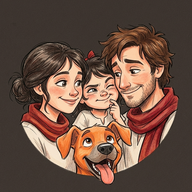
French Way, from the Pyrenees to Santiago · 1140
Walking the Camino de Santiago in the Middle Ages
November 5, 2026 · 18 min · Audio in Spanish, English
More from Spain →More from France →
Pressing play loads YouTube (Google). Privacy
How did people travel in the Middle Ages? Around 1140, an ordinary pilgrim, the father of our family, leaves Poitou, in western France, and walks the Camino de Santiago all the way to Compostela. We follow him with a guide written in his own time for people like him: it warned them which water not to drink, whom not to pay and whom not to trust. Along the way, he meets the boatmen of Sorde, the toll collectors and the bad innkeepers. He climbs the Cize pass with its crosses and walks past the Salado, the river the guide calls deadly; he carries a stone for the cathedral and changes his coins with the money-changers of Santiago.
The story, to read
The whole episode, chapter by chapter. Tap the minute to watch from there.
Setting out, with a guide for the road ▶ 0:00
Poitou, in western France, around 1140. How did people travel in the Middle Ages? A man leaves home to walk to Santiago de Compostela, with a staff and a scrip, a leather pouch. Let's imagine he's the father of our family, an ordinary pilgrim, and the mother and daughter see him off at the door. A guide from his own time counts thirteen stages, each a day's journey, from the foot of the Pyrenees to Santiago, and he'll walk them all.
That guide is real, and its warnings are for people like him: which water not to drink, whom not to pay, whom not to trust. It's part of a book that presented itself as the work of Pope Callixtus II, hence the name Codex Calixtinus. The guide was written around 1140 and is attributed to a French cleric, Aymeric Picaud, though it's not certain he wrote it. It lists the towns and the stages of the Way of Saint James, so pilgrims could work out their expenses in advance. And it takes one side: the side of the Franks, people from France. Its author counts himself among them: when he writes "we," he means the Gallic people. So our pilgrim is a Frank. The same book also holds a sermon for pilgrims. And that sermon tells him how to leave home.
To set out properly, the sermon says, a pilgrim first forgave those who had wronged him. He asked his priest and his wife for permission, provided well for his house, and arranged his alms in case he died on the road. In the church he received the blessed scrip and staff, with set words for each. The sermon describes the scrip: a narrow little bag made from hide, with its mouth always open and never bound with ties. And the staff, in the sermon's words, was almost a third foot: a support, and his defense against wolves and dogs. At our house, the mother has already given her permission. The daughter holds the scrip for a moment before handing it to her father, and finds it almost empty. The father says goodbye and starts walking south.
The Landes, the boatmen and the toll ▶ 2:13
Past Bordeaux lie the Landes, according to the guide: three days' travel for anyone who's tired, across flat, sandy country with few towns. There's no bread, no wine and no water, and no meat or fish either. But there's plenty of honey, millet and pigs. And if you cross in summer, the guide warns, you must guard your face against enormous flies and watch your step, because you can sink into the sand up to your knees. Then comes Gascony. According to the guide, the Gascons eat sitting around the fire, with no table, and all drink from the same cup; they dress badly and sleep all together on a little straw. But the guide also says they're among the first to take in the poor. That's how its author judges each land and its people: the good with the bad, on his own terms. Our pilgrim no longer walks alone: along the road, he's fallen in with others.
What did it cost to cross a river? Near Sorde, still in Gascony, the boatmen charged one coin a head, the same for poor and rich, and four per pack animal. The guide condemns them. Two rivers had to be crossed there, and the boat was small, made from a single trunk. Horses didn't fit: they swam behind, led by the bridle. And the guide warns of something worse. Sometimes the boatmen crammed in so many people that the boat capsized and pilgrims drowned. Then, the guide says, the boatmen kept what the dead had carried. The fair thing, the same guide says, was to charge the poor nothing. Was the guide exaggerating? A present-day philologist finds it believable that pilgrims were abused at those river crossings.
Farther south, at Ostabat, three of the roads coming from France meet, and from there they climb together to the pass over the Pyrenees, the Cize pass. This is the land of the Basques: mountains and forests, the guide says, with no bread or wine, but with apples, cider and milk. And at Ostabat, the toll collectors are waiting. The guide and the sermon condemn them for charging pilgrims a toll there and at the foot of the pass, when pilgrims owed none. According to the guide, the collectors came out to meet them armed with javelins, and anyone who wouldn't pay was beaten and searched right down to his breeches. By rights, the guide adds, they should have charged only merchants. The same present-day philologist finds this believable: the lords the guide accuses turn up in documents from the period. The father presses the scrip against his body and walks past with his eyes down.
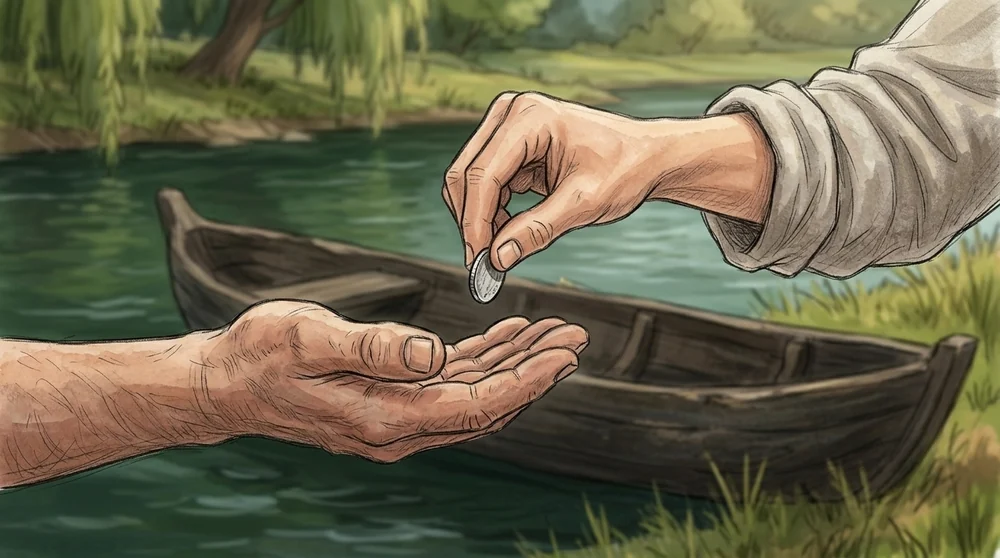
The Cize pass and the hospital ▶ 4:49
The Cize pass, according to the guide, is eight miles up and another eight down, and so high that it seems to touch the sky. Many pilgrims, the guide says, spared themselves the climb and went around below, through Valcarlos. Our pilgrim and his group climb. At the top stands the Cross of Charles. There, the guide says, pilgrims kneel facing Galicia, pray, and each one plants a cross. The guide speaks of a thousand of them. Our pilgrim plants his own, a small wooden cross, and stays on his knees for a moment, catching his breath.
Below the pass, there was a hospital for pilgrims. The guide names one just past the summit, and another farther down, with its church, before Roncesvalles. We don't know what they were like inside in 1140: the great building at Roncesvalles isn't on record until the second half of the twelfth century. The guide calls three other great hospitals, one of them in Jerusalem, houses of God: rest for pilgrims, comfort for the needy and health for the sick.
Navarre and the Basque words ▶ 6:09
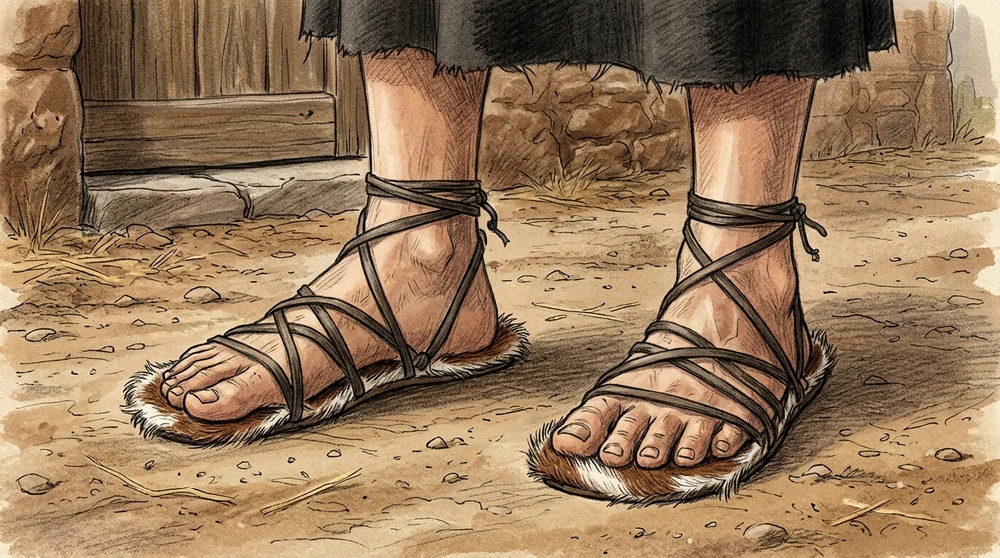
Beyond the pass, Navarre begins. The guide calls it a land rich in bread, wine, milk and livestock. And the guide looks closely at the people. It describes short black clothes, down to the knee, and abarcas: rawhide sandals with the hair still on, tied to the foot with straps, covering only the sole. Abarcas weren't only Basque: they were worn all over the peninsula. The guide says the Navarrese carried a hunting horn around the neck and two or three javelins, called azconas, and brought an offering of bread, wine or wheat to church every day. But its author despised the Navarrese and the Basques, and said so in writing, with a long list of vices. Historians today read that contempt as a prejudice of his time. One explanation suggests he learned it among the Franks of Estella, a town on the road, at odds with the Basque-speaking Navarrese. He'd already been hard on the Gascons, and was far harder on these two peoples.
How did the Basques say bread, around 1140? Orgui. That's how the author of the medieval guide to the Way of Saint James wrote it down, passing through their land. They called wine ardum, he writes. A house was echea. Water was uric. Wheat was gari. And the apostle Saint James was called iaona domne iacue, which means Lord Saint James. The curious part is who wrote those words down. That man had no love for the Basques: in the same book he heaps insults on them, and those who study the guide today read those insults as prejudice. But that list of words, tucked into a Latin text, is one of the earliest written records of the Basque language.
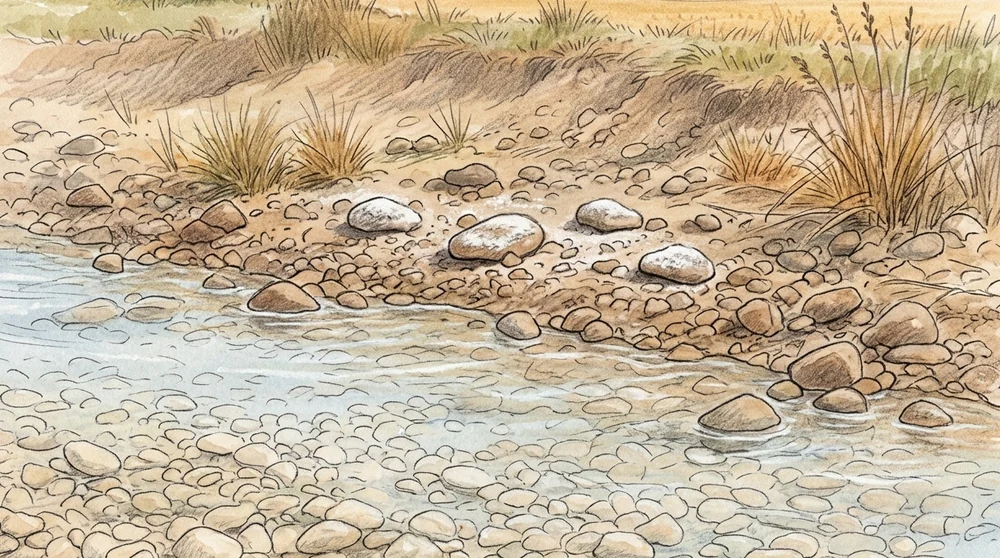
The river the guide calls deadly ▶ 7:55
Water that kills? The pilgrims' guide to Santiago, written around 1140, warns of a river in Navarre: the Salado, the Salt River, which runs past Lorca. Neither the pilgrim nor his horse should drink from it, because it's deadly. The author tells what he saw on its bank: two Navarrese sharpening knives, who said the water was good. Two of his group's horses drank and died, and the men, he says, skinned them. He adds that every river between Estella and Logroño was deadly. Was it true? Some twentieth-century historians tasted the Salado's water: salty, yes; deadly, no. A modern philologist reads the story of the horses as a caricature aimed at the Navarrese. Let's imagine the father of our family beside the Salado: just in case, he walks on without drinking.
Inns, food and tricks ▶ 8:46
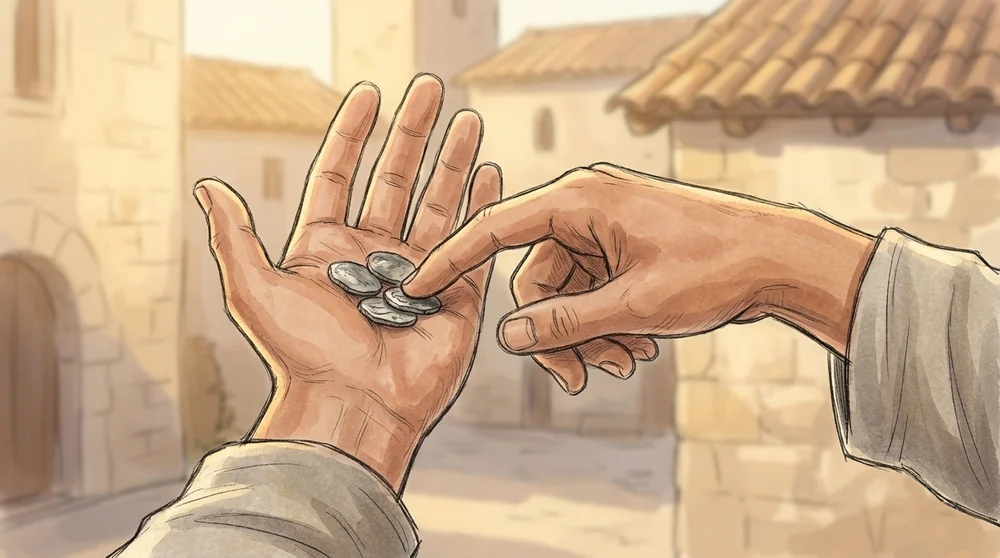
At Estella, the water is different: according to the guide, the Ega's is sweet, wholesome and very good. And the town is rich in good bread and excellent wine, with plenty of meat and fish as well. Then the fear of water comes back, all the way to the Ebro, which at Logroño is wholesome at last and full of fish. But the same guide warns foreigners that some fish of Spain and Galicia, such as eel or tench, will make them sick, and so will beef and pork. Along the way, food had to be bought. And the sermon warns that when crowds of pilgrims arrived, the price of bread, wine, cheese and meat went up. The father counts his coins before entering the town. As evening falls, it's time to look for an inn.
A maid pours out the inn's water at night, because her mistress tells her to: that way, the thirsty pilgrims will have to buy the innkeeper's wine. That story comes from the sermon, and its list of tricks goes on. Bad innkeepers, the sermon says, waited at the edge of town to kiss pilgrims as if they were relatives. They gave them good wine to taste and then sold them worse, or cider for wine, or watered-down wine, with false measures. And they wouldn't give a good bed unless the pilgrim bought dinner from them or paid them a coin. The sermon speaks of bad innkeepers, not of all of them. But it wasn't alone in worrying about false measures: a Compostela decree from 1133 banned innkeepers from keeping false weights. That night, our pilgrim pays for his dinner.
Across Castile and León, as a group ▶ 10:21
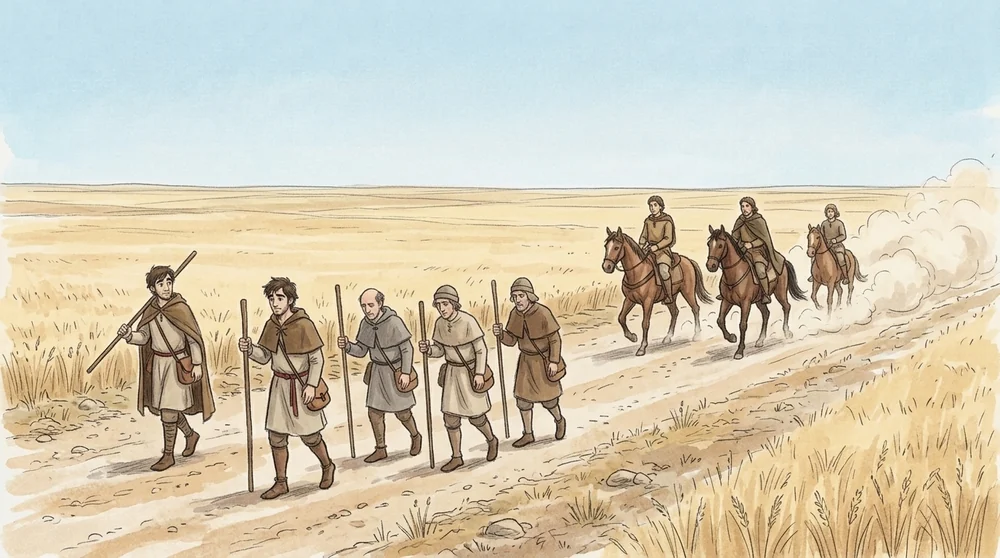
From Estella to Burgos, the guide counts two stages, and warns they're meant for riders: to Nájera, and from there to Burgos. Neither our pilgrim nor his group has a horse, so they walk. Then the Tierra de Campos plain opens up: rich in bread, wine and meat, the guide says, but with no firewood. The guide calls Sahagún plentiful in everything, and León a royal city, home to the court. Across that plain, the group walks together for many days, and by now they know each other well.
The guide and the sermon speak of groups of pilgrims, and the sermon asks them to hold all things in common, as if they had one heart. It is very disgraceful, the sermon says, when one pilgrim is thirsty and another is drunk, and on the road, everyone must share with poor pilgrims. The sermon also warns of false beggars by the road, faking sores, blindness or lameness. Even so, it asks that no one refuse them alms. The guide, for its part, reminds readers that pilgrims, rich or poor, were to be welcomed with charity. And it passes on a story people told against anyone who refused a pilgrim bread: a woman said she had none, and in the ashes, where her bread had been, she found a round stone. Our pilgrim shares his bread with a poor pilgrim in the group. And the bread, for now, is still bread.
Galicia: a stone and an innkeeper ▶ 11:47
At the top of O Cebreiro, the guide says, there was a hospital. That's where Galicia begins. The guide paints it as a land of forests, rivers, meadows and good orchards, with very clear springs and few towns. There's little wheat bread and little wine, but plenty of rye bread and cider, and milk and honey. And the guide writes that the Galicians are the people most like the French in their ways. On the father's table, there's rye bread now. And at last, the springs are nothing to fear.
Every pilgrim picked up a stone at Triacastela and carried it all the way to Castañeda. The pilgrims' guide in the Codex Calixtinus, from around 1140, says so. Triacastela is in Galicia, and Castañeda lies farther on, along the same road to Santiago. Why a stone? At Castañeda, the stones were burned into lime for the building work on the cathedral of Santiago. The same guide speaks of that work, and names its master masons, who worked with some fifty stonecutters. The guide doesn't say how heavy each stone was. The father of our family, who in this story is a pilgrim, chooses his own, like everyone in his group. He tucks it under his arm, and after a while switches arms. That way, every pilgrim left a little of his journey in the cathedral.
At Barbadelo, or in Triacastela itself, the sermon says, an innkeeper from Santiago might come out to meet pilgrims. He told them he was a resident of the city and hadn't come looking for guests, but to visit a brother of his who lived there. And while he was at it, he offered them his house in Santiago. To each group he gave something of his own as a token for his wife: a belt, a key, a ring, a glove. In his house, after the first course, the lady of the house sold them a candle worth four coins for eight or ten. And it seems this really went on: that 1133 decree already banned Santiago's innkeepers from going after customers beyond the Miño River. Our pilgrim's group gets a ring. No one is quite sure what to do with it.
Santiago: free water, money-changers ▶ 13:58
Two miles from Santiago, in a wood, there's a river where, the guide says, French pilgrims washed from head to toe before entering the city, out of love for the apostle. The father washes too, and shakes the dust from his cape. He passes the Monte do Gozo, the Hill of Joy, and there is the city. Compostela has seven gates, the guide says, and the first is the Frankish Gate, the gate of the Franks. Our pilgrim enters through it. And he goes into the cathedral from the north, as the guide says the Franks did.
In front of the cathedral, there's water. It hadn't always been so. The chronicle of Archbishop Gelmírez says pilgrims used to find no water there, and often had to buy it from innkeepers. Around 1122, Bernard the treasurer brought water all the way to the cathedral. The guide describes a fountain there with four lions spouting water, and an inscription bearing Bernard's name. The father drinks without fear and without paying. All around him, the square is crowded. How many pilgrims came? Many, say Gelmírez's chronicle and the sermon. How many exactly, we don't know: nobody kept a count.
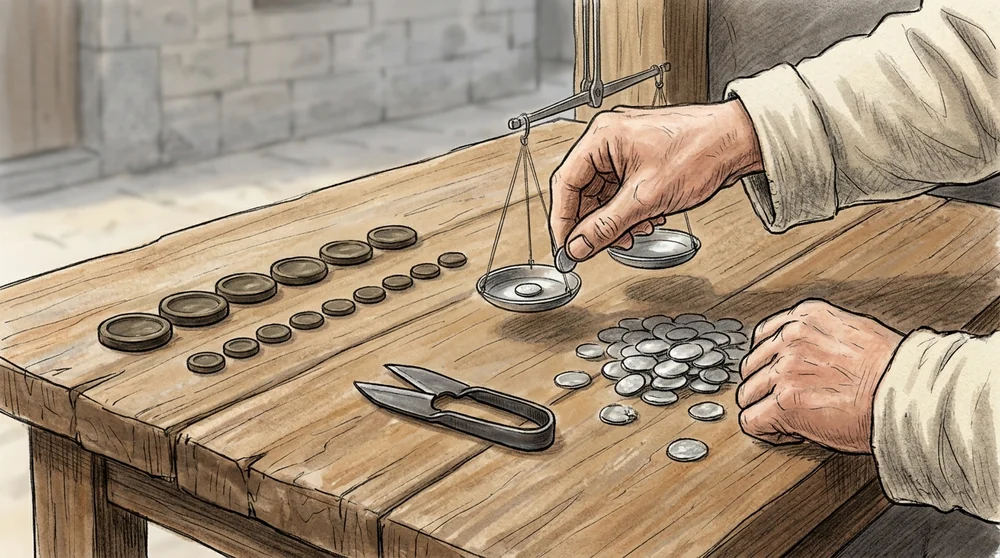
In the forecourt of the north door, the guide says, pilgrims could buy scallop shells, wineskins, shoes, deerskin scrips and straps. And in the city there were money-changers, who were suspected of using false weights: both the sermon and that Compostela decree say so. The sermon lists their tricks: big weights for buying and small ones for selling, a small balance they called the trebuchet, for weighing each coin, and shears for clipping the larger coins. The same decree set maximum prices in the city: a hen, no more than one penny; and for one penny, no fewer than thirty eggs. Our pilgrim changes only what he needs, and in the forecourt, he buys one of the scallop shells: the sign of the journey.
The first night, the guide says, every poor pilgrim had the right to lodging in Santiago's hospital, by the north door. There, in the quiet, our pilgrim reckons up the cost of the road. He paid for the boat: one coin a head. He got past the toll collectors. By rights, they shouldn't have charged him. He bought dinner to get a bed. And he left his coins with a money-changer. How long did the walk from the Pyrenees take? Well over thirteen days. The guide doesn't say exactly how many. The sermon kept the greatest risk in mind: that's why it asked pilgrims to arrange their alms before leaving, in case they didn't come back alive. Tonight, though, he has a roof over his head. Our pilgrim has made it. The journey home is still ahead of him.
The road today ▶ 16:49
That road is still there. In 2025, the Pilgrim's Office at Santiago cathedral registered more than half a million pilgrims, more than in any year before. Almost half came along the French Way, the Camino Francés, the one that comes in through Roncesvalles. And Galicia's official Camino de Santiago website still cites that guide, attributed to Aymeric Picaud. Its warnings have aged unevenly: the Salado turned out to be merely salty. And thanks to that author, so harsh on the Basques, bread, wine, house and water are among the first words of their language ever put in writing. What about you? Have you ever made a long journey on foot, or is there someone in your family who did, and still tells the story?
Words from this home
- tollSay it: —
- A tax for crossing a pass or a road.
- money-changerSay it: —
- The man who changed coins.
- trebuchetSay it: TREB-yoo-shet
- The scale on which the changer weighed each coin.
- scripSay it: —
- The pilgrim’s leather bag; the sermon calls it pera.
- abarcasSay it: ah-BAR-kahs
- Rawhide shoes tied with thongs, covering only the sole.
- Cize passSay it: seez
- The Pyrenean pass above Roncesvalles.
- Liber Sancti JacobiSay it: LEE-behr SAHNK-tee YAH-koh-bee
- The ‘Book of Saint James’, the codex that contains the pilgrim’s guide.
Sources
- Fidel Fita and Julien Vinson (eds.), Le Codex de Saint-Jacques-de-Compostelle (Paris, 1882): the pilgrims' guide, in Latin
- Adalbert Hämel (ed.), Revue Hispanique 81 (1933): Latin passages of the sermon for pilgrims
- Thomas F. Coffey, Linda Kay Davidson and Maryjane Dunn (trans.), The Miracles of Saint James (New York, 1996)
- Historia Compostellana, ed. Enrique Flórez, España sagrada, vol. XX (Madrid, 2nd ed.)
- José María Anguita Jaén, "Bascli et Navarri: los vascos del s. XII según el Liber Sancti Iacobi", Veleia 16 (1999)
- Adalbert Hämel, Überlieferung und Bedeutung des Liber Sancti Jacobi und des Pseudo-Turpin (Munich, 1950)
- Xunta de Galicia, "Camino Francés", official website of the Camino de Santiago in Galicia (consulted 2026)
- University of Navarra, Chair of Navarrese Heritage and Art, "Roncesvalles" (consulted 2026)
- Códex Calixtinus. Libro V, Spanish translation (Ríos Galegos, 2006)
- Luis Vázquez de Parga, José María Lacarra and Juan Uría Ríu, Las peregrinaciones a Santiago de Compostela, vol. II (Madrid, 1948), quoted by Anguita Jaén (1999)
- Pilgrim's Office, Santiago de Compostela Cathedral, 2025 statistics (consulted 2026)
- Gregorio del Sol, Diario de Santiago, January 2, 2026
- Nicolás de Cárdenas, EWTN Noticias, January 9, 2026