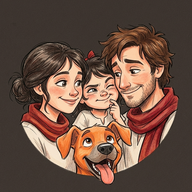
Yongding, Fujian · 1905
Inside China's Hakka Tulou, a Round House of Earth
November 16, 2026 · 16 min · Audio in Spanish, English, Portuguese, German
Pressing play loads YouTube (Google). Privacy
A tulou is a house several stories high, with walls of earth rammed between boards, built in Fujian, China, by a whole lineage to live in together. A tulou like the one in this video had a single iron-clad door, and a whole clan came and went through it. The family lives in a Hakka round house in the mountains of southwestern Fujian. We spend 1905 with a recreated family of Hakka farmers: the mother, who works in the rice paddy; the daughter, about four, always at her side; the grandfather, who stays home; and the father, who is away in the South Seas. We follow the day through that door, from the kitchen to the granary and the bedrooms, and on to the ancestral hall in the middle of the courtyard. We also meet the men who left for Southeast Asia and sent money home.
In 2008, forty-six Fujian tulou were added to the World Heritage List, the same tulou China had nominated to UNESCO the year before.
The story, to read
The whole episode, chapter by chapter. Tap the minute to watch from there.
A Fujian Tulou in 1905 ▶ 0:00
At dawn, between rice paddies and hills, an iron-clad door swings open. It's the only one in the house. And the house belongs to a whole clan. One door for everyone. How did people live inside a tulou? Tulou is the name for this round house of earth, four stories high, in the mountains of southwestern Fujian, China. In 1905, those who walk through this door are Hakka farmers, a Chinese people of these mountains. Let's say a small branch of the clan lives in this ring, a family pieced together from what we know of Hakka life in these houses. There's the mother, who goes out to the rice paddy today; the daughter, about four, who never leaves her side; and the grandfather, who stays inside. The father is away: he, too, once walked out through this door.
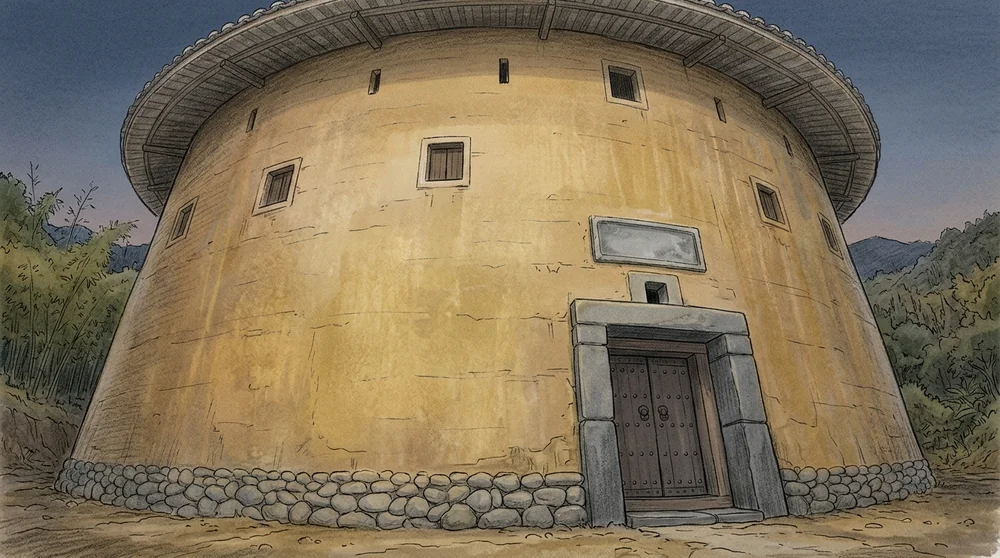
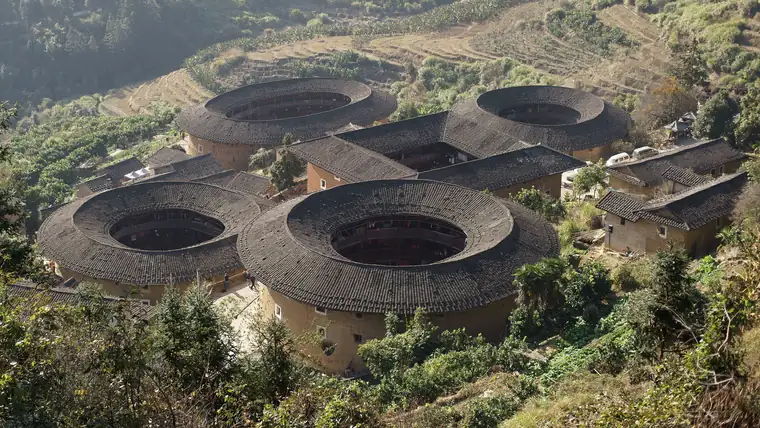
From the hillside, the house looks like a huge drum of earth. The mother sees it this way every evening, coming back from the rice paddy. A tulou is just that: a house of earth rammed between boards, several stories high, raised by a whole lineage to live together. Ours is round and stands in Yongding, a county in southwestern Fujian. It's like Yanxiang Lou, a real tulou that people began to build in 1842. At the bottom, a base of river stones. On top of it, the earth. The wall is thicker at the foot and thins toward the top, floor by floor. A roof of gray tiles crowns it, with very wide eaves. Rice paddies all around. And in the whole ring, on the outside, at a person's height, there's only one opening: the door.
Before she follows her mother, the daughter stops in front of the door, with her hand on the iron. The door is the first thing you see, and the most carefully planned part of the house. It's a thick door, clad in iron, set in a stone frame. And above it, there's an opening for pouring water, in case someone set the door on fire. A house like this had no back door. That's why fire was what people feared most: if the door burned, the only way out burned with it. Everything that came in and went out over a year passed through here: the people, the grain and the news.
Bandits, Fire and a Wall of Earth ▶ 2:27
So why a whole house with only one door? The grandfather knows why. Bandits roamed these hills, so families shut themselves in together behind a wall. A tall wall, one to two meters thick, about three to six and a half feet, with loopholes high up, hiding everything inside. In times of danger, the door was shut and everyone waited inside. The house had a well and a granary, so it could hold out through a siege. Water came from the courtyard well, rice from the granary, like any other day. We don't know how long a siege could last. The people of these mountains would rather live many to one house, safely shut in, than each in a little house with their own door and their own fear.
Kitchen Below, Grain Above, Sleep at the Top ▶ 3:14
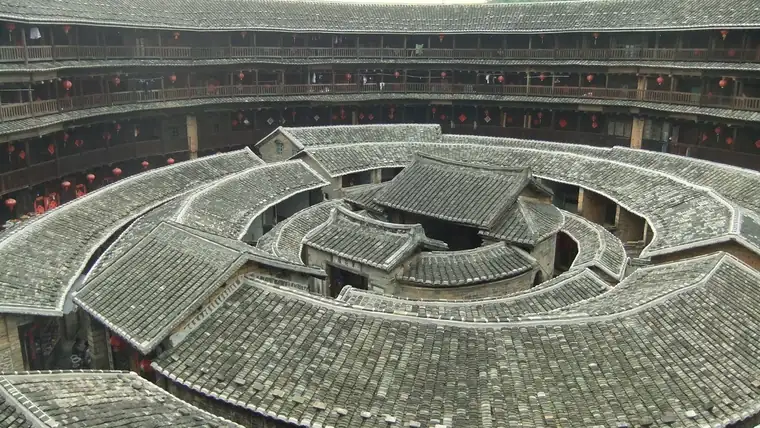
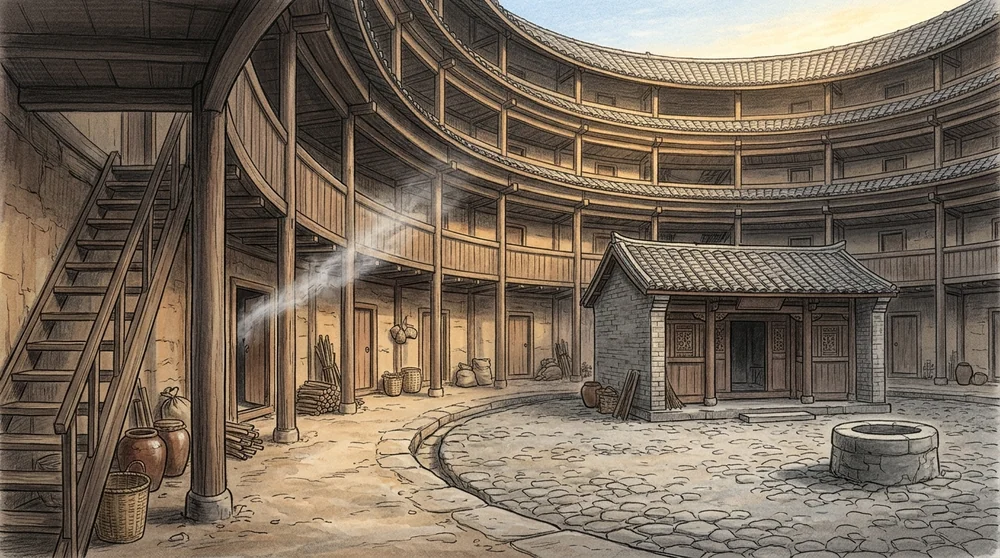
The daughter crosses the threshold pressed close to her mother, and the house turns inside out. From outside, it was a blind wall. Inside, it's all wooden galleries: four floors of railings looking onto a round courtyard. Each family had its own column of rooms, from bottom to top, and they all shared the corridors and the stairs. Our family's column starts at the level of the courtyard. At the bottom is the kitchen, above it the grain, and at the very top, the rooms where people slept. On the two lowest floors, not a single window faces out. Light and air came in from the courtyard, the open heart of the house. So a family didn't have a floor to itself. It had a slice of the house, from the ground to the roof, and it shared the rest with the whole lineage.
The mother starts her day down below, in the kitchen. There's a brick stove there, with a wok on it, and in the wok, rice. We know very little about what else people ate each day. The kitchen has no window: its light comes from the courtyard, through the door that opens onto the gallery. And the smoke? A book about the tulou says it rose up inside the wall itself. That way, the book says, the kitchen stayed clean. Nobody had to go far for water, either: the well was inside, in the courtyard. The daughter goes along with her little bucket, behind her mother. She fills it halfway, because she can't carry any more. With the door shut, that well was everyone's water. And the little girl is already learning to fetch it.
The shared staircase leads up to the second floor. Our family's grain is kept there: the rice, stored in chests, in the half-dark. People slept on the third and fourth floors. Up there, at last, small windows open to the outside. From them, you can see the rice paddies, the path, and whoever is coming toward the house. Along the galleries, life went on in full view of everyone. The daughter runs along them from door to door, and behind each one lives someone of the same lineage. An aunt, a cousin, an old man who has known her since the day she was born. For a four-year-old girl, the whole house is a village with a roof.
How Many People Lived in a Tulou? ▶ 5:32
How many people could fit in a ring like this? It depends on the tulou. The largest in the area, Chengqi Lou, came to have four hundred rooms, and at its height, hundreds of people inside. Another tulou in Fujian, Huaiyuan Lou, has a hundred and thirty-six rooms on four floors. A ring like that held several dozen households of the same lineage, according to the local press. And a house like ours? We don't know, and we're not going to make up a number. From the gallery, the daughter sees more doors than she can count. What we do know is what they all had in common: they were all relatives, and they all came and went through the same door.
Hakka Women in the Rice Paddy ▶ 6:29
It's daylight now, and the door never stops. The mother goes out through it, with a pole on her shoulder and a basket hanging from each end. She's on her way to the rice paddy. Hakka women never bound their feet, and you could see the difference in the fields: they worked the rice paddies like the men. Here, there was no strict line between the man outside and the woman inside. Beside the mother, the men of the clan who have stayed behind bend over the water. Rice grows all around, and so do tea and tobacco: that's what these slopes gave. And everything harvested on them came back to the house the same way: through the iron door.
The daughter follows behind, watching. Everything her mother does in a day fits into a Hakka saying: the four heads and the four tails. The field and the vegetable plot. The needle and the thread. The stove and the wok. The house and the children. Four kinds of work that never ended, and they were all hers, from head to tail. And all of it without leaving the rice paddy, side by side with the men. At four, the daughter can't manage any of it yet. But she already knows where the vegetable plot is, and she feeds the chickens. She'll learn the rest the way her mother learned it: by watching, next to a woman who is never still.
Not everything fits inside. At Yanxiang Lou, the real house that inspired ours, the pigsty and the room where the rice was hulled stood outside the ring. The pigs didn't sleep with the clan. And the dust from the husks stayed on the other side of the wall, too. When the mother brings the rice back from the room outside, she comes in through the door with the grain already clean. She carries it up the shared staircase to her family's granary. From there, it will come down, little by little, to the kitchen below, and into the wok. So inside the house, the grain makes the same journey the people do: it comes in through the only door, and it climbs, floor by floor, up its own column.
A Life in Full View ▶ 8:34
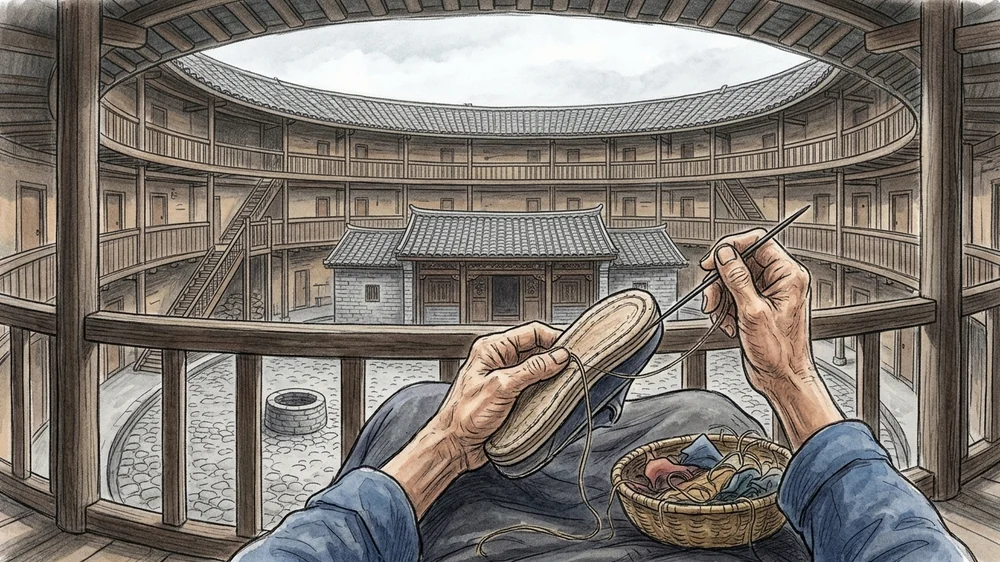
Living like this had a price, and it wasn't a small one. Each family had its column, but the corridors and the stairs belonged to everyone. To reach her room, the mother walks past everyone else's doors. When someone cooks on one gallery, the people on the next one can smell it. A voice in the courtyard carries around the whole ring. And anyone who wanted to go out while the door was shut had to open it, and it was everyone's door. Nothing we've read tells us how people got along with one another, day to day. But the people of these mountains had done the math. In exchange for their privacy, they had a wall of earth, a well, a granary and an iron door. And they had their whole lineage right beside them.
The Ancestral Hall and Its School ▶ 9:20
In the middle of the courtyard stands the ancestral hall. It's right across from the door: the first thing you see when you come in. The grandfather spends a good part of the day there. He's the eldest of our branch, and in this house, that counts for a lot. The grandfather's word was law. On the pillars at Yanxiang Lou, there are verses that call for doing good and reading books. They say, roughly, that doing good brings prosperity, and that keeping books fills the house with fragrance. From where he sits, the grandfather can see the door. And whatever passes through it, sooner or later, passes in front of him too.
By day, the hall has another use. The clan's children learned to read in that same ancestral hall. They sit together at a table, books open, under the painted beams. Above them, on the pillars, there are verses like those at Yanxiang Lou. Our daughter peeks in at the door of the hall and listens, though she doesn't understand any of it yet. And the women? At Chengqi Lou, not far from here, the owners didn't let women study outside, so they set up a classroom for them inside the tulou. This was one house's rule, not every house's. There, the women who went out to the rice paddies every day couldn't go out to study.
How a Tulou Was Built ▶ 10:42
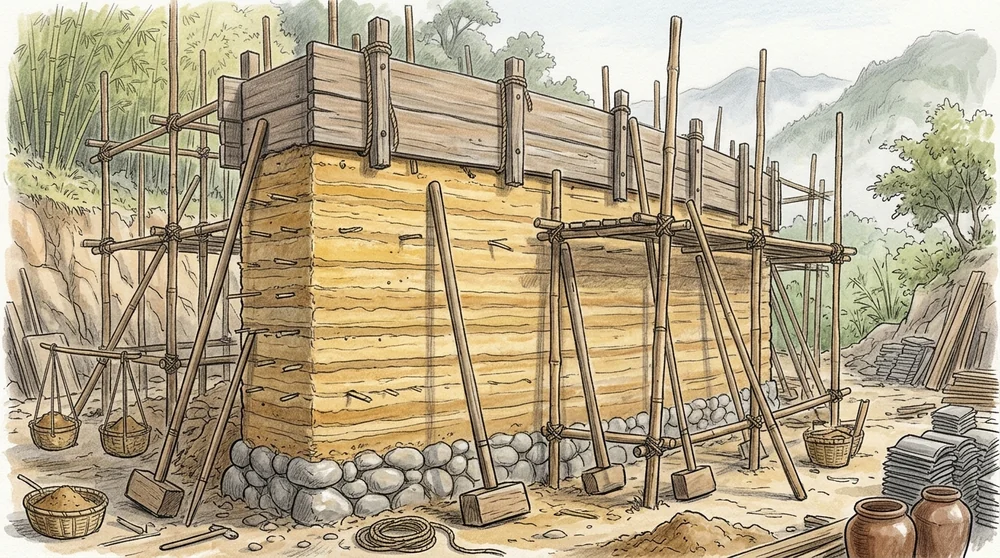
Who built a house like this? The whole lineage did the work. First came the stones of the base. Then, the earth. It was packed between two long boards and pounded down, layer by layer. Strips of bamboo and wood went into the mud, to keep the wall from cracking. When one stretch was firm, the boards were moved up, and it all began again, a little higher. The house rose floor by floor, year after year. That's why a house like this wasn't paid for with money alone. It was paid for with years, and with a whole lineage willing to wait. How many years? For one house of that time we do have the dates, from the first stone to the roof. And it was begun the very year of our story.
That same year, 1905, in another county of Fujian, a new tulou began to rise — Huaiyuan Lou. It wasn't finished until 1909. Glutinous rice and brown sugar went into the mud of Huaiyuan Lou, according to a Chinese newspaper. Glutinous rice is the kind that turns sticky when it's cooked. But the money for the building came from outside China. Huaiyuan Lou was paid for with money from brothers who worked in Burma. And its name means something like remembering relatives far away. A whole tulou, made of Fujian earth, raised with what was earned across the sea.
The Men Who Left for the South Seas ▶ 12:09
Burma is a long way from these hills. But in those years, many men left for the South Seas, in Southeast Asia. Nanyang was the Chinese name for those lands. From there, they sent money home, and that money from abroad paid for some of the last tulou. The father in our family is one of them. One day, he walked out the same iron door and down to the road. The front of his head was shaved, and his queue, the long braid, hung down his back. The mother watched him go from the threshold. We don't know, for this area, how many came back, or when. The door that kept the bandits out couldn't keep the men of the house in.
And one day, the door brings something back: letters with money in them. Qiaopi was the name for these letters from those who had gone away. They brought money, and sometimes medicine, as the village secretary of Huaiyuan Lou says today. Let's imagine one of these letters is for our mother. It comes in through the iron door, passes in front of the ancestral hall, and climbs the shared staircase to her room. By the time it gets upstairs, half the house already knows it has arrived. In a ring with only one door, nothing came in without someone seeing it. Not the bandits, and not the letters. She tells no one what the letter said.
The brothers who paid for Huaiyuan Lou came to see it when it was almost finished, but never came back to live in it. So its name carries even more weight: remembering relatives far away. These houses were built for a whole clan to live together behind a wall. Yet in those same years many of its members lived across the sea. The wall protected those who stayed, and could only wait for those who left. That was the price of a house built for staying put, in a time when so many were leaving.
Tulou Today, and Nightfall ▶ 14:06
The tulou are still there, in these mountains. In 2008, forty-six tulou were added to the World Heritage List. Today, many tulou are visited as monuments, and the villagers live in new houses next to them. The iron doors no longer close against anyone. Quite the opposite: they open to show how a whole clan lived together inside one ring of earth. Where the rice and the letters once came in, and the men went away, it's visitors who come in now. From the air, they still look like what they were: rings of earth among the rice paddies. A round house of earth, bamboo and river stones, built layer by layer by a whole lineage, and still standing.
But let's go back to 1905, to the end of the day. The mother comes back from the rice paddy with the daughter asleep on her back. She walks through the door, and the clan comes in behind her. Inside is everything the house needs: the well, the granary, the kitchens, the rooms upstairs. And in the middle, the hall, where the grandfather is one of the last to turn in. None of our sources says who shut the door each night, or who kept the key. But soon, a whole clan will be behind a single iron door. Everyone except the father. He's on the other side of the sea. And for a long time, the only things of his to come through this door will be his letters.
Words from this home
- tulouSay it: TOO-loh
- Multi-storey communal house of rammed earth for a whole lineage.
- HakkaSay it: HAH-kah
- Han Chinese people of the southern hills, with their own language.
- 永定 YǒngdìngSay it: yong-DING
- Hakka county in south-west Fujian.
- 衍香楼 Yǎnxiāng LóuSay it: yen-shyahng LOH
- Round tulou in Hukeng, 1842: the model for the house in the story.
- 怀远楼 Huáiyuǎn LóuSay it: hwhy-yoo-EN LOH
- Tulou in Kanxia (Nanjing county), 1905–1909, paid for from Burma.
- 承启楼 Chéngqǐ LóuSay it: chung-CHEE LOH
- The largest round tulou of Yongding: over 400 rooms.
- ancestral hallSay it: —
- Central hall where the lineage's ancestors were honoured.
- the South SeasSay it: nahn-YAHNG
- Chinese name for South-East Asia: Malaya, Singapore, Burma, the East Indies.
- qiaopiSay it: chyow-PEE
- Letter with money sent home by emigrants.
- the four heads and the four tailsSay it: —
- Hakka saying on a woman's duties: fields, needle, stove, house.
Sources
- State Administration of Cultural Heritage of China, “Fujian Tulou. Nomination for inscription on the World Heritage List,” 2007: the four-story earth house with a single iron-clad door, the kitchen below, grain above and bedrooms at the top, and Huaiyuan Lou, begun in 1905 and finished in 1909, paid for by brothers who lived in Burma
- ICOMOS, “Evaluation of nomination 1113, Fujian Tulou,” 2008: the bandits of these hills, the base of river stones and the bamboo and wood strips inside the wall
- Zheng Shanyun, “Fujian Tulou” (Chinese Culture), 2019: what a tulou is, the well and granary that let it hold out under siege, and its account of kitchen smoke rising inside the wall itself
- Gong Wanzao, “Si tou si wei” (Four Heads and Four Tails), Dictionary of Frequently Used Taiwan Hakka, 2022: the Hakka saying of the four heads and four tails, and Hakka women, who never bound their feet
- Sherman A. Nagel, “At Home with the Hakkas in South China,” 1921: Hakka women, with unbound feet and at work in the fields, and the word of the eldest, which was law at home
- Hu Zehui, Hunan Daily, 2026: the several dozen households Huaiyuan Lou could hold, the brothers who paid for it and never came back, and the letters with money and medicine, as the village secretary tells it
- UNESCO, “Memory of the World. Documentary Heritage in Asia and the Pacific,” 2016: qiaopi, the remittance letters that emigrants sent to their families in Fujian and Guangdong
- China Intangible Cultural Heritage Network, “Gannan Hakka Dress,” 2021: the clothes of Hakka women in Gannan
- Chinese Wikipedia, “Tifa yifu”: the shaved forehead and queue of men under the Qing
- Chinese Wikipedia, “Huaiyuan Lou”: the building's fact sheet