
Timbuktu, Mali · around 1900
Timbuktu's Salt Came by Camel From the Deep Sahara
November 15, 2026 · 14 min · Audio in Spanish, English, Portuguese, German
Pressing play loads YouTube (Google). Privacy
Timbuktu had no salt of its own, yet salt sold more than anything else in the city. Sahara salt caravans carried it by camel from the Taoudenni salt mines, about three weeks' journey north. We follow a recreated Timbuktu family around 1900. The father buys and sells salt but doesn't go to the mines. The mother spins cotton and watches the pot, and the daughter helps her pound the millet. Travelers and a missionary who were there between 1880 and 1906 take us along with the azalai, the great salt caravan of the Berabish. At the mines, captive men cut the salt in the open air, in bars of about thirty kilos, some sixty-five pounds. Then we trace the Timbuktu salt trade, from the mine, where a bar was worth almost nothing, to the markets on the Niger River, where it was worth many times more.
The story, to read
The whole episode, chapter by chapter. Tap the minute to watch from there.
A Timbuktu Family, Around 1900 ▶ 0:00
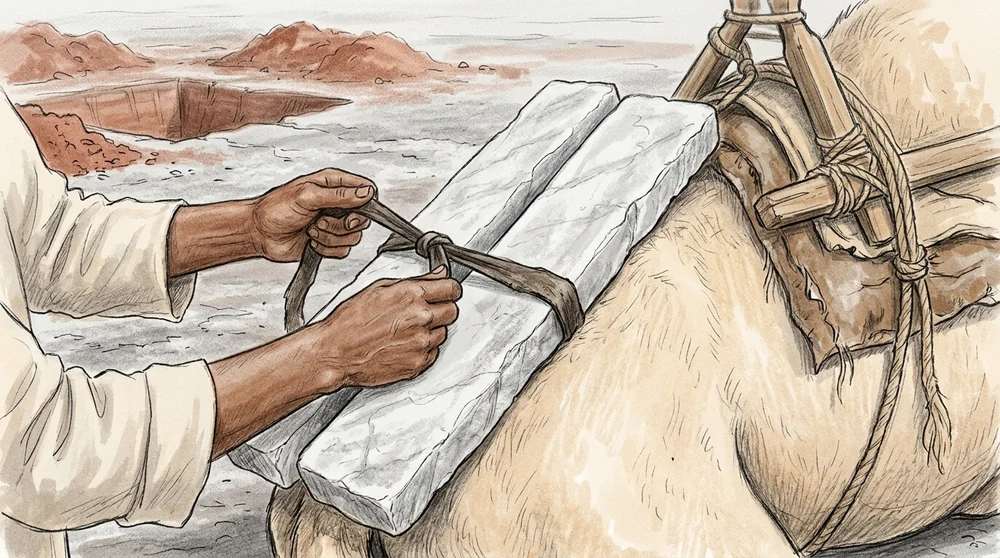
Four bars of salt, white and flat, tied to a kneeling camel: this is how salt reached Timbuktu. It came from the mines of Taoudenni, about three weeks' journey to the north. How did people make a living from salt that took so long to arrive? Let's imagine a family of Timbuktu, around 1900. The father buys and sells salt, but he doesn't go to the mines: he waits for it here. The mother spins cotton in the courtyard and keeps an eye on the pot. The daughter helps her pound the millet. And all three keep their eyes on the north, because what feeds them comes from there.
A Mud City With No Salt ▶ 0:43
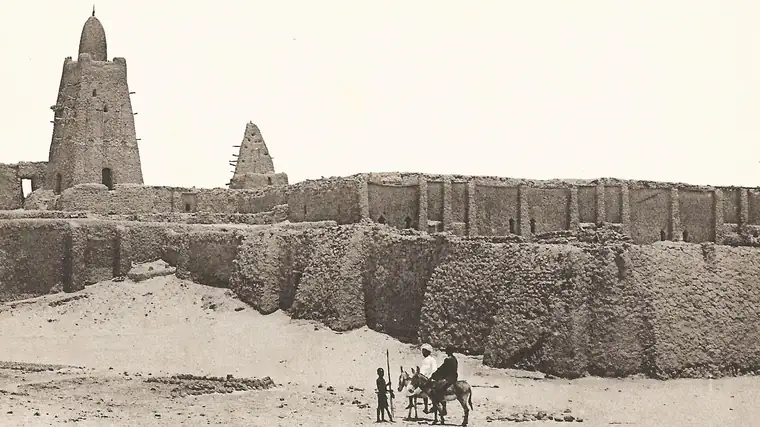
Timbuktu stands at the edge of the desert, near the Niger River. It's a city of mud. Its houses are built of sun-dried mud brick, with façades of thick pillars, and sandy streets run between them. Even the great mosque has walls of mud. But Timbuktu had no salt. Salt came from the north, by camel, and it sold more than anything else. Augustin Hacquard, a missionary who had lived in Timbuktu since 1895, summed up the city in one word: a warehouse. Salt arrived there, and from there it was sent on. Grain came by river, from the south; salt came down from the desert. Timbuktu lived between those two roads. And our family lives off one of them.
Their house is made of mud, with a courtyard in the middle. It's a low house, with a roof terrace on top. Hacquard noted that only one house in three in the city had an upper floor. The door has an iron ring. You go in through an entrance hall, where visitors are received. Behind it is the courtyard, with the rooms around it. In one, the father keeps his salt bars, propped against the wall. He dresses like the men of the city, in a loose robe and a turban. In our story, he has only a few bars left. And he can't go and fetch more. Like so many merchants in Timbuktu, he waits for the caravan in the city, buys bars, and then takes them by river to the south. His trade begins when the salt arrives. And the great salt caravan set out only twice a year. Between caravans, the room empties, bar by bar.
The Azalai, the Salt Caravan ▶ 2:22
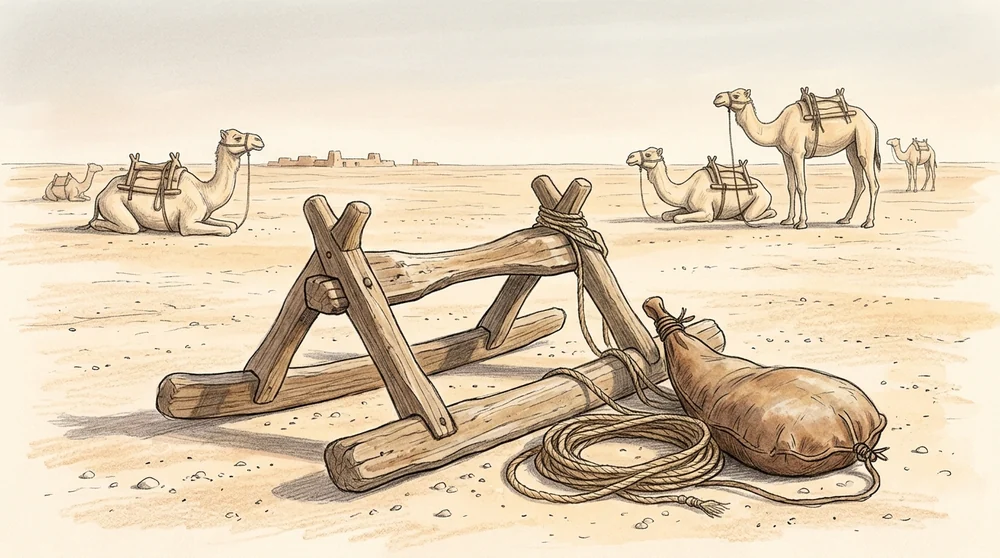
So who brought the salt? Mostly the Berabish, Arab nomads of the desert, whose center was Araouane, a small oasis to the north. They weren't the only ones: other desert peoples ran caravans too, and some city merchants had their own. But most of the salt came with the Berabish. Their big caravan, the salt caravan, had a name: the azalai. It went to the mines of Taoudenni twice a year, and came back loaded with salt. Nobody in our family travels with it. But we can follow it from the outside, through the accounts of people who saw it pass.
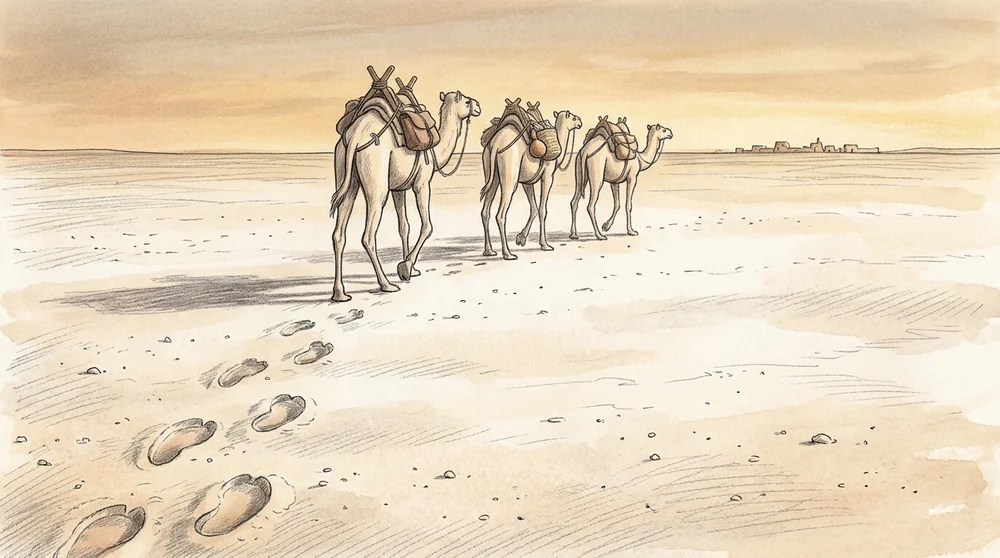
The road to the mines had only one stop with houses and wells: Araouane, a week north of Timbuktu. A French officer who reached the mines in 1906, a few years after our story, found the great caravan at Araouane, gathered by the wells and about to set out. In our story, the camels move forward in single file, slowly, in the low morning light. The longest stretch still lay beyond Araouane. All told, it was more than six hundred kilometers of desert, well over three hundred and fifty miles. About three weeks on the march, northward, into the heart of the Sahara.
After Araouane, water was scarce for days. There are no more houses. Only flat sand, the sky and the line of camels. Each day's march took them farther from the last well with houses beside it. That French officer called this stretch a terrible stage. And it wasn't terrible only for the men. The road wore out the camels. The same officer noted that the caravans lost a great many of them, and that a camel lasted six or seven years on that road. After that, it was no longer fit for the salt journey.
The Mother, the Spindle and the Mortar ▶ 4:25
Meanwhile, in Timbuktu, life goes on in the courtyard. Hacquard saw that in the city's courtyards, the free women spun cotton, watched over the cooking and received visitors. That's how the mother in our family spends her day. She has the spindle in her hand and one eye on the pot, a clay pot over a clay hearth. Against the wall, a clay jar holds the water. In the houses of Timbuktu, people chewed kola nuts. The daughter and the mother pound the millet in a tall wooden mortar. One lifts the wooden pestle and lets it drop; the other waits her turn. The dull thud of the mortar carries across the whole courtyard. So it goes, one day after another, while the caravan walks north.
And what's in the pot? Hacquard lists three meals a day. In the morning, the leftovers from the night before, or a porridge. Another meal in the middle of the afternoon. And supper, after dark. Millet and rice came from the south, by river. The sauce was made with baobab leaves, with okra or with squash. Meat, when there was any, was mutton or goat. The poorest ate dried fish. And in every sauce, a little salt. You can't see it, but it's in every dish: it's what the caravan has gone to fetch.
The Taoudenni Salt Mines ▶ 5:48
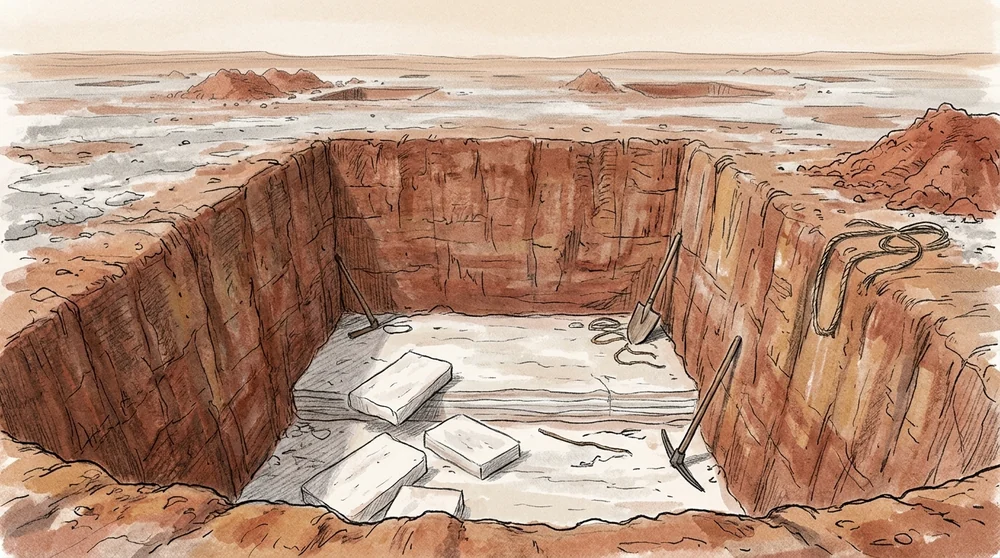
After about three weeks, the caravan reaches Taoudenni. It's the bed of an ancient lake, dried up long ago. A flat, bare plain, deep in the Sahara. Salt had been mined there for more than three hundred years: since the late sixteenth century, when the Songhai king lost his old salt mines to Morocco. At Taoudenni, the salt was mostly cut from pits open to the sky, layer by layer. They were square pits, dug into the red clay. The layers of salt appeared at the bottom.
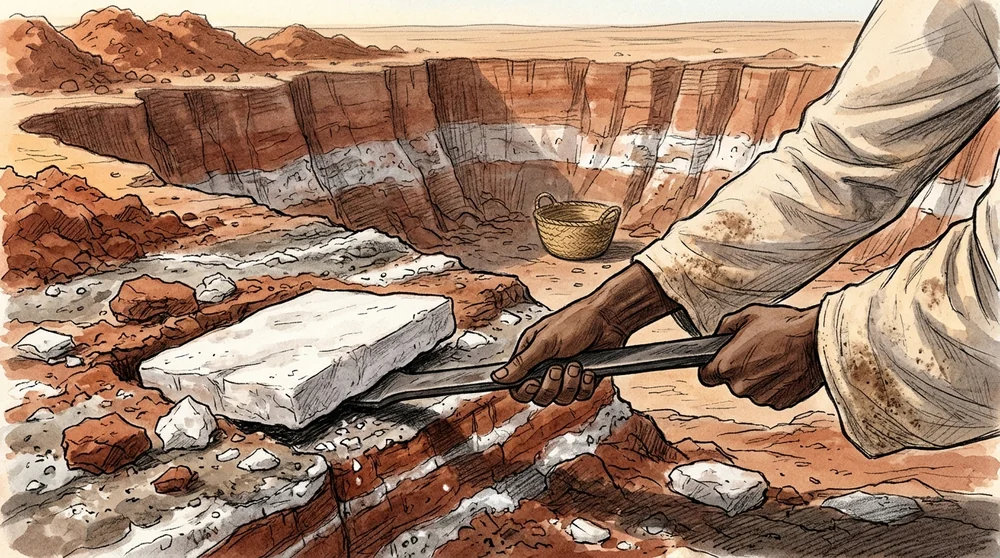
Each layer came out in bars. A bar was longer than an outstretched arm: a little over a meter, about four feet. It was about forty centimeters wide. And it was thin as a plank: only four or five centimeters thick. It weighed about thirty kilos, some sixty-five pounds. Another traveler, who was in Timbuktu in 1895, a few years before our story, wrote that they looked like slabs of white marble. That's how our family knows salt: not as grains, but as big, heavy slabs that have to be broken.
Who Cut the Salt ▶ 6:57
And who cut those bars? The men who worked in the mines weren't free: they were captives, in the service of the local chiefs. Several travelers of the time say so, and that French officer saw it in 1906. A study from 1980, describing the mines eighty years later, says the miners' lot was not enviable. We don't know the names of the men of 1900, or what they thought. In our story they have no faces: we only know that the salt in every pot in Timbuktu passed through their hands first.
Nothing grew at the mine. Not even the water was any use: the water of the salt pans was pure salt, and the water in the village made people sick. Someone who visited the mine in the twentieth century wrote that good water had to be brought from a well a day's walk away. He also wrote that not even the houses were made of mud: they were blocks of salt, with roofs of camel hide, and that even fuel came from the camels. The miners ate rice and millet brought up from Timbuktu, with camel meat dried in the sun. In other words, the grain that reached the city by river traveled on to the mines, and the salt made the journey the other way. At the mine, salt was worth nothing if the grain didn't arrive. And in Timbuktu, people paid for grain with salt.
Over Two Hundred Pounds on Each Camel ▶ 8:21
For the return, the bars are strapped on, two on each side of the camel: about a hundred kilos of salt or more on each back, over two hundred pounds. Oskar Lenz, a German traveler who passed close by these mines in 1880, twenty years before our story, put it this way: four slabs, one camel load. At the mine, a bar was worth almost nothing. The French officer who came in 1906 noted that it was paid for in goods: rice, millet, cotton cloth. He also reported that some thirty-two thousand bars left Taoudenni that year. More than a century later, the road is still open. Salt is still cut by hand at Taoudenni. Most of it now travels by truck, but camel caravans still set out. And in the Timbuktu market, the bars are still sawn into smaller pieces for sale.
The Caravan Reaches Timbuktu ▶ 9:14
The way back took another three weeks: the waterless stretch, then Araouane and, from there, the last week to Timbuktu. In our story, the news runs through the streets ahead of the camels: the caravan is here. From the courtyard, the mother and the daughter hear the noise in the street. The camels come in along the sandy streets, one behind the other, and kneel. The traveler who was there in 1895 saw that each owner put his mark on the bars as they came out of the mine. In Timbuktu, before they were sent south, they were painted with black designs and the names of saints. Then they were bound with rawhide straps so they would hold together if they cracked. A whole guild did nothing else. The father comes over, looks at the bars and touches them. The same traveler wrote that people preferred the thickest and whitest ones. Those are the bars the father wants for his empty room.
Hacquard saw that in the Timbuktu market, most of the sellers were women, while men sold the salt by the bar. The father takes his salt there, and the mother and the daughter go there too. The mother doesn't sell salt: selling it wholesale is men's work. Salt was traded for cloth, for clothing, for grain, for money. Hacquard adds that it was sometimes traded for slaves as well. Lenz noted in 1880 that in Timbuktu, a slab of salt was worth roughly one mithqal of gold, a small unit of weight used for gold. And to hire each camel, he was asked for four slabs of salt.
The Father Takes the Niger South ▶ 10:50
Now it's the father's turn to travel. Hacquard tells how the Timbuktu merchant, when the time came, took his bars to two markets in the south, Saraféré and Djenné. And he came back with goods from the south. In our story, the father sets out with his bars for Kabara, Timbuktu's port on the Niger. At Kabara, the bars are loaded into dugout canoes. The mother and the daughter stay at home, with a few bars left in the room. This time it's the house that waits for someone who is away. The father travels by river, to the south, toward the lands where the millet and rice eaten in Timbuktu come from.
Each time the salt went a little farther south, it was worth more. The traveler who was in Timbuktu in 1895 gave an example: a bar was worth fifty percent more in Saraféré than in Timbuktu, and twice as much in Djenné. On the river, the same bar was worth many times what it had cost at the mine. It made sense: every bar had crossed the desert, worn out camels and passed through many hands. But prices rose and fell from one year to the next, with the quality of the salt and with how safe the road was. We don't know how much a merchant like the father earned; Hacquard only says the profit was good. What fed him wasn't the salt from the mine, which was worth almost nothing: it was the road. On the way back, the canoes bring what the south grows: the grain that comes by river to Timbuktu.
Salt in the Pot ▶ 12:21
The traveler who was in Timbuktu in 1895 says the merchant broke the bars into small pieces as he sold them. At home, the mother doesn't throw salt in by the handful: she holds a piece over the clay pot and scrapes off a little, only what's needed. Housewives in the region still scraped their salt like this in the 1970s. The white powder falls into the sauce. Tonight, in our family's house, there's millet couscous with a meat sauce. Hacquard says couscous was eaten every day, but couscous with meat was a dish for the rich: the poorest could afford it only on feast days. Today the father is back from the river, there's grain from the south in the house, and the daughter serves the first helping.
Words from this home
- azalaiSay it: ah-zah-LYE
- The great camel caravan that fetched salt from Taoudenni.
- BerabishSay it: BEH-rah-bish
- Arab nomads based at Araouane, who mostly carried the salt.
- AraouaneSay it: ah-rah-WAHN
- An oasis with wells a week north of Timbuktu, the only inhabited stop on the way.
- TaoudenniSay it: tow-DEN-ee
- Salt mines deep in the Sahara, about three weeks north of Timbuktu.
- mithqalSay it: MITH-kal
- A small weight unit for gold, a few grams.
- DjennéSay it: jen-NAY
- A city on the Niger, south of Timbuktu, where merchants took salt bars to resell them.
- SaraféréSay it: sah-rah-feh-RAY
- A market upriver from Timbuktu where salt was resold.
- KabaraSay it: kah-BAH-rah
- Timbuktu's river port on the Niger.
Sources
- Oskar Lenz, “Timbuktu. Reise durch Marokko, die Sahara und den Sudan,” 1884: Taoudenni salt in slabs, four to a camel, and what a slab was worth in Timbuktu in 1880
- Augustin Hacquard, “Monographie de Tombouctou,” 1900: the city that stored and sent on the salt, its houses and courtyards, the market, the meals and the merchants' trips south
- Félix Dubois, “Tombouctou la mystérieuse,” 1897: the bars like slabs of white marble, their marks and painting, and how their price rose farther south
- René Caillié, “Journal d'un voyage à Temboctou et à Jenné,” 1830: a city with no salt of its own that received it by camel from the north, and life at the mines, as told in 1828
- Maurice Cortier, “De Tombouctou à Taodéni,” La Géographie, 1906: the road through Araouane, the waterless stretch, the camels, the work at the mines and the bars that left that year
- Dominique Meunier, “Le commerce du sel de Taoudeni,” Journal des Africanistes, 1980: the pits, the bars, the miners' lot and how households in the region used salt in the 1970s
- Wikipedia, “Taoudenni,” accessed November 11, 2026: the mines, worked since the late sixteenth century
- Augustin Fodou, Sahelien.com, 2019: salt still cut by hand at Taoudenni
- BBC News, “Timbuktu's ancient salt caravans under threat,” 2009: the trucks, and the camel caravans that still set out