
Axati (today Lora del Río), Baetica · AD 60
Raw Olives Are Bitter. How Did People in Roman Spain Eat Them?
October 30, 2026 · 15 min · Audio in Spanish, English
More from Spain →More from the 1st century →
Pressing play loads YouTube (Google). Privacy
Fresh off the tree, an olive is so bitter that hardly anyone can eat one raw. So how did people in Roman Spain eat olives? Around AD 60, an imagined family of olive growers in Baetica, the Roman province in the south of Spain, begins the November harvest on the Guadalquivir. We follow them through it with what the Roman farming writers left in writing (one of them, Columella, was born in Cádiz) and with what archaeology has uncovered about olive oil. November 26 is World Olive Tree Day, proclaimed by UNESCO in 2019.
The story, to read
The whole episode, chapter by chapter. Tap the minute to watch from there.
Too bitter to eat raw ▶ 0:00
Bite into an olive fresh off the tree, and you'll spit it out. It's so bitter that hardly anyone can eat one raw. So how did people learn to eat olives? We don't know who was first. But we do know how they did it in Baetica, the Roman province in the south of Spain. Let's imagine a family of olive growers on the Guadalquivir, around AD 60. It's November, and the father is already in the grove. The harvest has begun.
Their house stands near Axati, today's Lora del Río, by the river the Romans called the Baetis. Our family is a father, a mother and their daughter, and they tend a few olive trees along the bank. Around the same time, Columella, a Roman farming writer born in Cádiz, was writing a treatise on agriculture in twelve books. When he mentions Cádiz, he calls it «our own town». And quite a few of his pages describe what this family is about to do.
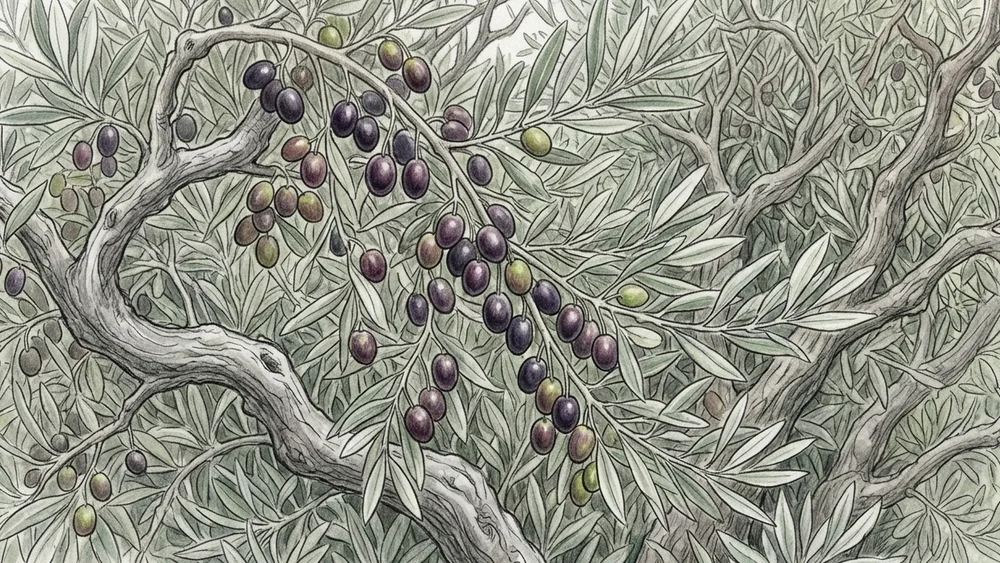
The harvest began in the fall and went on all winter. Now, in November, the father climbs a ladder and milks the olive tree. In Spanish, picking this way is still called ordeñar, milking: you run a closed hand down the branch so it lets go of the fruit. Below, reed mats are spread under the tree, beside wicker baskets. Hand-picking was the advice; beating the branches with poles saved on labor. Pliny the Elder, a Roman naturalist of the first century, warned that poles damaged the tree and the next year's crop. The careful ones, he says, tapped the branches with a light cane. But the father isn't alone. His daughter wanders among the trees, curious.

Why olives are bitter ▶ 1:53
A girl bites into an olive fresh off the tree, and spits it out right away. Let's imagine she's the daughter of a family of olive growers in Roman Spain, almost two thousand years ago. Anyone would do the same: almost no olive can be eaten raw. It has to be treated first. The main culprit is a bitter compound called oleuropein. Scientists today explain why: the olive tree loads its fruit with this compound to defend itself against insects and anything that would eat it. And green olives are more bitter than black ones. The girl knows none of this. But her family knows what to do: water, salt and patience.
There were exceptions, though. Pliny tells of very rare olives in Africa and in Spain, near Mérida, that only had to be dried to taste sweeter than raisins. The olives in our family's grove aren't like those: they have to be cured. Almost the whole harvest will go to the mill, but a few baskets stay in the kitchen. And there, the mother gets to work, with her daughter beside her.
Slit, soaked and seasoned ▶ 3:00
The daughter takes a sharp cane and slits the green olives, one by one. Columella writes that some people, instead of crushing their olives, slit them with a cane. It was more work, but they stayed whiter than the bruised ones, which turned purplish. The mother, working faster, crushes hers. Cato, two centuries earlier in Italy, listed the steps: crush them, put them in water and change the water often; and once they've soaked long enough, squeeze them and put them in vinegar with oil. Why did it work? Today's explanation is simple: water and salt slowly draw out the bitterness, which is why the olives were cut open. But removing the bitterness was only half the job. Next, they needed flavor.
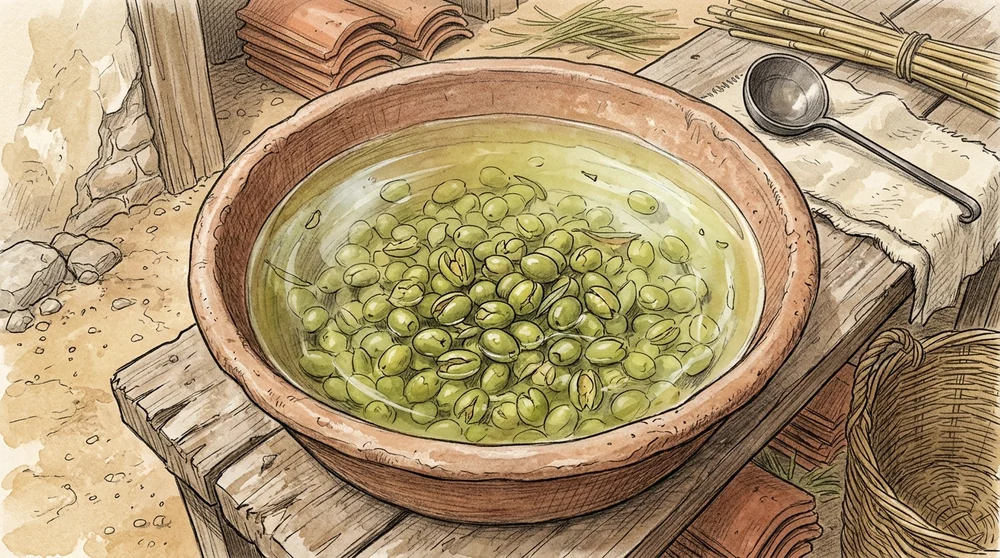
For that, in the Roman countryside, olives were crushed and seasoned with fennel and mastic, or lentisk, a Mediterranean shrub. Cato and Columella both say so. For preserving, one favorite was the pausia, a table-olive variety. We don't know which olive of today it matches. Columella packs it with fennel, mastic, a little salt and fresh grape must, pressed down under a bunch of green fennel. And he says it can be eaten from the third day on. Other olives, he writes, first went into cold brine, so they'd keep their color, and were then kept in must and brine all year. The brine, though, had to be strong. How could you tell it was ready?
The cheese test ▶ 4:27
A piece of fresh cheese told you when the brine was ready. Columella, a Roman farming writer born in Cádiz, explains how. Strong brine was made in a big jar out in the sun, with rainwater and a basket of salt, topped up again and again, until the salt wouldn't dissolve anymore. Then came the test: the piece of cheese, dropped into the jar. If it sinks, the brine isn't done yet. If it floats, the brine is ready. Let's picture the scene in a house by the Guadalquivir, in the first century: a girl lets her piece of cheese drop into the jar. And the cheese floats.

Pliny and the olive's bitter blood ▶ 5:20
For Pliny, the olive had blood, and that blood was bitter. The Roman naturalist, who died in AD 79 in the eruption of Vesuvius, wrote that an olive is made of a pit, oil, flesh and amurca, and that amurca is its bitter, tainted blood. Amurca is the dark, bitter liquid that olives give off when they're piled up or pressed. And Roman farming writers warned that olives left in a heap grew warm, leaked amurca and spoiled the oil. So olives went straight from the tree to the mill. Science now looks for the bitterness elsewhere, in a compound in the fruit. Pliny, with what he had, called it blood.
At the oil mill ▶ 6:07
In the grove, the father loads the baskets and sacks. The rest of the harvest goes to the mill. Some people believed the oil grew if the olives sat in a heap. Cato and Columella called that a mistake. Our family has no press of its own. Archaeologists think many small farmers took their olives to the mill of a large estate, and paid to use it. We don't know whether our family paid in oil or in money. So the father sets off toward the estate, his baskets full.
At the mill, the stone comes first: two millstones turning in a round basin, cracking the olives. Columella asks for them to be crushed without breaking the pit, because the pit spoils the taste, and for salt to be added during milling. Then a press squeezes out the oil. The paste went into flat baskets woven from esparto grass, and the baskets were stacked under a huge wooden beam, lowered with a winch to squeeze them ever tighter. In Roman oil mills excavated in Andalusia, that beam worked with a great stone weight. In Spain today, a place like this is called an almazara, but that word came centuries later, from Arabic. For our family, it's the oil mill. And under the beam, at last, the oil begins to flow.
The first oil, which runs under light pressure, is the best, says Columella. It's scooped out with iron ladles and poured from basin to basin to clean it. The most skilled oil makers, he says, would barely allow a single lamp. Pliny, on the other hand, said heat helped. But November oil didn't pay off. According to Columella, oil from the first olives of the season comes out harsh and sharp, and there's little of it. Green oil, he says, is made around December, and it was worth almost twice as much. Harsh or green, once it's made, oil has to be stored well.
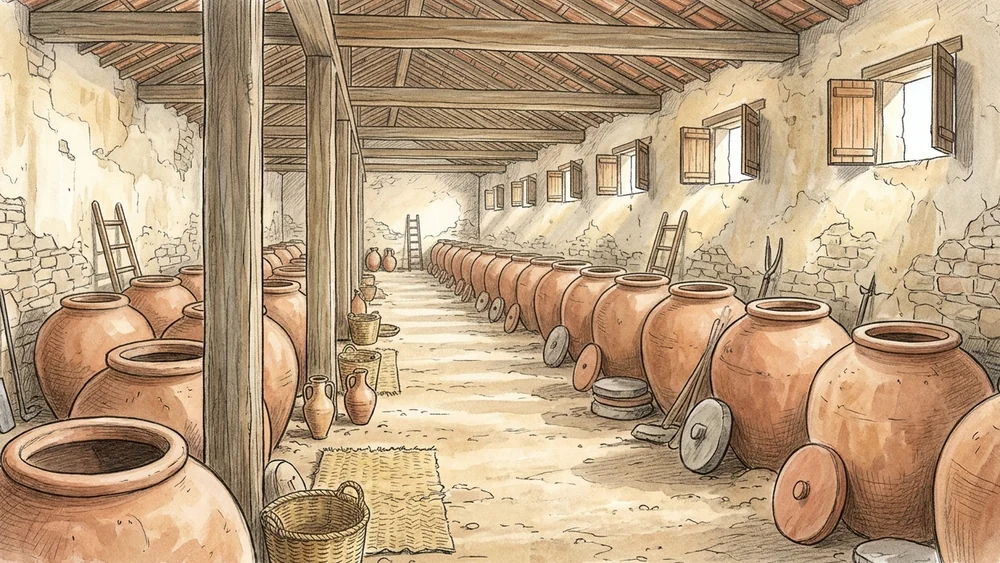
Oil was kept in big clay jars. On an estate, Columella gives that job to the vilica, the woman who runs the farmhouse: once the merchant has emptied the jars, she cleans them right away. And before the new oil, he says, the jars were smoked inside with white wax, so they wouldn't pick up a bad smell. Our family has no estate and no vilica, but the problem is the same: oil spoils if it isn't stored well. And oil that was sold set off on a very long journey.
Downriver to Rome ▶ 8:40
The oil traveled in round, pot-bellied amphorae with two handles, made on the riverbank. According to the amphora catalogs, each one held about sixty liters, close to sixteen gallons. Archaeologists know of nearly a hundred workshops along the river that made them, and on a few stamps from the area, the name Axati seems to appear. And that oil had a good name. A few decades earlier, under Augustus and Tiberius, the Greek geographer Strabo wrote that this region exported olive oil «not only in large quantities, but also of best quality». Pliny ranks it among the best, after Italy's. Once filled, the amphorae went downriver, and by sea they reached the army camps on the Rhine, on the northern frontier, and Rome itself.
There's a hill in Rome made of broken amphorae. It's Monte Testaccio: a kilometer around, about two-thirds of a mile, and millions of pieces. The vast majority come from amphorae that carried oil from southern Spain, from the Guadalquivir. On the shoulder of many, someone painted how much the jar weighed empty and how much its oil weighed, who was shipping it and in what year, and the handle bore the workshop's stamp. Let's imagine one of them, full of oil from farmers on the riverbank, heading downriver to the sea, around AD 60. The hill was only starting to grow then; most of it piled up over the next two centuries. And it's still there, in Rome.

Black olives in salt and grape syrup ▶ 10:10
As winter comes on, the olives left on the tree slowly turn black, and a little less bitter. Black olives were cured differently. Pliny describes many ways of curing olives; some, he says, floated in their own oil. For black ones, Cato and Columella use dry salt: Cato speaks of five days, Columella of more than a month. Columella puts them in wicker baskets, covered in salt, so they sweat out their bitter juice. In our house, the baskets wait in a corner, dripping a dark liquid, week after week. And once the olives are finally cured, they must be stored in something that sweetens them.
Someone painted on a few Roman amphorae: «black olives in grape syrup, pantry stock, excellent». They were amphorae from the Guadalquivir valley, from the first century, and that's how the label reads, translated from Latin. Oil wasn't the only thing going down the river: olives went too. The syrup was defrutum, grape juice boiled down until thick. Black olives, after weeks in salt, were kept in it: Columella, the farming writer, says so. Pliny, the naturalist, found it amazing that olives would drink a sweet juice and take on a flavor not their own. Whoever filled those amphorae was less amazed. One word was enough: excellent.
On every table, rich or poor ▶ 11:33
And what about meals? Olives turned up on every table, rich or poor. Horace, a Roman poet, said olives, chicory and mallows were what kept him fed. And Martial, another poet, said the olive opened and closed a meal. Let's picture our family's table at dusk: bread, a bowl of olives, and moretum, fresh cheese pounded with herbs, with a little vinegar and oil on top, as Columella describes it. The olives the mother and daughter slit and crushed are ready now. And this time, the daughter doesn't spit out a single one.
But not every olive ended up the same way. Kept in strong brine, Columella admits, an olive is not very pleasant to eat on its own. For the most lavish tables, he says, olives were taken out of the brine, crushed and dressed with leeks and herbs, vinegar and pepper, honey and green oil. Pepper and honey were not for homes like our family's. At the other extreme, Cato, two centuries earlier in Italy, gave the estate's workers the olives that fell to the ground, to eat with their bread. And when those ran out, they got fish sauce and vinegar. The same bitter fruit made it to both kinds of table. What changed was how much work someone had put into it.
That work took a lot of time, and a lot of people. Enslaved people worked the olive groves, but so did free farmers and day laborers: for the harvest and the pressing, crews were hired. Let's imagine the father, on other days, working in one of those crews for a day's wage, in his hooded wool cloak and wooden clogs: the work clothes Cato and Columella call for. Columella writes that, in the cold, the olive harvest needs the vilica's care; and that on days of rain or frost, the woman who can't work outdoors spins and weaves wool. In our family, the mother and the daughter do the preserving: slitting, changing the water, testing the brine, watching the baskets. You won't see any of it on an amphora. But without that work, there would be no olives on the table.
What remains today ▶ 13:48
Today, Axati is called Lora del Río. Spanish still keeps the olive grove's old words: ordeñar, milking the tree, and alpechín, the olive's bitter juice. Fresh off the tree, an olive is just as bitter as ever. And every November 26th is World Olive Tree Day: UNESCO proclaimed it in 2019. The family by the river turned a fruit that defends itself into something you can eat, with water, salt, herbs and patience. Now the question is for you. In your family, were olives store-bought, or did someone cure them?
Words from this home
- BaeticaSay it: BEE-ti-kuh
- The Roman province in the south of Spain, roughly today’s Andalusia.
- oleuropeinSay it: oh-lee-yoo-ROH-pee-in
- The compound that makes a raw olive bitter.
- alpechinSay it: al-peh-CHEEN (alpechín, B22); uh-MUR-kuh (amurca)
- The dark, bitter liquid that piled or pressed olives give off.
- arropeSay it: deh-FROO-tum (defrutum)
- Grape must boiled down to a syrup.
- masticSay it: LEN-tisk / MAS-tik
- A Mediterranean shrub whose leaves and seeds flavored olives.
- trapetumSay it: truh-PEE-tum
- The Roman olive mill: two stone rollers turning in a basin.
- beam pressSay it: PREE-lum; tor-kyoo-LAIR-ee-um
- A long wooden beam lowered with a winch and a stone counterweight.
- Dressel 20Say it: DRESS-ul TWEN-tee
- The globular amphora in which Baetican oil traveled.
- TestaccioSay it: tess-TAH-choh
- The hill in Rome built from broken amphorae, many of them Baetican oil jars.
- to beatSay it: —
- To knock the fruit down by beating the branches with a pole.
Sources
- Columella, De re rustica (Latin text)
- Columella, Los doce libros de agricultura, 1824 Spanish translation, vol. II
- Cato, De agri cultura (Latin text)
- Pliny the Elder, Natural History (Latin text)
- Strabo, Geography III.2, tr. H. L. Jones (1923)
- R. L. Johnson and A. E. Mitchell, bitterness in table olives, Journal of Food Quality (2018)
- E. Susamci, C. Romero, O. Tuncay and M. Brenes (Instituto de la Grasa, CSIC), Grasas y Aceites (2017)
- J. Remesal, the Spanish excavations at Monte Testaccio (1994)
- P. Tyers, Roman Amphoras in Britain (1996): Dressel 20 and Haltern 70
- RACAMed (University of Barcelona): Baetican Haltern 70 amphorae
- J. R. Carrillo Díaz-Pinés, olive oil production in Baetica, AnMurcia (2011-2012)
- UNESCO, Proclamation of World Olive Tree Day (40 C/66, 2019)
- Real Academia Española, Diccionario de la lengua española
- S. H. Omar, “Oleuropein in Olive and its Pharmacological Effects,” Scientia Pharmaceutica (2010)
- Turismo Roma, Monte dei Cocci (Monte Testaccio)
- R. López Gutiérrez and J. Moros Díaz, a stamp from Mesa de Lora (Lora del Río), Ex Officina Hispana 16 (2025)
- Martial, Epigrams XIII.36 (Latin text)
- Horace, Odes I.31 (Latin text)
- K. Koudounas et al., Journal of Experimental Botany (2015), abstract
- J. Remesal Rodríguez and J. Moros Díaz, Journal of Roman Archaeology 32 (2019)
- International Olive Council, news item of November 28, 2019