
Cévennes, France · 1850
Living Off Chestnuts: A Year in Southern France, 1850
November 4, 2026 · 13 min · Audio in Spanish, English
More from France →More from the 19th century →
Pressing play loads YouTube (Google). Privacy
The Cévennes, mountains in southern France, fall of 1850. How did people live off chestnuts for a whole year? The region had plenty of chestnuts and very little grain, and the chestnut stood in for wheat. We follow an imagined family on a mas, a farmstead above Alès, through a year set by a tree: the October gathering; more than ten days of fire in the clède, the chestnut-drying house; a sack beaten against a block to shell the dried chestnuts; and bajana, the winter soup of dried chestnuts.
The story, to read
The whole episode, chapter by chapter. Tap the minute to watch from there.
The Cévennes: plenty of chestnuts, very little grain ▶ 0:00
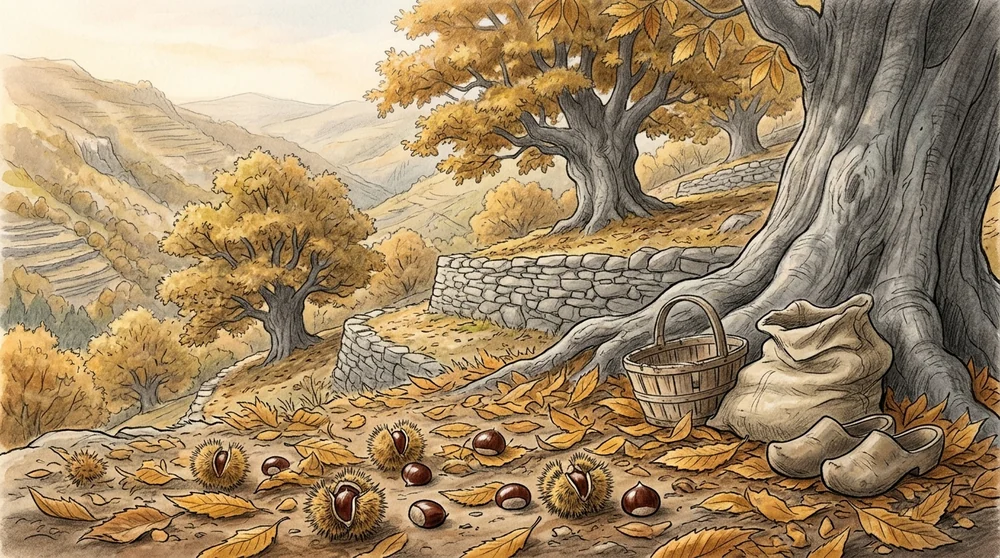
The Cévennes, southern France, fall of 1850. How did people live off chestnuts for a whole year? The grove floor is covered with them, and a woman and a girl are gathering them. Let's imagine they're the mother and daughter of our family. Off to one side, smoke seeps through the roof of a small stone house. Inside, these chestnuts will spend more than ten days over a fire.
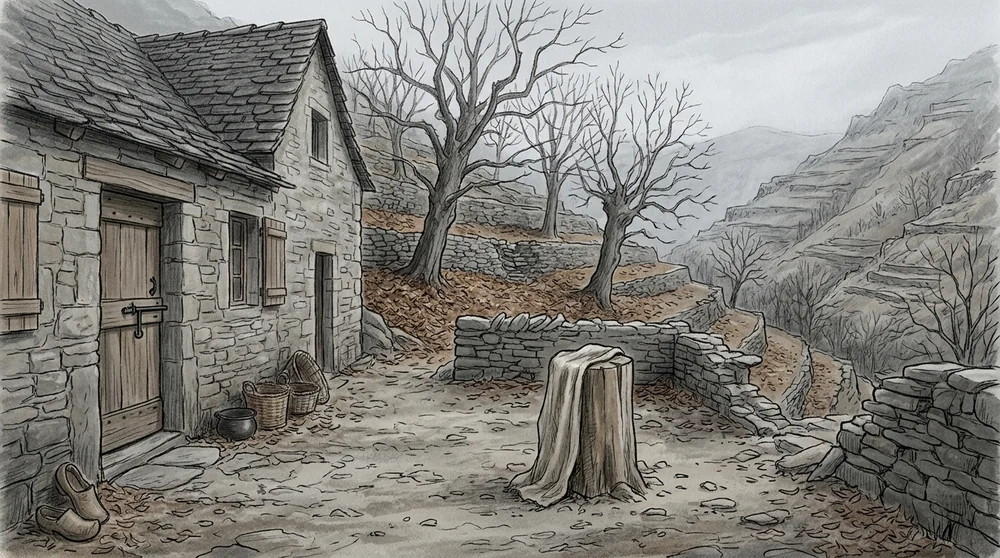
The Cévennes are mountains on the southern edge of France's Massif Central, between the Lozère and the Gard. Our family's mas, the farmstead, sits high up a valley above Alès, a town at the foot of the mountains. Here, almost everything is on a slope. The hillsides are terraced and held up by dry-stone walls, and the chestnut trees grow on those terraces. The Scottish writer Robert Louis Stevenson, who crossed these mountains on foot in 1878, wrote that some chestnut trees were planted "each on its own terrace no larger than a bed." The books of the time put it plainly: the Cévennes had plenty of chestnuts and very little grain, and the chestnut stood in for wheat. A man from Alès wrote in 1812 that in the high Cévennes, the chestnut was almost the only crop. And peasant meals were made up largely of chestnuts. Largely, not entirely: an 1802 statistical survey of the Lozère, the department to the north, also listed rye bread, cheese, milk and bacon. But this household's year is set by a tree, and that year begins in October.
October, the gathering season ▶ 1:40
In the Gard, the department Alès belongs to, the 1842 statistical survey dates the harvest from October 10 to 30. And the season had its own name: the castagnados, the gathering season. Dictionaries of the language spoken around Alès, the Occitan of these mountains, explain that chestnuts weren't picked off the tree: they were gathered from the ground. The season even worked as a date: people would say at castagnados, meaning around October. One of those dictionaries also says who did the gathering: only women, and above all girls. According to the dictionary, the work was too painstaking for men. On our mas, the mother and daughter work through the grove terrace by terrace, each with her bertoul, a small basket with a handle. They bend, gather, straighten up and bend again. The mother is faster: she's spent many harvests bent over. By mid-afternoon, the daughter's back is complaining more than her mother's.
The clède: more than ten days of fire ▶ 2:41
The full baskets go to the clède, the chestnut-drying house, and the father carries them. A man was in charge of the clède and its fire. According to an 1820 dictionary from Alès, he took what the women gathered to the drying house. The clède was a small building set away from the house for fear of fire. It was for drying, not for heating the home. Inside, a floor of beams split it in two. A local dictionary from the late 1800s puts that floor about two meters, or six and a half feet, off the ground. On top, a lattice of rods or slats, and on that, a thick layer of chestnuts: up to three-quarters of a meter, about two and a half feet, says the same dictionary. Underneath, the fire was no ordinary one: thick chestnut logs and stumps, covered with last year's shells so they burned slowly, with little flame and lots of smoke. There was no chimney: the smoke rose through the chestnuts and out the roof. The father crouches by the fire and covers it with another layer of shells. That's how he wants it: like a fire that's nodding off but never quite falls asleep.
At first, the chestnuts were made to sweat: that's how the books of the time put it, with that very word. As more of the harvest came in, more fires were lit, according to the Gard survey. And those weeks had their evenings, too. The dictionary from the late 1800s says the evening gatherings of the castagnados were often held in the drying house, and that the girls did their spinning there. The daughter of our family sits with the others, wool between her fingers and her eyes a little sore from the smoke. The girls talk quietly, and one of them laughs louder than she should. The father stays by the fire, never taking his eyes off it.
A man watches over a fire that has to give off little flame and lots of smoke. He's in charge of the clède, the little house where chestnuts were dried in the smoke, in the Cévennes, mountains in southern France. The fire must stay steady and slow for more than ten days. A local dictionary says people took turns keeping watch, even at night. A 1780 treatise describes the rest of the job. After nine or ten days, the chestnuts were turned over with a shovel. And every day, the drying-house man swept the soot from under the beams, so it wouldn't catch fire. The harvest sat right above that soot. In these mountains, people still remember how long that smoke could last: two or three weeks.
For eating, selling and trading ▶ 5:30
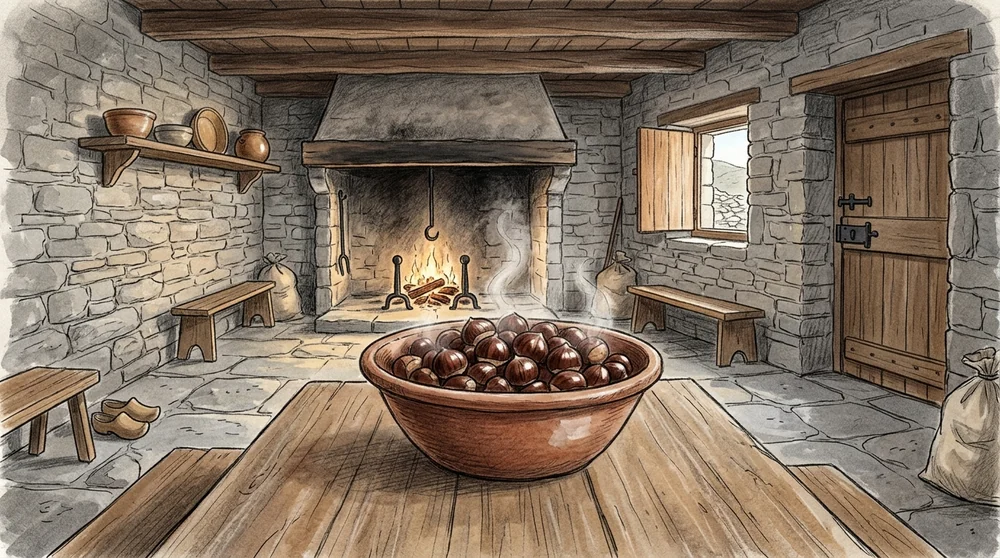
How do you eat a chestnut boiled in its shell? You bite into it, then suck it out. In the Cévennes, in France, chestnuts boiled this way were called tétos. A dictionary of Occitan printed in Alès in 1884 explains the name: people sucked them the way a baby nurses. This was the fresh chestnut of the fall, just gathered. Roasted, they became afachados: chestnuts roasted in a pan full of holes. And according to an official report from 1842, others were peeled while still fresh and boiled with salt. Even so, the same report says that in the mountains of the Gard, a department in southern France, people ate more dried chestnuts than fresh ones.
At our family's table, the grandfather blows on his chestnut before biting into it, and the daughter is already on her third. But chestnuts weren't only for eating: they were also sold, fresh or dried, and dried ones cost more, the Gard survey says. People took their surplus down to the south of the department and came back with wine, and sometimes grain. To the north, in the Lozère, the 1802 survey records wine and chestnuts being traded in the town of Villefort. So the chestnut tree was food, and also something to trade. And there were plenty of trees: the 1842 Gard survey counts almost sixteen thousand hectares of chestnut groves in the department. The part of the harvest meant for winter is still waiting in the drying house. When the time comes, the father will climb up to turn it with the shovel and come down coughing and smelling of smoke.
Shelling the dried chestnuts ▶ 7:09
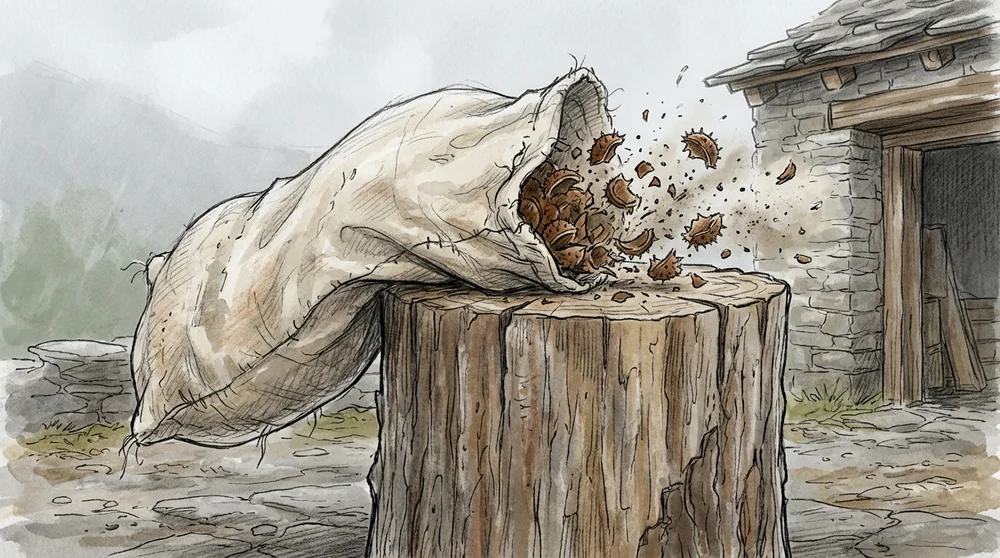
Two men lift a wet sack and beat it against a wooden block. That's how dried chestnuts were shelled in the French Cévennes in the nineteenth century. The job had a season: in Alès, people said shelling time came around late November. The dried chestnuts went into a strong cloth sack, open at both ends. The sack was soaked so it would hold up, and the two men beat it against the block. Then the chestnuts were winnowed to get rid of the shells. A French book about chestnuts, from 1780, describes another method: sticks, a sturdy bench, fifty or sixty blows. And in some places, instead of the sack, people used clogs studded with spikes and trod on the chestnuts. The result of all that pounding was the white chestnut, dry and shelled.
Bajana, the winter soup ▶ 7:59
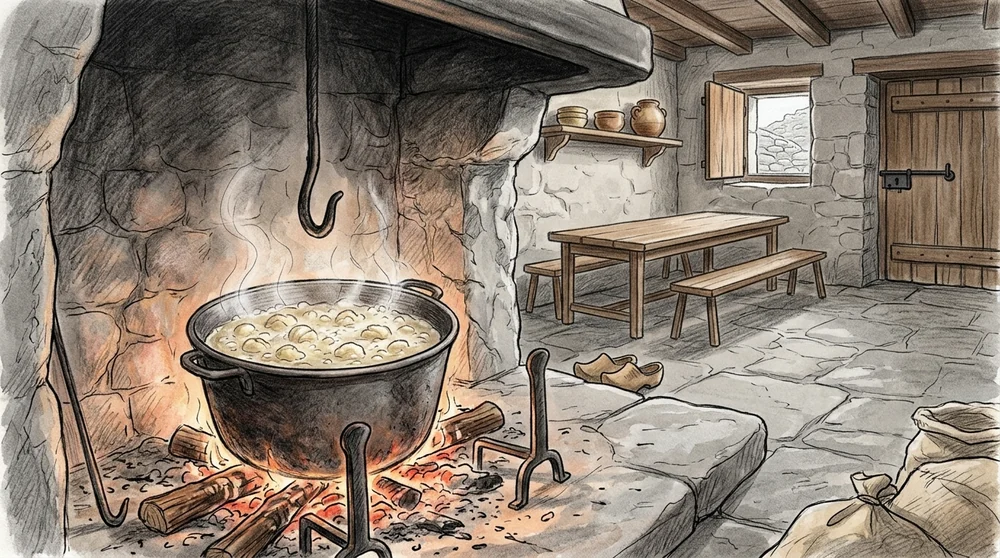
On our mas, the father and the grandfather have beaten the sack, and the grandfather can feel it in his arms. Boiled, those white chestnuts made bajana, the soup of dried chestnuts. One of those Alès dictionaries calls it the staple food all winter long. The same dictionary adds that the soup was exquisite with a little milk. The mother tips the white chestnuts into the pot with water, and the whole house smells of chestnuts. Tonight there's a little milk, and the daughter shares it out carefully, so there's some for every bowl. How much did each person eat in a day? We don't know. None of the sources we've read gives a ration.
The pig, the leaves and the shells ▶ 8:40
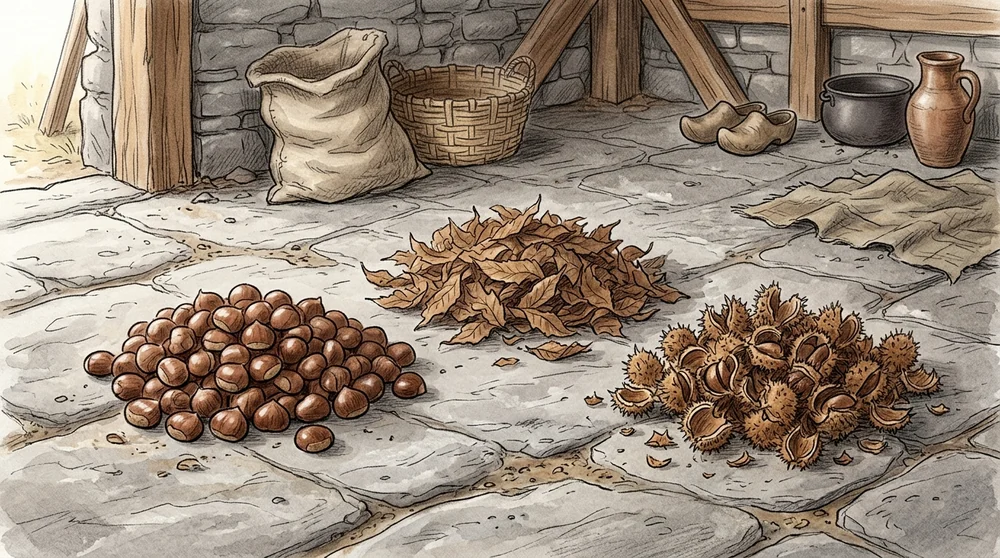
The family pig ate chestnuts too. The man from Alès who wrote in 1812 said pigs were fattened on acorns, chestnuts and potatoes. His nephew, in one of the dictionaries, describes fattening them on a thick mash made with flour from white chestnuts. A fat pig meant money, and our family's pig will end up at the Alès fair. And the chestnut tree gave more than its fruit. In the fall, people gathered its leaves as well, and Stevenson wrote that "the peasants use them in winter by way of fodder for their animals." Weeks earlier, the daughter had come back from the grove loaded with leaves. People used the tree's fruit, its leaves and even the shells, which next year would cover the drying-house fire once more.
The grandfather, the pruning and a proverb ▶ 9:24
The grandfather knows trees better than anyone. He looks at the bare winter chestnut trees, runs his hand over the bark of the oldest one and is already thinking about spring. That man from Alès, the one who kept a diary, noted that chestnut trees were pruned in March and young ones grafted in spring. The grandfather will do both, as he does every year. There's a reason for all that patience, and it lives on in a proverb that same man recorded. The proverb says you enjoy the mulberry you plant yourself, the chestnut your father planted and the olive your grandparents planted. The mulberry was the silk tree: in the Cévennes, people also raised silkworms. This winter's chestnuts come from trees that earlier generations planted, and those who come after will enjoy the ones the grandfather grafts this spring.
The price of living off a tree ▶ 10:16
Living off a tree had its price. There was the fire, so feared that the clède was built away from the house. There were the days and nights of smoke and watching in the drying house, and backs bent double in the grove. There was the sack, beaten again and again. And there was the biggest risk: depending almost entirely on one harvest. According to that Lozère survey, most day laborers from these mountains spent half the year away, working. Perhaps this year the father, too, will head down for work when winter ends. And sometimes, the harvest really did fail.
A hurricane knocked down the chestnuts left on the trees, still inside their spiny burrs. It struck on October 21 and 22, 1812. A man from Alès, a French town at the foot of the Cévennes, recorded it in his diary. He kept track of the weather and the harvests. That summer, the drought had already ruined most of the burrs. Then came the hurricane, and two days later the rains washed away the ones that had fallen on the slopes. He wrote that in the high Cévennes, there was absolutely nothing. In other years, the pigs for the Alès fair were so fat they couldn't walk there, or even stand, so people from the Cévennes brought them in small carts. This time, he saw none. And what did people eat that winter? His pages don't say.
What remains today ▶ 11:41
Our family's year isn't 1812. This time, the chestnut trees have done their part, and on the mas there are white chestnuts for the winter. Decades later, ink disease would reach the Cévennes and kill many chestnut trees. But the tree hasn't been forgotten. In 1889, a forestry survey of the Gard, now in the department's archives, already presented it as the golden tree of the Cévennes. And today, in the Cévennes, people call the chestnut the bread tree. The books of the time that we've read don't use that name: they said its fruit stood in for wheat. The nickname is modern and puts the same idea in fewer words. Since 2023, Cévennes chestnuts have had their own protected designation of origin in Europe. In the fall, several villages in the Gard Cévennes hold chestnut festivals, and chestnuts are roasted in the village squares. Afachados haven't gone anywhere: some festivals are built around them, and in one village the chestnut festival is named after them. And the memory of the clèdes is still alive in the area: people remember layers of chestnuts forty or fifty centimeters deep, sixteen to twenty inches, and smoke drifting out through the roofs. What about where you live? Was there a tree or a plant that took the place of wheat, one your family still remembers?
Words from this home
- clèdeSay it: KLED
- The chestnut-drying house: a small stone building apart from the farmhouse, with a slatted floor halfway up and a slow fire underneath.
- bajanaSay it: bah-jah-NAH (the soup); the chestnut: bah-JAH-noh
- The soup of dried, peeled chestnuts boiled in water; the dried white chestnut itself was also called this.
- masSay it: MAHSS
- A farmstead: the farmhouse with its outbuildings and land.
- pisadoSay it: pee-ZAH-doh
- Shelling the dried chestnuts by beating them in a sack; also the season for it.
- afachadosSay it: ah-fah-CHAH-dohs
- Chestnuts roasted in a pan with a perforated bottom.
- bancelSay it: bahn-SELL
- A terrace: a strip of farmland held up by a dry-stone wall.
- lauzeSay it: LOHZ
- A flat stone slab used to roof houses in the high Cévennes.
- cadisSay it: kah-DEE
- Coarse woollen cloth, grey or brown, undyed.
Sources
- Hector Rivoire, Statistique du département du Gard (Nîmes, 1842)
- Pierre-Augustin Boissier de Sauvages, Dictionnaire languedocien-françois (Nîmes, 1785)
- Antoine-Augustin Parmentier, Traité de la châtaigne (Bastia and Paris, 1780)
- Louis-Augustin d'Hombres-Firmas, Recueil de mémoires et d'observations…, vol. II (Nîmes, 1838)
- Maximin d'Hombres and Gratien Charvet, Dictionnaire languedocien-français (Alais, 1884)
- Gabriel-Joseph Jerphanion, Statistique du département de la Lozère (Paris, 1801–1802)
- Robert Louis Stevenson, Travels with a Donkey in the Cevennes (London, 1879)
- Archives départementales du Gard, "La culture des châtaigniers en Cévennes"
- French Ministry of Agriculture, specification of the "Châtaigne des Cévennes" designation of origin (BO-Agri, 2023)
- Wiktionnaire, Occitan entries castanha, cleda, bajanat and others
- Robert Dechery, Contribution à l'étude du châtaignier et des châtaignes en France (thesis, 1941)
- Patrimoine de Rousses, "Les clèdes"
- Boissier de Sauvages, Dictionnaire languedocien-français, revised by d'Hombres-Firmas (Alais, 1820)
- Commission Implementing Regulation (EU) 2023/107, "Châtaigne des Cévennes" (2023)
- INAO, "Châtaigne des Cévennes" product page
- Arrêté du 21 septembre 2020, "Châtaigne des Cévennes" (JORF, 2020)
- European Commission, single document "Châtaigne des Cévennes" (Official Journal of the EU, 2022)
- Mairie de Lasalle, "Fête de la châtaigne 2026"
- Alexandre Maniez, Midi Libre, on the Lasalle chestnut festival (October 31, 2026)
- Gard Tourisme, "Fête de la Châtaigne – Lasalle" (2026)
- Mairie de Sainte-Cécile-d'Andorge, "Affachade et Olympiades intergénérationnelles" (2026)
- Midi Libre, "La châtaigne à la fête durant trois jours" (October 8, 2026)