
Skagafjörður, Iceland · 1879
Surviving an Icelandic Winter in a Turf House, 1879
November 1, 2026 · 14 min · Audio in Spanish, English
Pressing play loads YouTube (Google). Privacy
It's the winter of 1879 in northern Iceland. Big farms housed ten to twenty people, and the room where they all worked, ate and slept had no fire; the only fire in the house burned in the kitchen. So how did a family get through winter in a turf house, with earth walls and a grass roof? We follow an imagined farming family in the valley of Skagafjörður: a father, a mother, their daughter and the grandfather, along with Ember, their dog. Their day runs from the moment the mother uncovers the fire banked overnight in the kitchen to the evening gathering by the light of a small fish-oil lamp. Their story is built on what Iceland's museums have published and on what travelers saw on the island's farms.
The story, to read
The whole episode, chapter by chapter. Tap the minute to watch from there.
Northern Iceland, winter of 1879 ▶ 0:00
It's the winter of 1879 in northern Iceland. Big farms housed ten to twenty people. And the room where they all worked, ate and slept had no fire. So how did a family get through winter in a house made of grass? Let's imagine a farming family in the valley of Skagafjörður: a father, a mother, their daughter and the grandfather. And Ember, the dog. Their house is built of turf; only the kitchen has a fire.
Iceland lost its forests early, to grazing and to building. From then on, people burned turf for fuel. Timber had to be bought from abroad, or gathered on the beach as driftwood. That winter, about seventy-two thousand people lived on the whole island. Our family lives on a more modest farm in the valley. Nearby is Glaumbær, the parson's farm, a large estate in the area. Its house still stands, and it will show us what our family's home was like. The father tends the livestock and the mother runs the kitchen; the grandfather and the daughter, like everyone else in winter, work with wool.
Earth walls and a grass roof ▶ 1:16
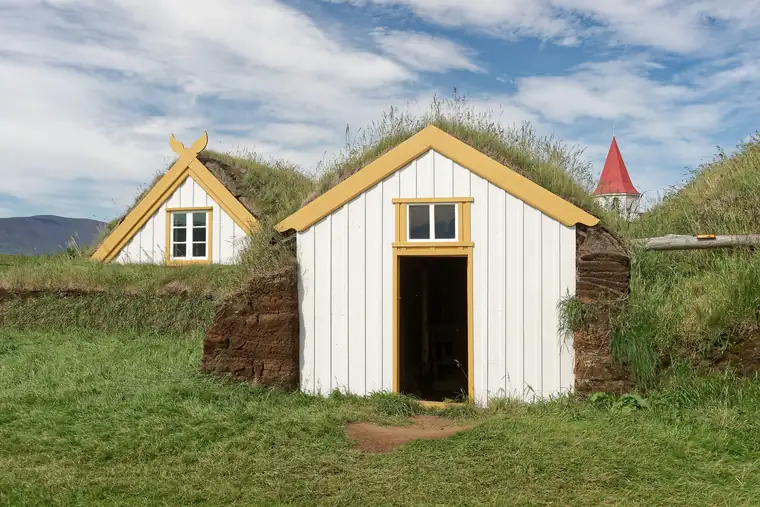
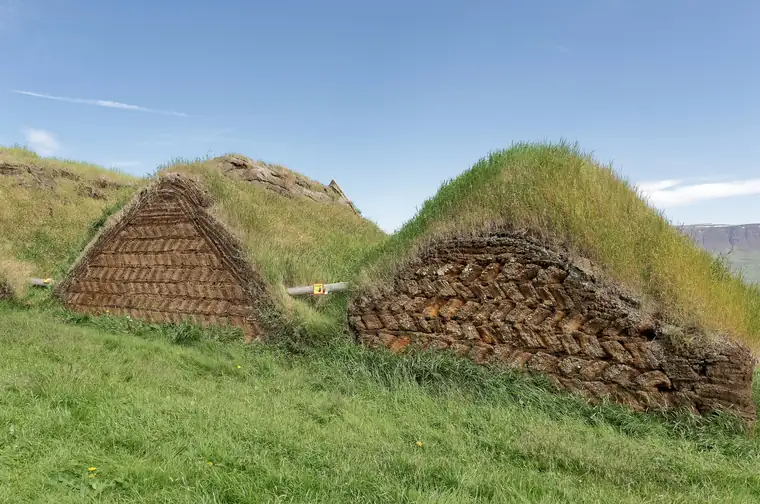
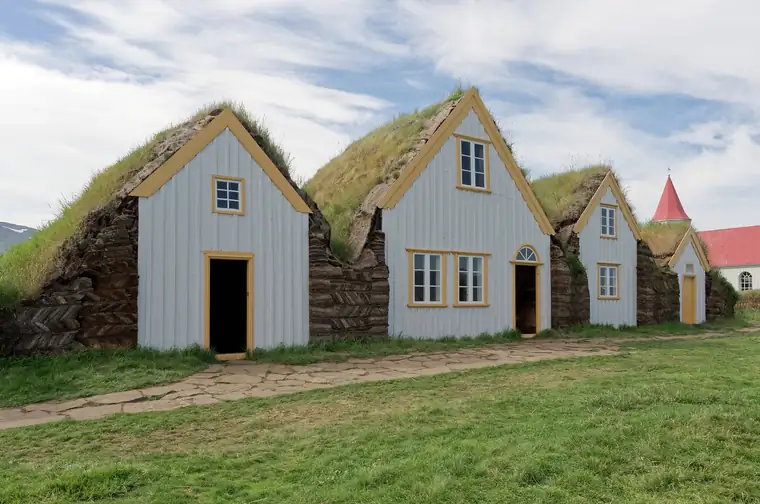
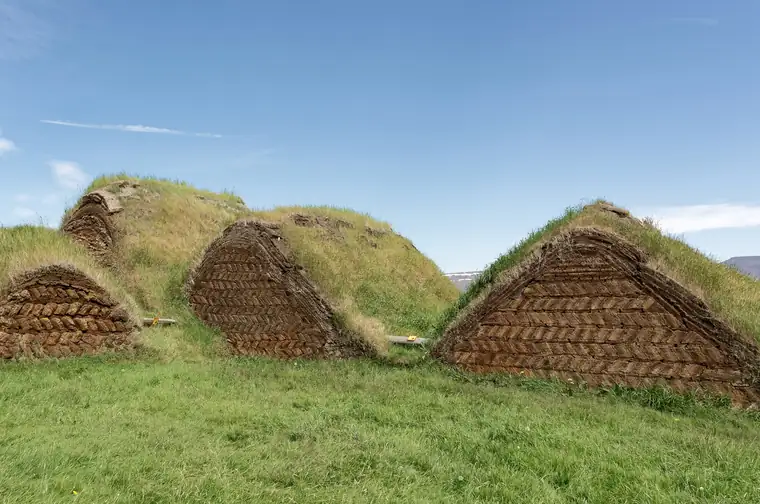
Earth walls and a grass roof: that's what Iceland's country houses looked like in the nineteenth century. They were built of turf: blocks and strips of earth cut with the roots still in. Timber was scarce and expensive; turf was close at hand, and it kept out the cold. At Glaumbær, a farm in the north that's now a museum, the walls are turf blocks laid in a herringbone pattern. The roof was covered with strips of turf, grass and all, overlapping like shingles. From the yard, you saw a row of wooden gables. An English traveler, Baring-Gould, described one farm in 1862. Out front, the gables were painted red or black. From the other three sides, he wrote, the farm looked like «a confused cluster of turf mounds».
Through the door in one of those gables, you step into a long passage that links everything. Glaumbær has thirteen buildings, all connected on the inside. Six face the yard; the rest sit behind them. The passage runs from the front door all the way to the back, to the room where everyone lived. At the farm he visited, Baring-Gould found the passage dark, and «too low for a person to stand upright in it». Why so many small rooms, and not one big house? An ethnologist at the National Museum explains it this way: as the climate grew colder and firewood ran short, small houses needed less heat.
The shared room had no fire ▶ 2:42
An Icelandic family sits reading sagas around a blazing hearth. Some old engravings showed them like this. But Baring-Gould, an English traveler who visited Iceland in 1862, called those pictures «utterly inaccurate». Icelanders, he wrote, «never have the opportunity of sitting round a fire». On turf farms, he adds, the only fire was in the kitchen, «a small cell» with no seats. Everything else happened in the baðstofa, the room where everyone lived: they worked, ate and slept there. And it had no fire, no stove, no heating of any kind: the people themselves kept it warm. The Skagafjörður museum, in northern Iceland, confirms it, and other travelers saw it too. Wool and feathers did the rest.
The kitchen and the pantry ▶ 3:28
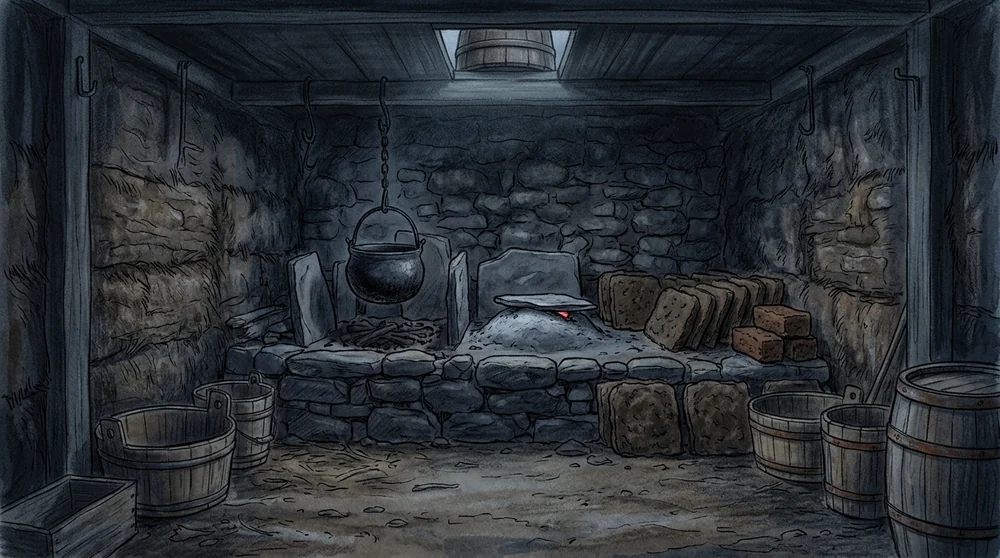
In the morning, the only fire in the house is hidden. Last night, the mother raked the coals together, covered them with dung or a slab of half-damp turf, buried them in ash and laid a light flat stone on top. Banked like this, says the same ethnologist at the National Museum, the fire lasted until morning. Now the mother uncovers it. The kitchen hearth is open and made of stone, with a pot hanging from iron hooks. For the smoke, there's a hole in the roof, which also lets in the light. The walls are black with smoke. What burns on the hearth is dried sheep dung, and dried turf.
Milk is warming in the pot. The mother is making skyr, a thick, sour milk curd that people ate every day. She uses skim milk: she heats it almost to a boil, then lets it cool to body temperature. Now she adds a little skyr from the last batch, and rennet. When it sets, she'll strain it. The whey that drains off isn't thrown away: it's left to ferment, and then used to preserve food and give it flavor. Mixed with water, the sour whey was the everyday drink.
The barrels wait in the pantry. In the fall, they were filled with meat, sheep's heads and blood sausage, all covered in sour whey. This is súrmatur, food pickled in sour whey for the winter. According to the ethnologist, it was an Icelandic way of preserving food, since salt was scarce. Next to the barrels is harðfiskur, air-dried fish. For centuries, and still in the early nineteenth century, the most common country meals were skyr with porridge in the morning and at night, and dried fish with butter in the afternoon. Meat was for holidays. Porridge was often made with Iceland moss, a lichen, instead of grain. And bread, early in the century, was so rare that servants hardly tasted it all year. Later in the century, the ethnologist says, food was starting to change: more salted fish and meat, and more flour. This winter, our family eats skyr and dried fish.
In the barn ▶ 5:51
Meanwhile, the father puts on his shoes to go to the barn, which on many farms in the valley was joined to the house. Shoes were cut from a single piece of sheepskin and tied on with leather straps. For outdoor work, according to the valley's museum, men also wore cowhide shoes. In winter, the livestock was the men's job, writes Ebenezer Henderson, a traveler who lived in Iceland from 1814 to 1815. The cows stayed inside and ate hay from the home field. The sheep went out by day to look for food under the snow; when the snow was too deep, the boys cleared it away. The horses, except perhaps one for riding, spent the winter outdoors. Winter grazing was poor: at Glaumbær, very scarce and unreliable. On farms in the valley, there are accounts of lambs inside the baðstofa: on one, in 1822, there were nine on the floor. Ember goes with the father. According to Richard Burton, another traveler, the dogs guarded the flocks, roamed around the farm and kept the cattle off the home field.
The lamp, the wool and the sagas ▶ 6:56
Between three and four in the afternoon, Henderson writes, the lamp was hung up in the baðstofa. The lamps were lit from fall until spring. By day, light came in through tiny glass panes set in the turf roof. Baring-Gould describes them as three inches square, and says they could never be opened. In many country homes, light still came from lýsi, fish oil. Kerosene had been sold in the ports since around 1870, but it was expensive, as the Skagafjörður museum explains. So the evening light comes from a little fish-oil lamp. And everyone sits on their own bed, facing each other, with their work in their hands.
Two men lie on their backs, put their feet into a barrel with both ends knocked out, and kick. That's how Icelanders fulled cloth, according to Ebenezer Henderson, a traveler who crossed the island in 1814 and 1815. The woven wool goes inside, and the men «literally walk the cloth», he writes, beating it tight. Smaller pieces were fulled another way: held between the knees and chest, while rocking back and forth. Fulling was one more wool job, and on turf farms, wool was everyone's work. In the common room, people carded, spun, knitted, wove and sewed. Women spun with a spindle and distaff, and in some parts of the country, he says, the men also spun and knitted. The result was vaðmál, a homespun woolen cloth that both men and women wore.
Then the kvöldvaka begins, the winter evening gathering. One of the family, «selected on purpose», Henderson writes, takes a seat near the lamp and reads an old saga aloud. On our farm, the one chosen is the grandfather. The daughter spins as she listens, and the father, back from the barn, knits. On other nights, people chanted rímur, sagas retold in rhyme. And in winter, storytellers and reciters came by too, going from farm to farm. Meanwhile, no one's hands are idle: the spinning wheel, the needles, the wool cards.
Meals in bed ▶ 9:08
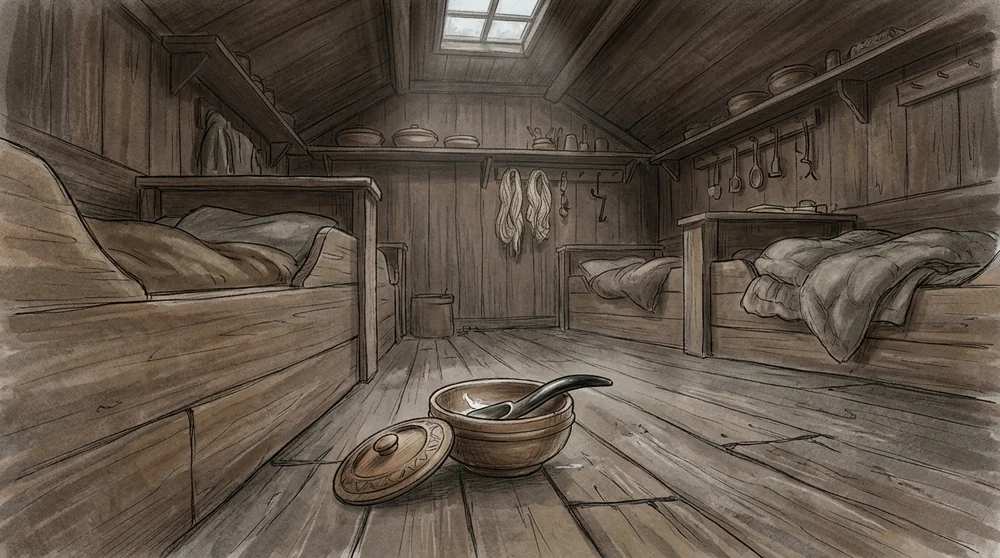
The dog did the dishes, with its tongue. This happened on many Icelandic farms in the nineteenth century. People ate sitting on their beds, with a horn spoon and an askur, a lidded wooden bowl, on their knees. When they finished, it was common to set the bowl down in front of the dog, to lick it clean. Both the Skagafjörður valley museum and Richard Burton, who traveled through Iceland in 1872, describe the custom. But the habit passed a disease on to people. Burton wrote that «the danger would be less if the dogs were not so often allowed to lick the platters clean». Gradually, the custom died out, and in the second half of the century, the wooden bowls gave way to earthenware ones.
The daughter of the house brought a traveler a long board and set it in front of his bed. It was there, he wrote, «to prevent my falling out». The traveler was Ebenezer Henderson, and this was at Hólar, in northern Iceland, early in the nineteenth century. That board had a name: the rúmfjöl, the bed-board. In turf houses, the beds were built in along the walls of the common room. At night, each one had its board in front, often carved with a prayer, so the bedding wouldn't slide onto the floor. By day, the board leaned against the wall. The same board guarded the bed at night, and at mealtimes, laid across the knees, it became the table.
Night, and each other's warmth ▶ 10:36
According to Henderson, the evening ended with psalms, a reading from a devotional book, and a prayer. Then everyone went to bed, often two to a bed, for warmth. Baring-Gould mentions «two or even four in a bed, with the head of one at the feet of the other». Underneath was a feather mattress; on top, a feather comforter or a thick blanket of homespun wool. The master and mistress of the house and their children slept at the far end, so that's where the father, the mother and the daughter are. In 1896, a Danish traveler saw something similar at Glaumbær: everyone on the farm slept in the middle room, including a married couple with their children, in rows of beds along the walls. And Ember? A researcher at the Skagafjörður museum writes that nobody chased off the dogs or cats that curled up on the comforters at night. Every bit of warmth was welcome. So Ember sleeps on top, at the daughter's feet.
How cold was that room at night? We don't know: we haven't found any measurement from the time. There's a modern one, though. At Glaumbær, the common room stands empty, and ventilation keeps it from freezing. Over the year, the museum says, it averages about fifteen degrees Celsius, around fifty-nine Fahrenheit. Some houses in the north had another way to keep warm: the room sat above the cowshed, and the cows slept underneath. In this valley, though, such rooms were rare. So our family keeps warm with what it has: wool and feathers, and each other.
The price of that warmth ▶ 12:07
That warmth came at a price. Smoke from the kitchen crept into every corner of the house. And Baring-Gould found the air in the baðstofa stifling. The lamp gave off smoke too. From the constant smoke, many of these rooms turned black all the way to the ceiling. An Icelandic author who recorded his country's customs wrote that, and the Skagafjörður museum quotes him. Then there was the winter itself, which wasn't the same every year. The next one, from 1880 to 1881, was a winter of extreme frost and snow in northern Iceland. It's remembered as the Hard Winter.
The house that still stands ▶ 12:46
That world was already changing. The same Danish traveler noted that at Glaumbær, the parson's room had a stove by then. Today, that house still stands, much as it was around 1880. Nobody has lived there since 1947: it's protected, and it shows visitors how people lived in turf houses. The house is open from April to October. In the north there's another great turf house, Laufás, which its museum plans to reopen in June 2027. And at your place, when it gets cold, which room does everyone end up in?
Words from this home
- baðstofaSay it: BAHTH-stoh-va; voice spelling: «bath-stova» (ð as in «this»)
- The farmhouse's common room: workroom, dining room and bedroom at once, unheated.
- kvöldvakaSay it: KVURLT-vah-kah; voice spelling: «kvurlt-vaka»
- The winter evening gathering: wool work by lamplight while someone read or chanted aloud.
- skyrSay it: SKEER; voice spelling: «skeer»
- Strained, soured skimmed-milk curd; an everyday food.
- rúmfjölSay it: ROOM-fyurl; voice spelling: «room-fyurl»
- A board, often carved with a prayer, set along the front of the bed at night; at meals it served as a lap table.
- lýsiSay it: LEE-see; voice spelling: «lee-see»
- Fish (or seal) oil, burned for light.
- vaðmálSay it: VAHTH-mowl; voice spelling: «vath-mowl» (ð as in «this»)
- Homespun woolen cloth, thick and fulled; everyday clothes were made of it.
Sources
- Sigríður Sigurðardóttir, Þrif og þvottar í torfbæjum (Skagafjörður Heritage Museum, 2017)
- Sigríður Sigurðardóttir, Glaumbær. Sýning og safn (Skagafjörður Heritage Museum, 2011)
- Hallgerður Gísladóttir, Eldamennska í íslensku torfbæjunum (2nd ed., 2007)
- Sigríður Sigurðardóttir, Building with Turf (2008)
- Sigríður Sigurðardóttir, Glaumbær. Kirkja og staður (2nd ed., 2011)
- Sigríður Sigurðardóttir, Traditional Building Methods (2012)
- Sigríður Sigurðardóttir, Þróun torfbæja. Glaumbær (2nd ed., 2007)
- Skagafjörður Heritage Museum, “Glaumbær” and “Life in Turf Houses in the 19th Century” (museum website)
- National Museum of Iceland, “Glaumbær í Skagafirði” (Húsasafn)
- Guðmundur L. Hafsteinsson, Glaumbær. Byggingarlýsing (National Museum of Iceland, 2008)
- Daniel Bruun, Fortidsminder og Nutidshjem paa Island (Copenhagen, 1897)
- Ebenezer Henderson, Iceland; or the Journal of a Residence in that Island, vol. I (Edinburgh, 1818)
- Sabine Baring-Gould, Iceland: its Scenes and Sagas (London, 1863)
- Richard F. Burton, Ultima Thule; or, a Summer in Iceland, vol. I (London, 1875)
- Statistics Iceland, Sögulegar hagtölur (Hagskinna series): population, 1879 and 1880
- Akureyri Museum, “Laufás heritage site and museum”
- Vesturfarar, “The hard winter of 1880-1881”
- Þór Jakobsson, “Harði veturinn 1880-1881”, Vísindavefurinn (2018)
- J. Scott Keltie (ed.), The Statesman's Year-Book 1883 (London, 1883)
- National Museum of Iceland, Þjóðháttasafn: questionnaire answers on wool and knitting (1966 and 1996), in Sarpur