
Fukagawa, Edo · 1840
Paper Doors in the Dead of Winter: Edo, Japan, 1840
November 2, 2026 · 13 min · Audio in Spanish, English
Pressing play loads YouTube (Google). Privacy
It's the winter of 1840 to 1841 in Edo, today's Tokyo, during Japan's Edo period. In a traditional Japanese house, the sliding doors, called shoji, were covered with paper, and the city's smallest homes were about nine feet wide. So how did people get through winter in a house of wood and paper? We spend the day with an imagined family from an alley in the Fukagawa district: the father, a sawyer; the mother; their four-year-old daughter; and Ember, the alley dog. Their day runs from dawn, when the mother stirs up the coals, to night under the yogi, a quilt with sleeves. Their story is built on the notes of Kitagawa Morisada, an Osaka merchant who came to Edo in 1840, and on the account of Edward Morse, an American who lived in Tokyo around 1880.
The story, to read
The whole episode, chapter by chapter. Tap the minute to watch from there.
Edo, winter of 1840–41 ▶ 0:00
It's the winter of 1840 to 1841 in Edo, today's Tokyo. How did people get through winter in a house of wood and paper? Day is breaking over an alley in the Fukagawa district. Behind a door covered with paper, a mother is stirring up the coals. Let's imagine that mother and her family: the father, a sawyer, and a four-year-old daughter. And Ember, the alley dog. They rent a home with a single room: the smallest ones in Edo were about nine feet wide.
An alley and a single room ▶ 0:40
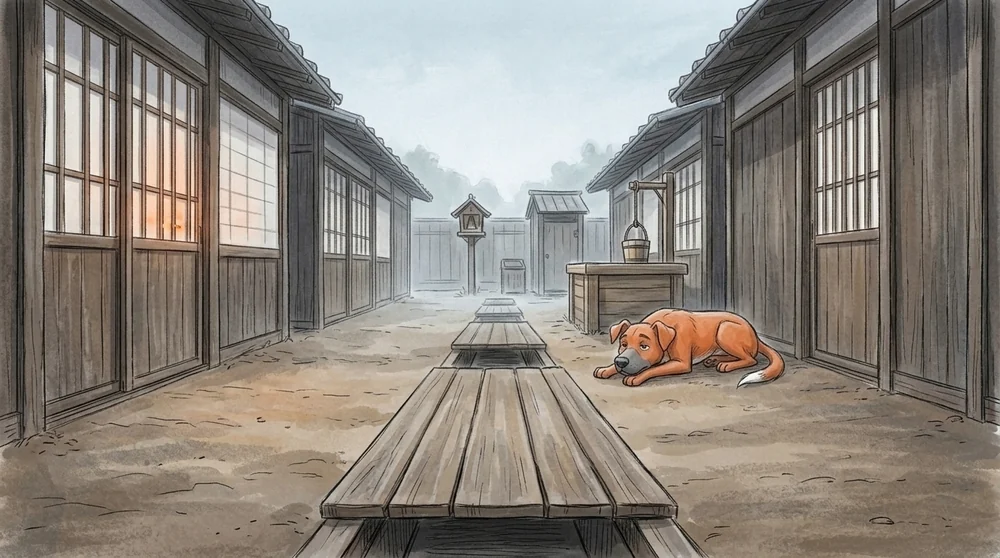
The latrine belonged to all the neighbors. What fell into it didn't: that belonged to the landlord's agent, who sold it to farmers as fertilizer. We know this from Morisada, an Osaka merchant who came to Edo, the city now called Tokyo, in 1840. Edo's narrow back alleys were lined on both sides with nagaya, row houses: rented homes side by side under one roof. The neighbors shared the well, the garbage heap and a small shrine. And according to Morisada, the rent went to the agent on the last day of every month. So he collected twice over: from the tenants for the rent, and from the farmers for the latrine.
Morisada, whose full name was Kitagawa Morisada, was thirty-one then and had already spent three years writing about the customs of his day. In Edo, he lived in retirement in Fukagawa, east of the Sumida River, on land reclaimed from the sea. According to the Fukagawa museum, around 1840 the area by the river mouth was full of warehouses and big wholesalers, who dealt in rice, in timber and in fertilizer made from fish. The Kiba timber yards, where our family's father works, were in the same district. This is Morisada's first winter in the city: he sees it as an outsider, just as we do.
Our family lives in one of the alley's homes: a single room of tatami, the thick straw mats on the floor, with an earthen entryway by the door. Counting that entryway, the smallest ones were about the size of six tatami mats. The three of them eat and sleep right there. And the rent? According to a 1923 book on architecture, around 1840 rents in Edo had gone through the roof, and two years later the government cut them by decree. They shared a wall with the family next door, and the houses were packed so tightly that an eighteenth-century satirical verse made fun of the crowding.
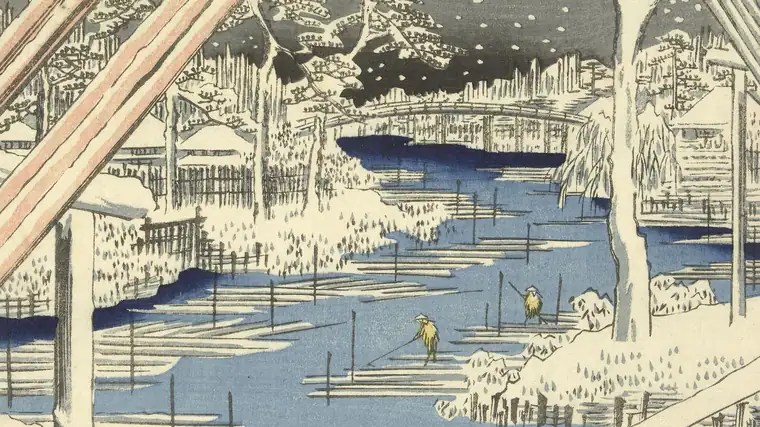
Paper on the doors, not the walls ▶ 2:43
The doors of Edo's houses were covered with paper. Not the walls: the doors. They were shoji, sliding doors made of thin wooden strips, and Morisada, an Osaka merchant, described them around 1840. Around 1880, Edward Morse saw them too: he was an American living in Tokyo, Edo's new name. According to him, the outer shoji were covered with white paper and took the place of windows, letting in the light. The walls, he wrote, were wood or plaster. So what stood between the room and the cold outside was often a sheet of paper. To Morse, a Japanese house in winter was «comfortless to the last degree».
Padded clothes and coals close by ▶ 3:26
How cold was that winter? We don't know: we haven't found any record of temperatures or snowfall from those months. Edo did get heavy snow at times: a city chronicler noted that one day in 1839, about two and a half feet of snow fell. So, first thing in the morning, our family bundles up. Against the cold, more layers on and small coals close at hand: that's what Morisada describes in Edo, and Morse in Tokyo. The father puts on a hanten, a padded jacket. According to Morisada, it was the simplest coat that humble people, men and women alike, wore against the cold wind. Tradesmen, like carpenters, wore a dark blue one every day, with a white emblem. The mother stays in her dotera, a thick cotton robe, bigger than a kimono. It was an Edo garment, Morisada says, to wear around the house when the cold wind blew.
Those small coals burn in the hibachi, a charcoal brazier. People kept warm with braziers like this: Morisada describes the men who sold them, in many sizes and qualities. And Morse, in Tokyo around 1880, wrote that every home had one, «from the most exalted to the very humblest». Our family's is the common kind he describes: a wooden box and, inside, a jar of black unglazed earthenware with ash and a few coals. The mother stirs the coals with tongs, and the father warms his hands before leaving for Kiba. The daughter, still wrapped in the quilt, holds out her fingers.
Water that came by boat ▶ 5:15
At mid-morning, the mother goes out for water. She lifts her daughter onto her back and pulls a short padded quilt over them both: that's how Edo's mothers went about in winter, Morisada says. Children, according to him, had their heads shaved at birth, with a few tufts of hair left on. The daughter watches the alley over her mother's shoulder. The mother wears her hair in a married woman's bun; in Edo, he notes, married and unmarried women wore different buns.
In Fukagawa, on land reclaimed from the sea, there was no good water. Drinking water had to be bought: boats brought it from the city's aqueducts. That lasted until 1899. The mother pays for it at the edge of the canal, careful not to get her daughter wet. Winter peddlers also come down the street. According to Morisada, people sold tadon, balls of charcoal dust and mud that were dried in the sun and burned in place of charcoal. They came large and small. He noted that they cost from one to four mon, Edo's smallest coin. The mother buys a few.
Legs under the kotatsu ▶ 6:21
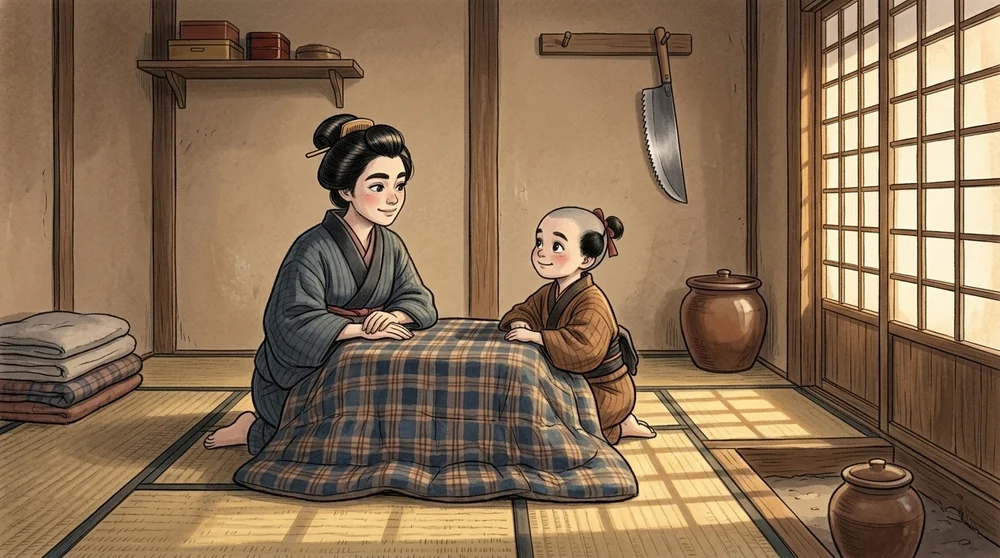
In the afternoon, while the father works at the Kiba timber yards, mother and daughter slip their legs under the kotatsu, a brazier under a quilt. Theirs is portable: a container of coals at the bottom, a square wooden frame above it, and the quilt over the frame. According to a 1901 book on the customs of Tokyo, people of modest means used the portable kind. And around 1840, Morisada noted that in winter, men walked the streets mending or swapping kotatsu frames. Morse describes how the quilt on top warmed through, and by day, you could pull it around you. The afternoon light comes in through the paper of the shoji. The daughter tucks herself in up to her chin, and the mother drops one of the morning's tadon balls onto the coals. When the light on the paper begins to fade, it's time for the bath.
The bathhouse and the gate watchman ▶ 7:14
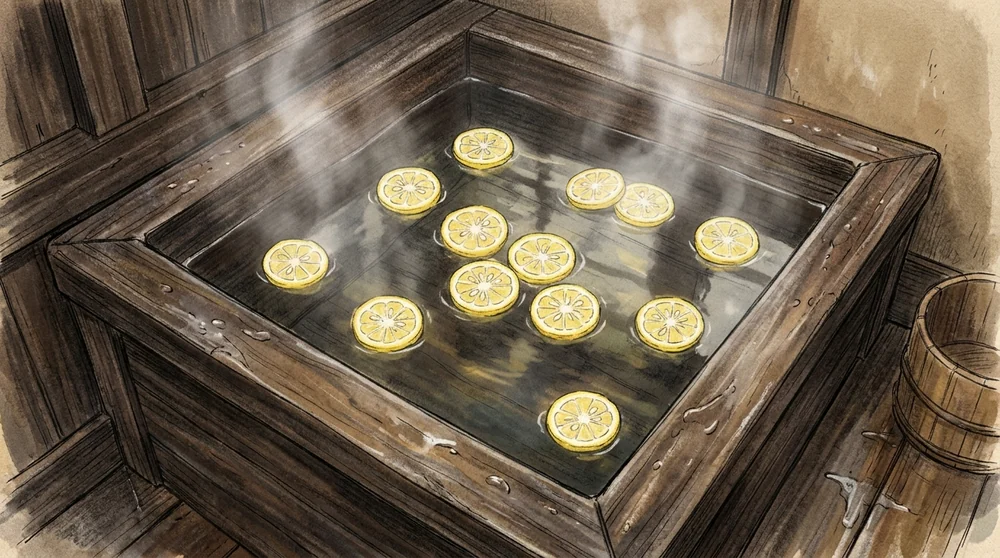
The public bath smelled of yuzu on the shortest day of the year. On the winter solstice, the bathhouses of Edo, now Tokyo, put yuzu citrus in the water, and customers paid for their bath with coins wrapped in paper. Edo had plenty of sento, public baths you paid to use: an early nineteenth-century book counted more than six hundred. On very windy days, bathhouses put out their fires early, for fear of a blaze. How often did a family go in winter? None of the sources we've read tell us. But Morisada, an Osaka merchant who had settled in Edo in 1840, writes that those who went stepped into water that was very hot. To save fuel, the baths burned old wood that the bathhouse hands gathered from garbage heaps and riverbanks.
And what did a bath cost? Morisada noted that before 1830, the price was ten mon, but four-mon coins were so common that most people paid with two: eight. Later, a government order set the price at eight. And unlike in his own Osaka, in Edo the bath didn't cost more in winter. After dark, warm all through, mother and daughter walk home from the bath past the neighborhood gatehouse. The watchman lived there, and sold straw sandals, brooms, sweets and roasted sweet potatoes. Morisada wrote that in Edo, roasted sweet potatoes were the rule, and the shops selling them were beyond counting. The father, back from Kiba, catches up with them there and buys one. The daughter blows on it before taking a bite. At night, the watchman walked the streets, striking wooden clappers to call the hours. According to Morisada, he did this from nightfall until dawn, at each change of the hour: roughly every two hours.
Night, and the dogs of Edo ▶ 9:03
At home, the mother spreads out the mattress and, on top of it, the yogi, a quilt with sleeves. Thickly padded and shaped like a huge kimono, it was what people in Edo slept under in winter. Morse also describes a small wooden box holding a clay pot of coals, that people took to bed. Before turning in, the father takes one last look at the coals. The three of them sleep close together, in the same room where they've eaten and kept warm all day. The daughter falls asleep first, between her parents. The watchman's clappers sound in the distance. Ember sleeps outside, in the alley, beside a little shelter of boards that the children built.
The children of Edo built little shelters for dogs with newborn puppies, against rain and snow, and brought them food. A painter born in 1849 in Edo, as Tokyo was then called, remembered it that way. In the merchant quarters, where space was short, the shelters went in the corner behind the shared latrine or the garbage heap. Dogs were everywhere in Edo, in the merchant quarters as well as the samurai districts and temple grounds; so many that a saying counted their droppings among the things the city was known for. According to the painter, people kept them to stand guard at night. They were reddish, black, spotted or white, and many were named for their color. Aka, for instance, was the red one.
That winter also brought the New Year, which in Edo fell, by our count, around January 23, 1841. On New Year's Day, the same painter remembered, the streets of Edo were empty at dawn and the shops were shut. Only dogs could be seen, lying here and there. Ember, for once, has the whole street to himself. And our family spends the day at home, with their legs under the kotatsu quilt.
The price of warmth: fire ▶ 11:03
All that warmth came at a price: fire. Edo was a city built almost entirely of wood, where people cooked and kept warm with fire. Fires were so common there that they were counted among the things the city was known for. According to the Tokyo Fire Department, there were more than a hundred great fires in 264 years, and the big ones came mostly in winter, with dry air and strong winds. That's why the bathhouses closed early on windy days. And that's why there were fire watchtowers, with a bell to sound the alarm: according to Morisada, roughly one for every ten wards. Morse, looking at the kotatsu, wrote that with bedding so flammable, many fires «must originate from carelessness». In the first month of the new year, the city chronicle records two fires at night, in other parts of Edo. One burned until dawn. Neither was in Fukagawa. What did a family from the alley take with them when fire came? We don't know: we haven't found anyone who describes it.
The neighborhood, rebuilt today ▶ 12:06
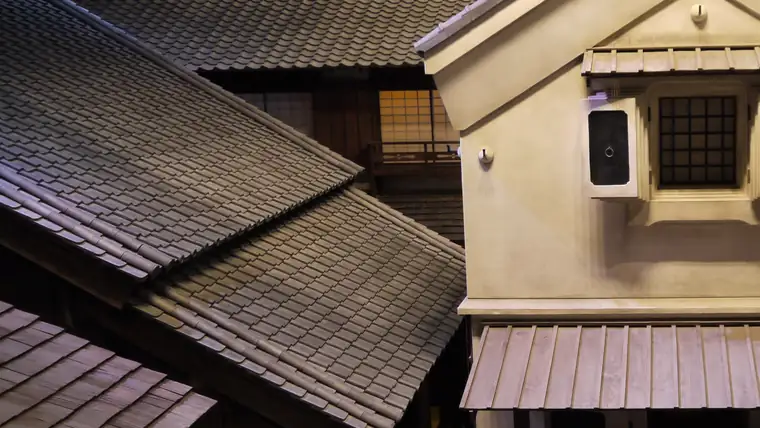
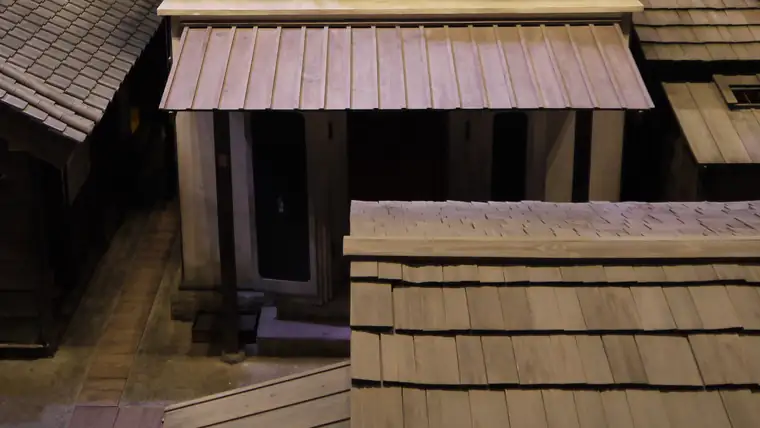
So that's how people got through winter in a house of wood and paper: layers of cotton, coals close by, legs under the quilt and the hot water of the bath. Today, you can walk through that neighborhood. In Tokyo, a museum has rebuilt the Saga-cho area of Fukagawa life-size, as its makers believe it looked around 1840: with its shops and warehouses, a boathouse, the canal, the fire watchtower and the alley of row houses. One of those homes belongs to a sawyer from Kiba, like the father in our family: with his saw, meal trays for two and his wife's makeup tools. It's not a palace or a castle: it's the alley where ordinary people lived. And at your place, when the cold sets in, do you heat the house, or bundle up?
Words from this home
- nagayaSay it: nah-GAH-yah
- A row house: a line of rented homes under one roof.
- tatamiSay it: tah-TAH-mee
- A thick straw floor mat, also used to measure rooms.
- shojiSay it: SHOH-jee
- A sliding door or window of wooden lattice covered with paper.
- hibachiSay it: hee-BAH-chee
- A charcoal brazier: a vessel of ash with a few live coals.
- kotatsuSay it: koh-TAHT-soo
- A charcoal heater under a wooden frame covered with a quilt, to warm legs and bedding.
- tadonSay it: TAH-dohn
- A ball of charcoal dust and mud, sun-dried and burned like charcoal.
- hantenSay it: HAHN-ten
- A short jacket, often padded, worn by working people.
- yogiSay it: YOH-ghee
- A thick quilt shaped like a huge kimono, with sleeves.
- sentoSay it: SEN-toh
- A public bathhouse.
- monSay it: MOHN
- Edo's smallest coin.
Sources
- Kitagawa Morisada, Morisada mankō, vol. 1 (上) (Tokyo, 1908)
- Kitagawa Morisada, Morisada mankō, vol. 2 (下): bathing (Tokyo, 1908)
- Fukagawa Edo Museum (Tokyo), permanent exhibition
- Kōtō City, heritage page "Mizuba ato" (Fukagawa's water supply)
- Kōtō City, page on the Fukagawa Edo Museum
- Kikuchi Kiichirō, Edo funai ehon fūzoku ōrai, part 1 (上編) (Tokyo, 1905)
- Kikuchi Kiichirō, Edo funai ehon fūzoku ōrai, part 2 (中編) (Tokyo, 1905)
- Kashima Manbei, Edo no yūbae (Tokyo, 1922)
- Hiraide Kōjirō, Tōkyō fūzokushi, vol. 2 (中の巻) (Tokyo, 1901)
- Saitō Gesshin, Zōtei Bukō nenpyō, book 8 (Tokyo, 1912)
- Edward S. Morse, Japanese Homes and Their Surroundings (Boston, 1886)
- Ōkuma Yoshikuni, Kenchiku nijikkō (Tokyo, 1923)
- Nihon kokugo daijiten and Dejitaru daijisen, "Kushaku niken" (Shōgakukan, on Kotobank)
- Tokyo Fire Department (Tōkyō Shōbōchō), "Edo sandai taika" (The Three Great Fires of Edo, in Japanese)
- Inagaki Shisei and Suzuki Shin'ichi, "Sentō" (Nipponica and Sekai daihyakka jiten, on Kotobank)
- Chūō City local museum (Masuyama Kazunari), heritage page "Umemasu oyobi mokuhi"