
Venice · 1507
Renaissance Venice: Water Everywhere, Not a Drop to Drink
November 7, 2026 · 15 min · Audio in Spanish, English, Portuguese, German
Pressing play loads YouTube (Google). Privacy
Renaissance Venice sat in a salty lagoon, with no rivers and no springs. So how did Venice get fresh water? From the rain: every campo, or square, had a well that caught it from the roofs and the paving and filtered it through sand. In the dry spring of 1507, in a campo in the Cannaregio district, an ordinary family watches the well run lower every day: the father, a water boatman, brings river water from the mainland, and the mother has to buy it by the bucket.
The story, to read
The whole episode, chapter by chapter. Tap the minute to watch from there.
A city that drank rain ▶ 0:00
A girl lowers a bucket into a well, in a square in Venice, in the spring of 1507. There's water everywhere, and not a drop to drink: the lagoon is salty. So how does a city surrounded by water get its drinking water? And this year, on top of that, it has hardly rained. Let's say she's the daughter of our family, and they live in the Cannaregio district. Her mother fetches water from the well; her father brings river water by boat.
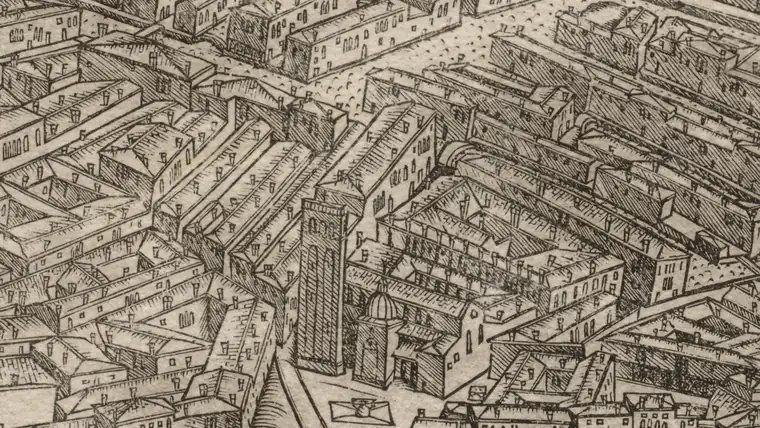
A Venetian chronicler of the late fifteenth century, Marin Sanudo, put it in a single sentence: Venice is in the water and has no water. No rivers run through the city, and no springs lie beneath its houses. What Venetians drank was rain. And to store it, every campo had its well. The campo is what Venetians call a square. By one scholar's estimate, in the early sixteenth century there were about a hundred public wells for about a hundred thousand people. One of them is our family's, in a campo of the parish of Santi Apostoli. But in Venice, a well isn't dug to find water underground: there's none down there. The water has to come from above.
A family that lives off the water ▶ 1:19
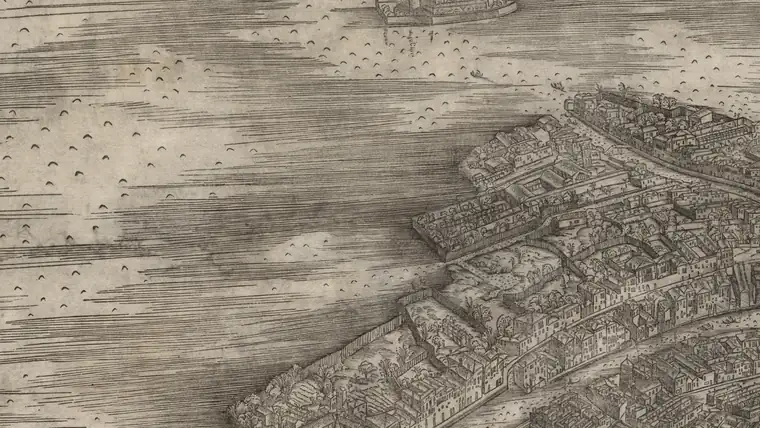
Our family lives near a canal that's still called the Rio dell'Acqua Dolce, the freshwater canal, next to the church of Santi Apostoli. A historian in 1882 wrote that the boats bringing river water docked there. The father is an acquarolo, a water boatman. The acquaroli formed their own guild in 1471, and they worked in flat-bottomed barges called burchi. The daughter goes to the well with her mother, and learns. It's a family that lives off water two ways: the rain the well stores, and the river water the father brings. Before we get on the boat with him, let's follow the rain, from the roof to the bucket.
From the roof to the well, through sand ▶ 2:00
Let's imagine a rainy day, before the drought. A drop falls on a roof in Cannaregio, covered in curved tiles laid double. That's how Venetian roofs were made, according to Francesco Sansovino, who described the city in 1581. And every house, he says, had a wooden or masonry terrace on top, the altana, for drying laundry in the sun. The drop slides down the tiles and falls into a stone gutter that runs around the roof. From there it goes down a hidden pipe, all the way to the well. That way of bringing roof water to the wells went back to the fourteenth and fifteenth centuries. In a city without rivers, every roof served to catch the sky.
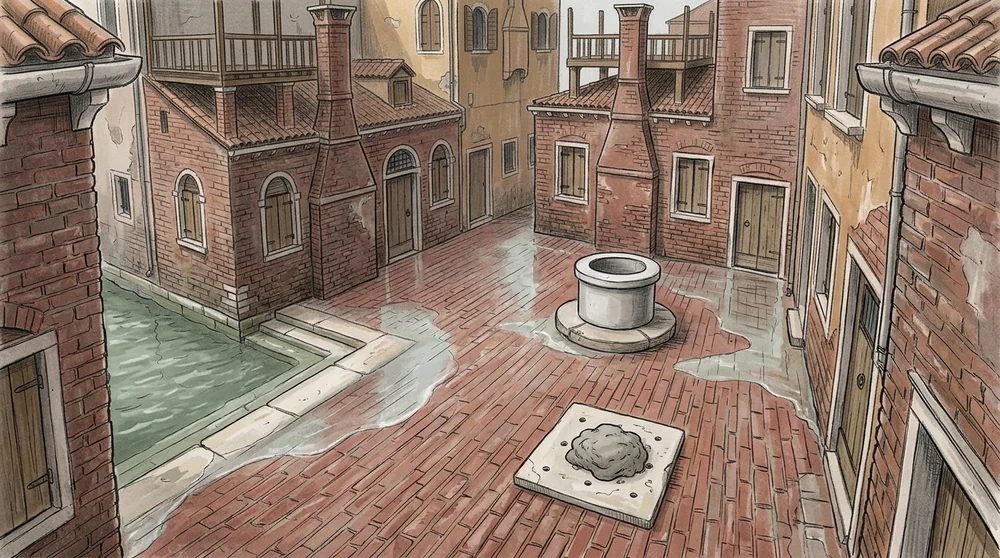
Now let's follow another drop, one that falls on the ground of our campo. We picture that ground as brick: stone paving began to replace brick in the sixteenth century. And the ground isn't flat. It slopes down slightly, from the well toward some stone grates with small holes, set into the paving. The drop runs downhill, slips through one of those holes and disappears. What no one sees begins down there, beneath the grates. A large pit has been dug out, and brick galleries run all along its walls. Through them, the rainwater spreads out around the whole edge of the pit.
That pit is full of sand: the sand they called the sponge. The water comes in from the sides and works its way slowly through, and the sand cleans it as it goes. The pit is several meters deep, and it's lined inside with a thick layer of clay. An engineer in 1860 compared it to potter's clay. The clay has two jobs. It keeps the rainwater from leaking out. And it keeps out the salt water, which is right there, on the other side. Meanwhile, the drop keeps sinking.
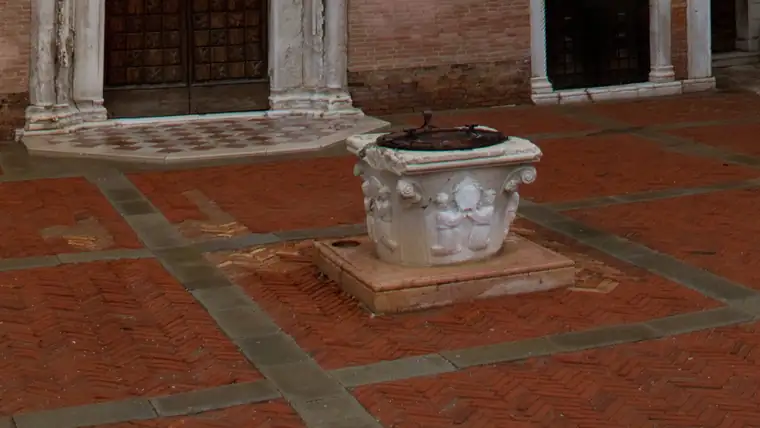
In the middle of the pit, surrounded by sand, there's a brick shaft. The filtered water seeps in through its joints and collects inside. At the top, the shaft ends in the stone ring you see in the campo: the vera, the well-head. That's where the daughter's bucket goes down, and where it comes back up, with water that was once rain. It's the end of the drop's journey. A present-day historian writes that a Venetian bucket held almost eleven liters, nearly three gallons, and that Venetian household inventories of the sixteenth century list copper buckets and large earthenware jars for storing water. That's how the rain reaches our family's house: from the roof to the well, from the well to the bucket, and from the bucket to the jar.
The well's two enemies ▶ 4:46
A well like this had two enemies. The first was too much water. During very high tides, salt water could get in through the stone grates, so people plugged them with clay. If the salt did get in, the same historian writes, the well had to be pumped out and fresh water poured through the sand, again and again. The second enemy was the opposite: too little water. If the well dried out, the clay lining cracked. So a well was never allowed to run dry: when it got too low, it was topped up with river water. River water is exactly what the father of our family brings in his boat.
1507: a winter without rain ▶ 5:43
But in the winter of 1506 to 1507, it barely rained. Sanudo, the chronicler behind that line about water, kept a diary. On February 11, 1507, he notes that the winter has been beautiful, without rain, and that the city is very short of water. No one, he says, could remember a better one. He also notes that flour is cheap: what's scarce is water. In our campo, the mother notices it every morning: the bucket has to go down a little deeper than the week before. The daughter leans over the well-head and no longer sees the water so close.
With so little water, didn't they lock the well, so no one would take too much? Historians write that the parish head kept the keys to the lids of the public wells and opened them twice a day. But we don't know how far back that goes: iron lids are described from the nineteenth century on, and for 1507 nothing documents either lids or keys. Sansovino, in 1581, says something different about the wells in the courtyards of wealthier homes: they stood in the middle, uncovered, because people believed the sun purified the water. In our campo, the well is open, and lower every day.
River water from Lizzafusina ▶ 7:01
What did Venice do when it didn't rain? Venice had been here before. Sansovino says that in the fifteenth century, after another winter without rain, from November to February, the Republic had thirty new wells built for the poor. And it had water brought in by boat from the Brenta, a river on the mainland. But a new well needs rain too. The only thing that didn't depend on the sky was river water. In 1507, water from the Brenta is needed again. For our family, that cuts two ways: the campo well is running low, and the father has more work than ever.
With the drought, the father of our family casts off his empty burchio and heads for Lizzafusina, on the mainland. That's where the Brenta water sold in the city came from, by boat. We don't know how the boats were loaded in 1507. In 1580, a French traveler, Montaigne, saw a wheel there that horses kept turning without ceasing. The wheel raised the river water into a canal, and the boats were loaded in that canal. A writer in 1805 reckoned that a burchio held about twenty-five thousand liters, nearly seven thousand gallons. The father fills it as far as he can and starts back, slowly, the boat heavy with fresh water.
A boatman pours fresh water onto the paving of a Venetian square, and he isn't wasting it. He's the father of our family, back from Lizzafusina: a text from 1747 says the trip took three or four hours. According to the same present-day historian, the acquaroli, the water boatmen, didn't pour the water down the well-head. They poured it through the holes in the stone grates, so it would filter through the sand before reaching the well shaft. That way, river water takes the same path as rain. It goes down through the holes, gets cleaned in the sand and reaches the well.
Water for sale ▶ 8:59
A city surrounded by water had to buy its water by the bucket. Sanudo wrote it down at the end of the fifteenth century. In droughts, he says, the wells gave out. Then river water came in by boat, and it was sold. Sanudo even gives the price back then: eight buckets for a soldo, a Venetian unit of money. And he adds his own comment: that truly, it was laughable to be in water and have to buy it. In 1507, with the wells low, the same thing happens. And the mother of our family has to buy river water, the same kind her husband brings in.
How much did our family pay for those buckets in 1507? We don't know. The sources we've read don't say: the prices we know are from other years, undated, or for whole boatloads. We do know what a worse drought was like. In January 1514, during a great frost, Sanudo writes that nothing was coming from Padua, because of the ice, and that the wells were dry. Fresh water was sold along the canals, at two buckets for a soldo. And the poor, he says, suffered greatly. By our count, water then cost four times as much as in the droughts of the late fifteenth century. In the house by Santi Apostoli, every bucket they pay for counts.
The drought didn't hit everyone equally ▶ 10:22
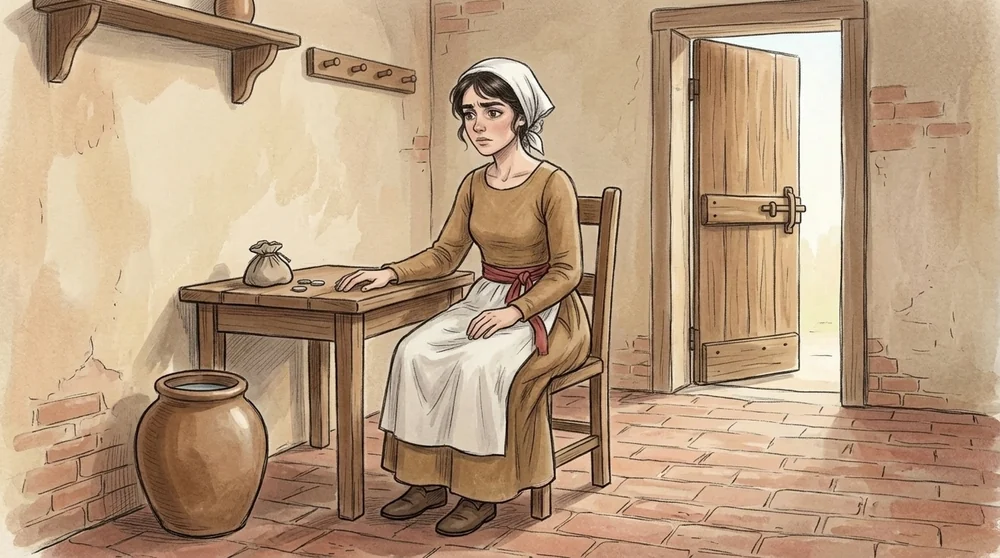
The drought wasn't the same for everyone. The scholar who studied the public wells estimates that in the early sixteenth century, alongside those hundred, there were some two thousand seven hundred private ones. Those with their own well drew from it. Those without relied on the campo well, like our family. For the poor, that estimate gives just under a liter and a half a day, less than half a gallon. An inventory from 1582 lists a lawyer's water jar that held twenty buckets: more than two hundred liters, over fifty gallons. And a book from 1767 puts it bluntly: in long droughts, Venice's wells don't contain enough water for a family.
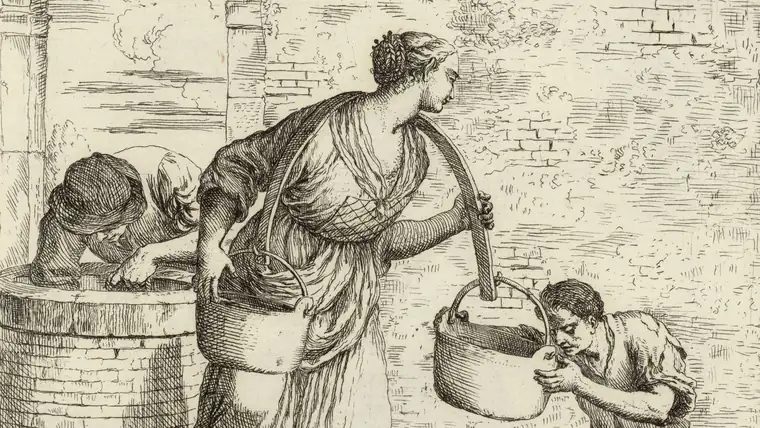
In 1513, a gang in Venice stole more than a hundred buckets. Sanudo records it in his diary, and he says who they were taken from: the women who went to draw water at the wells in the campi, the city's squares. It was women who fetched the water. The mother of our family carries two buckets, not one. We imagine she uses a bigolo: a wooden yoke across the shoulders, with a bucket hanging from each end. The word was already in use in 1410, according to that present-day historian. With the drought, the mother makes more trips: from the well to the house, and from the boat to the house, her shoulders loaded.
Holy Saturday: the rain returns ▶ 11:46
Holy Week arrives, and still no rain. Every afternoon the daughter climbs up to the altana, among the hanging laundry, to look for clouds. And so it goes until Holy Saturday, April 3, 1507. It hadn't rained for months, and in the city, Sanudo writes, water was extremely scarce. That day, it began to rain. Let's imagine our family in the campo, looking up at the sky. The rain drums on the curved tiles and runs along the stone gutters. It goes down the hidden pipes. On the ground of the campo, the water runs downhill toward the stone grates and disappears through them. Below, the sand slowly soaks it up, and the stone well-head turns dark with rain. And inside the brick shaft, the level rises again.
For the mother, the rain means fewer trips with the bigolo and fewer buckets to pay for. For the father, it's the opposite: with the wells filling up, river water isn't needed as much, and his burchio stays tied up longer. That's what comes of living off water two ways. What the sky gives one half of the house, it takes from the other. But the burchio won't sit idle forever. When the well runs low again, it will have to be topped up with river water, so the clay lining doesn't crack. And the father will go back to Lizzafusina.
The well-heads that remain ▶ 13:10
The city went on living off the rain for centuries. The people who sold water in the streets, mostly women with a bigolo on their shoulders, first appear in an etching from the mid-eighteenth century: they were called bigolanti. Today, the wells of Venice no longer give water. Since 1884, water has reached the city through an aqueduct from the mainland, and over the twentieth century the cisterns went out of use. But the well-heads are still there, in the campi and in the courtyards. A 2025 archaeological study estimates that more than five hundred remain. Each of those stone rings was the visible part of a well like our family's: the stone grates with holes, the galleries, the sand, the clay and the brick shaft. If you ever see a photo of a campo in Venice, look for the well-head in the middle. Underneath, the city kept the rain.
Words from this home
- campoSay it: KAHM-poh
- A neighborhood square in Venice. Every campo had its well.
- veraSay it: VEH-rah
- The stone well-head. «Vera» means ring in Venetian.
- spongeSay it: SPON-jah
- The sand that filled the cistern and filtered the rainwater.
- bigoloSay it: bee-GOH-loh
- A wooden yoke worn over the shoulders to carry two buckets of water.
- acquaroloSay it: ah-kwah-ROH-loh
- A water boatman: he brought water from the Brenta by barge. They had a guild from 1471.
- burchioSay it: BOOR-kyoh
- A large flat-bottomed barge, the one that carried the water.
Sources
- David Gentilcore, "The cistern-system of early modern Venice," Water History 13 (2021): the wells of Venice, the acquaroli, prices and the bigolanti
- Elena Giacomello, "Raccolta e gestione dell'acqua meteorica nella Venezia storica," Ateneo Veneto CCX (2023): the well, campo and roof system
- Francesco Sansovino, Venetia città nobilissima et singolare (Venice, 1581)
- Marin Sanudo, I diarii, vols. VI, VII and XVII (Venice, 1879–1903): the rainless winter and Holy Saturday of 1507, the theft of 1513 and the frost of 1514
- Giuseppe Caprin, L'Istria nobilissima (Trieste, 1905): quoting Sanudo's De origine
- Agostino Sagredo, Sulle consorterie delle arti edificative in Venezia (Venice, 1856)
- Cesare Vecellio, De gli habiti antichi et moderni (Venice, 1590)
- Martina Secci, Archeologia delle vere da pozzo veneziane (Sesto Fiorentino, 2025): the surviving well-heads