
Ererê, near Monte Alegre, Pará · 1875
Life on the Amazon in 1875: Turning Cassava into Bread
November 9, 2026 · 15 min · Audio in Spanish, English, Portuguese, German
Pressing play loads YouTube (Google). Privacy
Is cassava poisonous? Raw bitter cassava, the root Brazilians call mandioca, is. Yet farinha, a coarse cassava flour toasted over a fire, was the bread of the poor all along the Amazon. On the banks of the Lower Amazon, in the Brazilian state of Pará, around 1875, we follow an ordinary family through one batch of farinha: the roots soak for days, then they are peeled and grated, the mother squeezes the mash in the tipiti, a tube of woven palm, and the fire of the forno, a huge clay pan, drives off the last of the poison. The same juice gave them tapioca and tucupi, a yellow sauce for fish.
The story, to read
The whole episode, chapter by chapter. Tap the minute to watch from there.
A poisonous juice ▶ 0:00
Drop by drop, a whitish juice falls from a tube of woven palm into a clay bowl. That juice is poison. And what stays inside the tube will become this household's bread. How could a poisonous root feed the Amazon? This time, our family lives on the banks of the Lower Amazon, in Pará, around 1875. The mother squeezes the tube, and the daughter brings water. The shed smells sour.
When the work is done, what's left in the tube will be farinha: a coarse flour of toasted mandioca, the root also known as cassava. Farinha was this household's bread, and the bread of the poor across the region. A traveler called the mandioca plant the standard article of food among all the poorer classes of tropical America. But the root had a problem. Raw, mandioca was poisonous, and people knew it. Fresh from the ground, the root is full of juice, and the poison travels in it. Today we know why: the root holds a compound that releases cyanide when it breaks down. So every step we're about to see had one purpose: to make that bread safe to eat.
A house on the riverbank ▶ 1:19
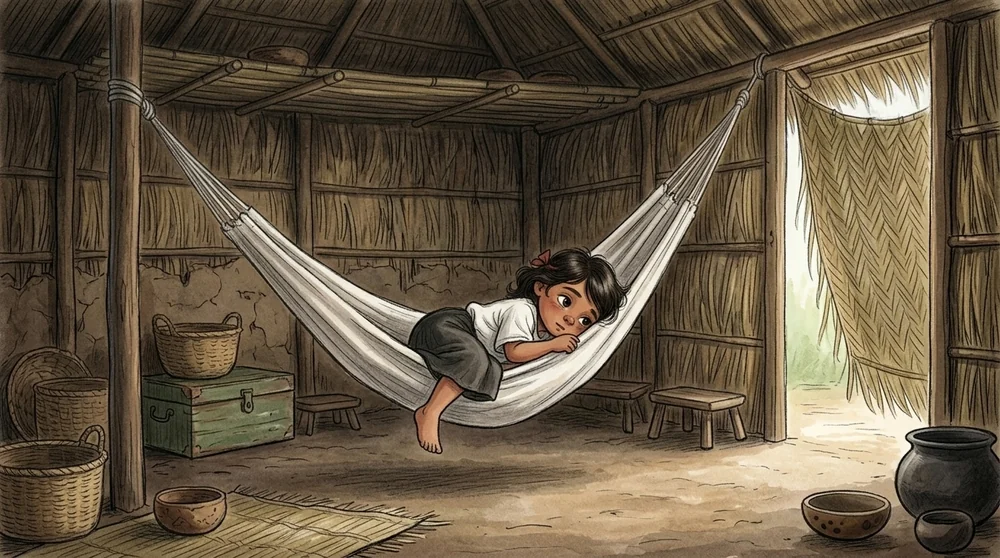
Our family's house stands on dry ground, right by the water. Herbert Smith, a traveler who lived in Ererê, near Monte Alegre, from 1874 to 1876, describes the houses there: roughly hewn logs for the uprights, a palm-leaf thatch, and for a floor, Mother Earth. There were no windows, and the doorways were closed with palm-leaf mats. Inside there were hammocks, mats, a chest and little else. And out front, tied up, sits the montaria, the family's small canoe, made of planks and moved by paddle. Elizabeth Agassiz, who traveled up the Amazon in 1865, saw small straw-thatched houses on the riverbank, each with its montaria moored in front.
The people of these houses were river folk, the ones we now call ribeirinhos. Travelers back then used other words; one was tapuio, an Indigenous person already settled by the river. In Ererê, Smith says, the kitchen stood apart, and three large stones made the fireplace. He wrote that at night nothing but a hungry dog disturbed his rest. Ember, our family's dog, is a skinny mutt.
In this house, mandioca is women's work. The father fishes, hunts in the forest and makes his own paddles. In Ererê, Smith met the man who was the best hunter and the best fisherman in the village, and found him busily shaping a paddle. The daughter brings water and washes roots. At a place upriver, near Villa Bella, Elizabeth Agassiz saw the older children doing just that: bringing water from the lake, washing the mandioca and taking care of the younger ones. And on the coast of Pará, when the fishermen went out by canoe, the whole family went along, and the dog too. That's how José Veríssimo, a writer from Óbidos, described it in 1895.
Harvesting and soaking the roots ▶ 3:17
Mandioca grows in the roça, the forest clearing where it's planted. People cleared a patch of forest. There was no plow: the cuttings, pieces of stem, were simply placed, several together, in holes dug in the unprepared ground. After a few years that clearing was left behind and a new one was opened. The travelers don't agree on exactly how many years. In Ererê, Smith says, the ground was too stony for cultivation, so the poor folk planted their roças two or three miles away, in the woods. Our family has its own in a clearing among the trees. This morning, the mother and the daughter go there for roots. They come back with the roots on their backs, in a basket held by a band across the forehead.
But these roots aren't going to the fire yet. First they spend a few days soaking, until they soften and ferment. Soaked mandioca like this was called puba. Veríssimo describes it as mandioca first left to rot in the water. Smith guessed that the roots he saw in Ererê had probably been in the water for two days. Puba is what makes farinha d'água, water farinha, the kind from Pará. And in Ererê, Smith watched a girl walk up from the water with her sixty pounds of fermented roots on her back. She just laughed at the visitors' wry faces.
While they wait, let's do some math nobody could do in 1875. In 2010, a study tracked the cyanide step by step in a farinha d'água from Pará, made with today's roots and methods. In that study, the soak lasted four days. At the start, the root had more than three hundred milligrams of cyanide per kilo. The soak alone took away most of it. Each step removed more poison, and the fire took the last of it. We don't know how much was left in our family's farinha. But today's numbers make one thing clear: every step those people took had a reason behind it.
Peeling and grating ▶ 5:34
When they're soft, the roots go from the water to a shed open at the sides: the casa de farinha, the farinha house. Everything else happens there. Elizabeth Agassiz saw one like it: a veranda-like room with the great oven and baskets of mandioca root. In Ererê, Smith saw half a dozen women and boys cleaning the mandioca as it was brought in. The tough outer skin, he says, came away easily from the softened inner mass. The mother peels. The daughter comes and goes with water.
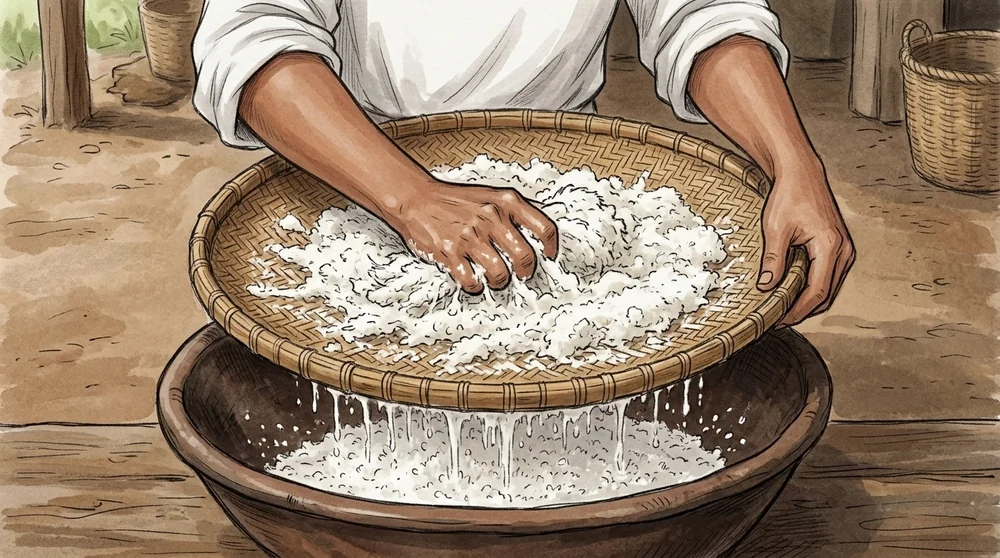
The peeled roots are piled in a trough, half a hollowed-out log. Then they're grated on a rough board. Smith says that in Ererê the board was covered with sheet copper full of nail holes. Grating did more than make a mash. When the root breaks, its poison compound meets another substance from the same plant, and only then is the cyanide released and free to escape. A 1990 report by the FAO, the United Nations food agency, explained that the compound isn't changed by boiling. That's why boiling the whole root wasn't enough: the root had to be broken first. And in the 2010 study, grating brought the numbers down a little more. According to Smith, the grated mass was then rubbed through a basket-work sieve to remove the larger bits of woody fiber. What's left is a damp mash. It still holds juice, and that juice has to come out.
The tipiti, a tube that squeezes ▶ 7:02
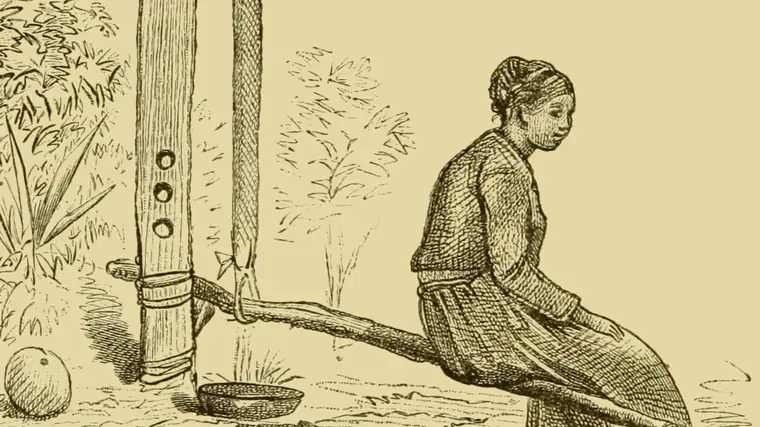
In homes along the Amazon, that juice was squeezed out with the tipiti, a press: a long, narrow tube of palm strips woven on the diagonal. The mother fills it with mash and hangs it from a beam. A pole goes through a loop at the bottom of the tube. Then the mother sits on the end of the pole. Under her weight, the tube stretches, narrows and squeezes the mash inside. Smith says a heavy stone could be tied to the pole, but the woman he watched found it easier to sit. Elizabeth Agassiz saw the same thing: elastic tubes of palm fiber, and the woman sitting on the other end of the pole.
Tipiti is a word of Tupi origin. This know-how wasn't Portuguese; it was Indigenous. Smith said as much in a footnote. The method, he wrote, did not differ essentially from the Indigenous one, used from Paraguay to Florida. Alfred Wallace, a naturalist who traveled the Amazon in the mid-nineteenth century, wrote that the Portuguese and Brazilians had not yet introduced any substitute for that Indigenous press. The press made sense because the tube needs no arm strength: the weight of one seated person is enough, and the woven palm does the rest. The words point the same way: a dictionary of Nheengatu, a language of Tupi roots, lists tipiti and other words from this same kitchen, which we'll hear as we go.
Tapioca and tucupi from the juice ▶ 8:29
And we're back where we started. Drop by drop, the whitish juice falls from the tube, and the bowl below catches it. That juice is the root's poison, which is why it has to come out. The bowl is made of clay. In Ererê, Smith says, most older women could make their own pots from coarse clay. The juice isn't thrown away. If it stands, a white paste settles at the bottom of the bowl: the goma, or tapioca. Smith calls it the tapioca of commerce, the same kind already sold back then. Elizabeth Agassiz saw it made another way: from the mash, mixed with water.
In the Amazon, that same poisonous juice, boiled for days, became tucupi, the yellow sauce people ate with fish. Smith says it was seasoned with red peppers. With the poison out of the root, boiling drove it off, and a juice that no one could drink turned into a sauce. A 2011 study, by the same team as the 2010 one, measured tucupi as it's made today: the finished sauce held far less cyanide than the freshly pressed juice. Henry Bates, another nineteenth-century naturalist, says that on the Tapajós, tucupi was used chiefly as a sauce for tacacá: the goma whisked into boiling water.
At that place upriver, near Villa Bella, Elizabeth Agassiz saw neighbors come in to help with the mandioca. They came in the morning with all their children and stayed through the day. People had a word for neighbors working together: puxirum. Veríssimo says they also gathered this way to fish. Let's imagine that neighbors have come today, too, to lend a hand in our family's farinha house: since morning, the kids have been peeling, the women grating, and the tipiti hasn't stopped.
The forno drives off the last of the poison ▶ 10:22
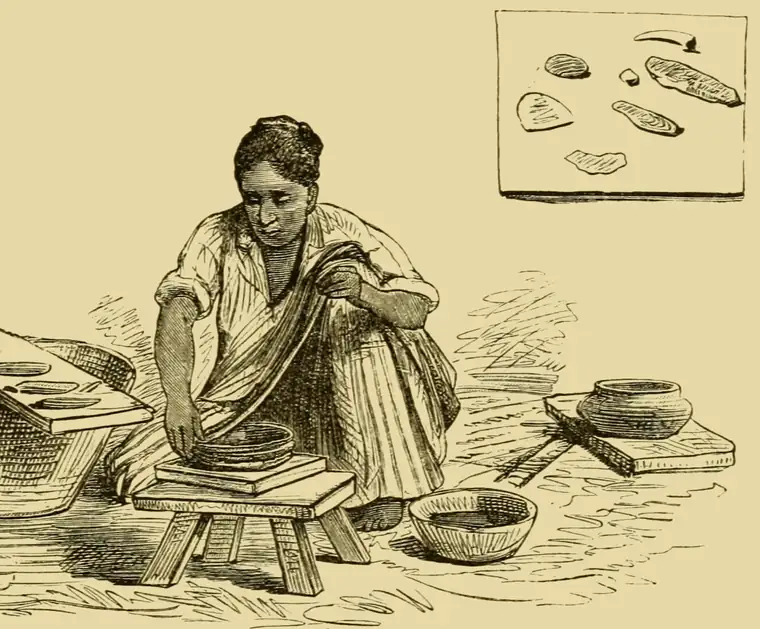
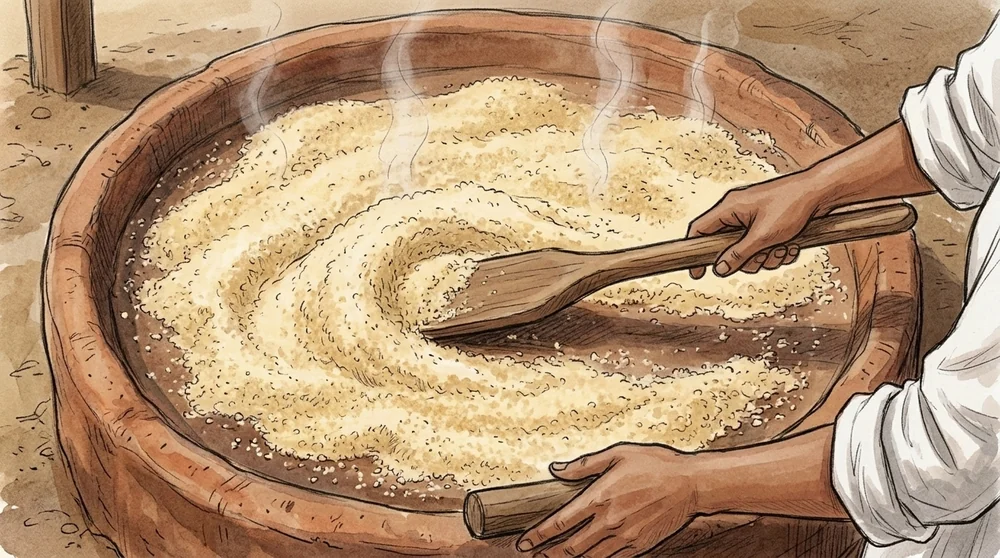
With the mash pressed, it's time for the fire. The forno was a huge clay pan, wider than a man lying down, set on a low wall with the fire underneath. Smith puts it at six feet across. Elizabeth Agassiz calls it the great round oven, built of mud. The fire is fed through an opening on one side. The mother spreads the mash over the hot clay. And she starts stirring it and doesn't stop.
Along the Amazon in 1875, roasting had a signal of its own. Little by little, the smell changes. According to the traveler Smith, the vile odor gradually disappeared, leaving a fragrance like roasting corn. Smith knew a little poison still remained in the mash, but that it was very volatile and roasting would remove it. Back then, no one could measure it. In the 2010 study, by the end of roasting, the numbers had dropped to nine. From over three hundred to nine. That FAO report said as much in 1990: traditional processing and cooking methods, if efficiently carried out, can reduce the cyanide to non-toxic levels. The poisonous root is now bread.
Women's work ▶ 11:34
All of this, from the roça in the forest to the forno, was women's work. In Ererê, Smith wrote that the women were occupied much of the time in preparing farinha. Elizabeth Agassiz, at that place near Villa Bella, wrote that the men there were never seen doing any of the work of the house, not even bringing wood or water. And she saw the woman of the house grating, pressing or straining the mandioca, generally with her baby astride her hip. Henry Bates saw women carrying their children that way in the city of Pará, today's Belém. That bread was paid for in hours, and those hours were mostly the women's.
From basket to supper ▶ 12:14
The farinha, now dry and loose, is spooned out of the forno. It was stored in paneiros, baskets lined with broad, tough leaves. Smith says these baskets were woven in just a few minutes. He also says farinha was often stored in baskets for a year, and the poorer classes ate it that way. Our family's paneiro is already full. Veríssimo says that on the coast of Pará, when the fishermen set out, the farinha went along in the boat.
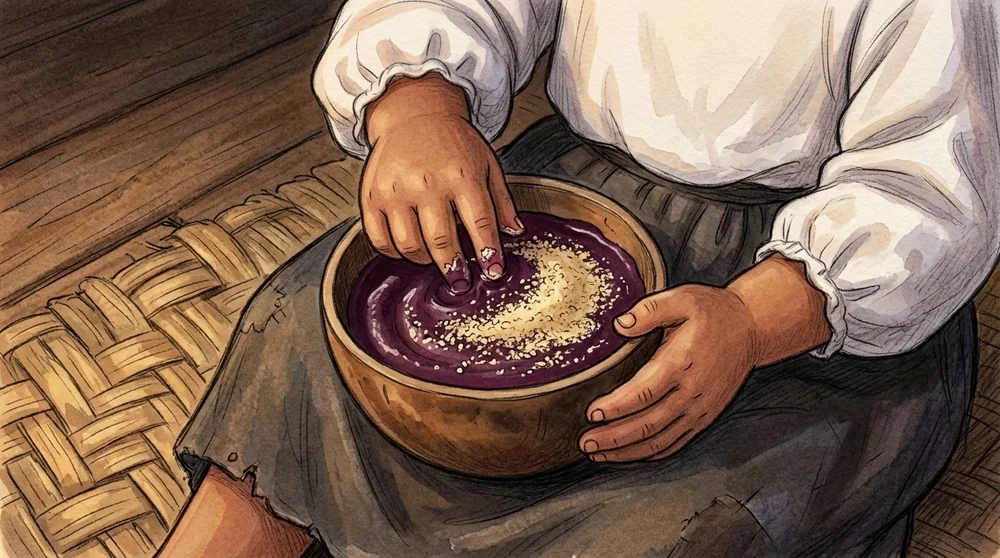
As evening falls, the father comes back from the river with fish. Fish, Veríssimo says, was eaten smoked, roasted, ground into meal after smoking, or simply boiled in water. Veríssimo spoke of the never-failing farinha d'água. Smith says people often ate from calabash bowls, cuias, and with their fingers. And there was açaí, thick and purple, with farinha on top. Elizabeth Agassiz, in one of those houses, saw fresh fish broiling over the fire on the floor for the family's supper. Tonight our family has roasted fish, with the new farinha beside it. Fish and farinha: that was a meal.
Cassava in Pará today ▶ 13:29
Today, according to the IBGE, Brazil's statistics office, Pará is still the state that harvests the most mandioca in the country: almost four million metric tons in 2024. And the 2010 study calls farinha the main source of carbohydrates for a large share of Pará's lower-income people. Tucupi, the same team says, is widely eaten in northern Brazil. That Indigenous know-how of the tube, the water and the fire didn't stay in the travelers' books. It lives on in every cuia of farinha, and in every dish made with tucupi.
Words from this home
- farinha d'águaSay it: fah-REEN-yah DAH-gwah
- Coarse toasted meal from soaked (fermented) manioc, the Pará kind.
- tipitiSay it: tee-pee-TEE
- Press: a long plaited palm-fibre tube that squeezes the pulp when stretched.
- pubaSay it: POO-bah
- Manioc left in water until soft and fermented.
- fornoSay it: FOR-noo
- A huge clay pan on a low mud wall with a fire beneath, for toasting farinha.
- tucupiSay it: too-koo-PEE
- Yellow sauce made from manioc juice, boiled for days to remove the poison.
- roçaSay it: HOH-sah
- A slashed-and-burnt forest clearing planted with manioc.
Sources
- Herbert H. Smith, “Brazil, the Amazons and the Coast,” 1879: Ererê, the farinha house, the tipiti, the forno and tucupi
- Louis and Elizabeth Cary Agassiz, “A Journey in Brazil,” 1868: riverbank houses, mandioca and neighbors at work near Villa Bella
- Henry Walter Bates, “The Naturalist on the River Amazons,” 1863: farinha, tucupi and tacacá on the Tapajós
- Alfred Russel Wallace, “A Narrative of Travels on the Amazon and Rio Negro,” 1853: the Indigenous mandioca press
- José Veríssimo, “A pesca na Amazônia,” 1895: fishing, fish and farinha d'água
- Renan Campos Chisté et al., “Quantificação de cianeto total… farinhas de mandioca,” Acta Amazonica (2010): cyanide at each step of making farinha
- Renan Campos Chisté and Kelly de Oliveira Cohen, “Teor de cianeto total e livre… do tucupi,” Revista do Instituto Adolfo Lutz (2011): cyanide in tucupi
- FAO, “Roots, tubers, plantains and bananas in human nutrition,” 1990: cyanogenic glucosides and their removal
- IBGE, “Produção Agrícola Municipal,” the mandioca harvested in Pará in 2024
- Marcel Twardowsky Avila, “Proposta de dicionário nheengatu-português,” 2021: tipiti, tucupi, cuia and other Nheengatu words