
Rome, Italy · around AD 100
Ancient Rome's Saturnalia, When Masters Served Slaves
November 11, 2026 · 13 min · Audio in Spanish, English, Portuguese, German
More from Italy →More from the 1st century →
Pressing play loads YouTube (Google). Privacy
Saturnalia in ancient Rome was the festival of Saturn, when masters waited on their slaves at table and the whole city put on the felt cap of freedmen, Roman slaves who had been set free. We live through those five upside-down days in an ordinary Roman home around AD 100, one we have recreated: a bakery on the ground floor of an apartment building, with a single slave and a dog tied at the door. Martial, Seneca, Lucian and Macrobius tell us what the Roman Saturnalia looked like, mostly in rich households. We show how a house like this one might have kept the festival on a smaller scale, from the dice and the king of the feast to clay figurines, gift candles and the sixth day, when everything went back to normal.
The story, to read
The whole episode, chapter by chapter. Tap the minute to watch from there.
A Roman household, December AD 100 ▶ 0:00
Two hands white with flour pour wine for a man seated at the table. They belong to a baker in Rome, and the seated man is his slave. How did an ordinary Roman household live through the Saturnalia, the one week of the year when everything was turned upside down? It's December of the year 100, and let's say this house belongs to our family. The father makes the bread and the mother sells it. They share the house with the grandmother, a daughter of about four, and Felix, the slave. And the whole place smells of bread, and of candle wax.
Saturn's festival, five days long ▶ 0:42
The Saturnalia was the festival of the god Saturn. It began on December 17. At first it lasted a single day; over the years it grew longer. In the verses of Martial, a poet writing in Rome a few years earlier, the festival lasts five days. And with the figurine market, people celebrated it as a whole week. That's the week we'll spend with our family, day by day, in one possible order, because we don't always know which custom fell on which day. Almost everything written about the festival is about rich households; nobody left a word about a house like this one. So we'll tell you what the sources say, and what this family would do on a smaller scale. What nearly all the sources agree on is that, during those days, the order of the house was turned on its head. For a while.
A bakery in an apartment building ▶ 1:30
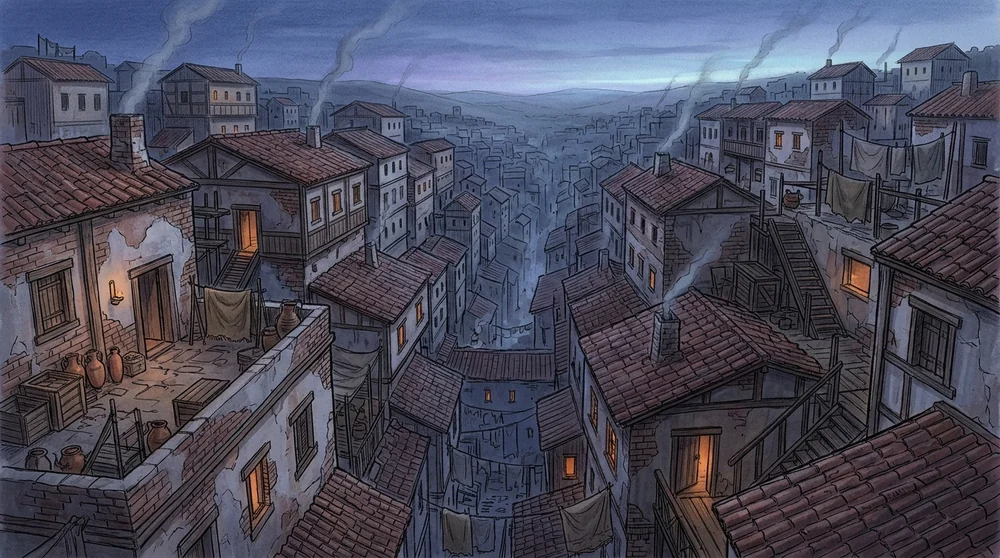
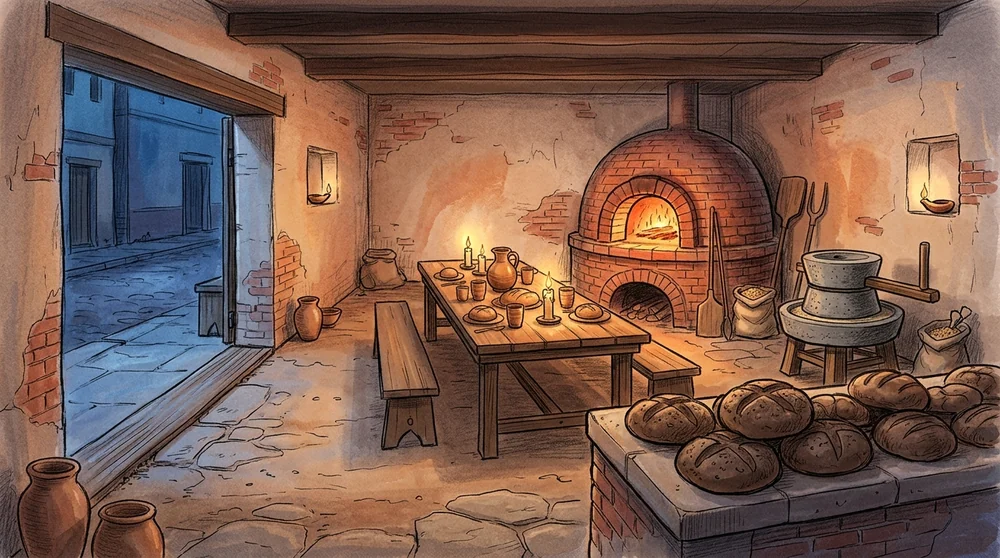
The bakery is on the ground floor of an apartment building, open to the street. The mill and the oven are at the back. A steep staircase leads up to two rooms, and that's where the family lives. Other neighbors live farther up. Juvenal, a poet writing satires in those same years, complains that fire was a danger in these buildings, and that the poorest lived right under the roof tiles. Our family, with its shop, is somewhat better off. Some artisans owned one or two slaves. This baker owns one, Felix, who, like the rest of the family, is a character of our own. Felix grinds the grain and tends the fire in the oven. And Ember, the family dog, is tied up at the shop door. Guard dogs were kept tied at the entrances of houses, and guarding the door is Ember's job.
On the eve, December 16, the streets ring with shouting. The philosopher Seneca wrote in a letter that in December all of Rome was sweating over the preparations for the festival. And in a bakery? Lucian, a Greek writer who lived some sixty years after this week, said in jest that during those days only the cooks and the pastry cooks worked. He never mentions bakers, and nobody wrote down what a baker did that week. In our house, we're guessing, the oven won't go completely cold, but it will be lit less: just enough bread for the family and the odd neighbor. The mother sweeps the shop. The daughter counts the nuts she's been saving. And Felix, as he does every morning, is at the mill before the sun comes up.
Day one: Io, Saturnalia! ▶ 3:02
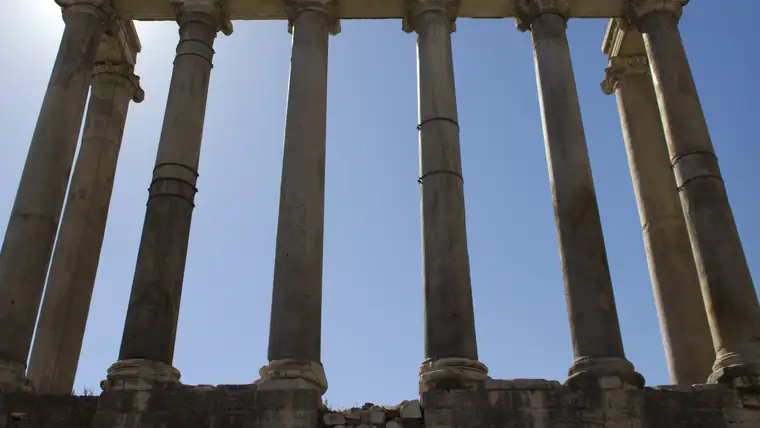
The 17th dawns with shouting in the street: "Io, Saturnalia!" It's the festival greeting, something like a hooray, and that's how Martial writes it in his verses. The shout went back a long way. According to Livy, in 217 BC, in the middle of the war against Hannibal, Rome held a sacrifice and a public banquet in front of the temple of Saturn. And people shouted "Saturnalia!" through the streets day and night. All of this happened more than three centuries before our family's time. But part of the temple has come down to us. Today, in the Roman Forum, eight columns of the temple of Saturn are still standing. That morning, at the bakery door, the daughter shouts the greeting too: "Io, Saturnalia!"
That first day, something else changes too. People put away the toga and changed their clothes: the knights and senators in Martial's verses wore a light dinner outfit. Our family has no toga to put away and no dinner outfit to put on: they wear tunics, as on any other day. But there's one garment they do share with the whole city. All of Rome put on the pileus, a felt cap: the cap of freedmen, slaves who had been set free. Martial has the emperor, whom he calls "our Jupiter", wearing one too. In this house, everyone puts one on: the father, the mother, the grandmother and the daughter. And so does Felix, who is not a freedman. For a few days, every head in the house wears the same cap.
With the cap came another privilege. During those days, a slave could tell his master what he thought. The poet Horace, who lived a century earlier, wrote a satire in which his own slave uses December's freedom to list his faults to his face, one by one. It's literature, and we don't know how much of it is a joke. Nobody recorded what was said in a bakery. Let's imagine that Felix tells the baker what he thinks of the early mornings, and that the baker, for once, keeps quiet and listens.
Dice and nuts ▶ 5:25
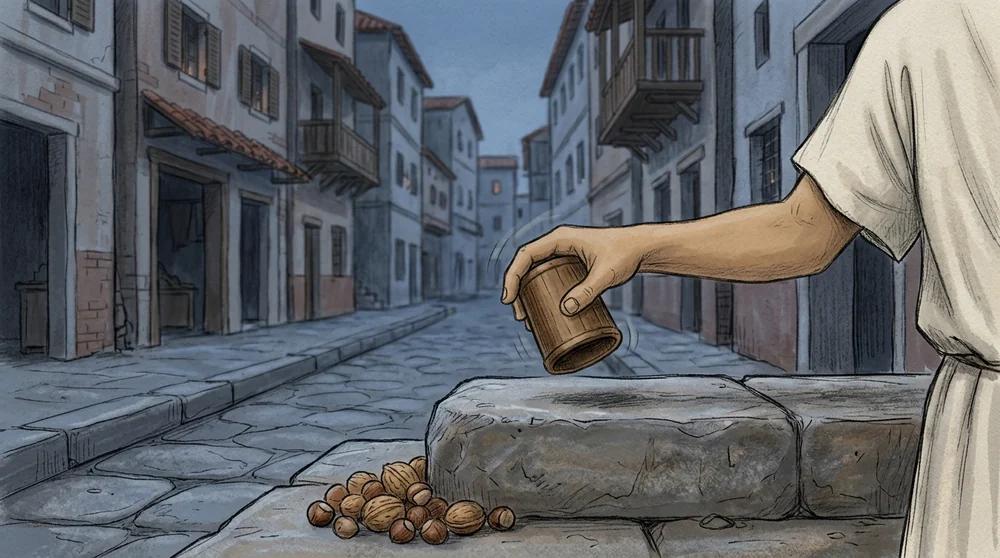
On the second day, the dice come out. During those days, you could play dice without fear of the aedile, the magistrate who policed gambling the rest of the year. Martial describes a slave born in the house who shakes the dice cup right in front of the aedile, without the slightest fear. People bet nuts. So now the daughter knows what her nuts are for. They play in the upstairs room, by the light of a clay lamp: the father, the mother, the grandmother, the daughter and Felix, each one wearing a cap. Someone wins, someone loses, and the nuts go back and forth across the table. The grandmother, though, hardly loses a single one.
The dice also chose a king of the feast, who gave absurd orders. Lucian, in jest, calls him an absolute monarch by favor of the knucklebone, a small bone thrown like a die. And he gives an example of the king's orders: someone has to shout an insult at himself. In every example we know of, the king is a man. In our house, we take a liberty of our own: the lot falls to the daughter. And the daughter, queen for a night, copies Lucian's order. The father confesses out loud that he snores. The grandmother admits she cheats at nuts. Nobody escapes except the queen: she gives the orders.
The figurine market ▶ 6:45
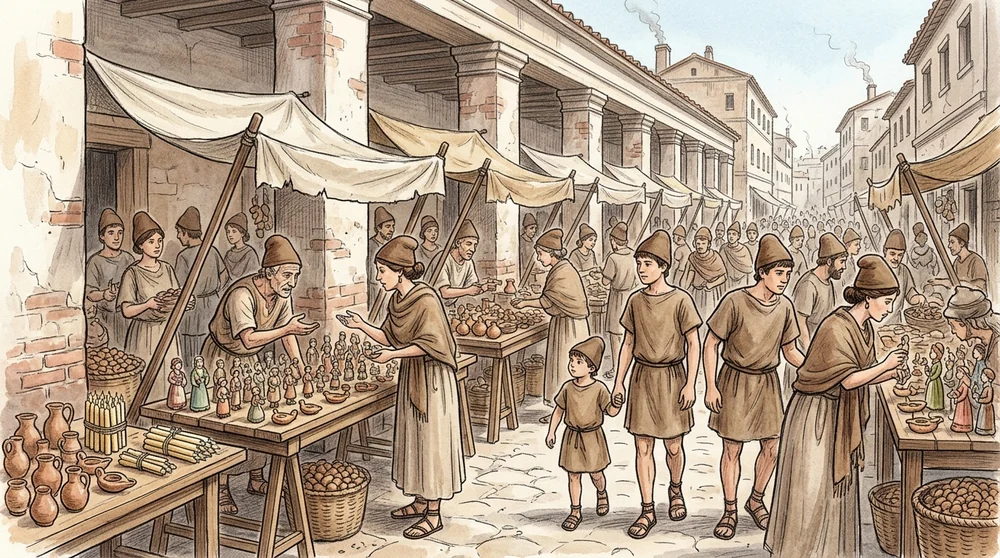
On the third day, it's time to go shopping. There was a market called the Sigillaria, the figurine market, with stalls full of gifts. Clay figurines were made and sold for the festival, and some of them were children's toys. Other writers mention a bookshop in that market, and even a silver carriage put up for sale. The gifts listed in Martial's verses even include a hunting dog, but a dog like that was a present for the rich. Ember isn't a gift, and he plays no part in the festival: no source gives dogs any role in it. He stays at the door, as always. For Ember, it's just another week. The father and the daughter come home from the market with a package she's not allowed to open yet.
They bring back something else from the market: wax candles. People gave them as festival gifts, and a poor client would send them to his patron. In Rome, a client wasn't a customer: he was someone who depended on a richer man, his patron, who protected him and helped him out. Macrobius, an author writing much later, around AD 430, says these gifts became a burden for clients. A magistrate, he says, ruled that only candles should be sent to wealthier patrons. And Martial writes about the penniless client's candle. Suppose the baker has a patron too, someone the business depends on. That afternoon, Felix takes the patron a bundle of candles.
How much did all this cost? We know nothing about the price of a candle or a figurine. But Martial gives a clue. According to him, a whole bundle of cheap gifts barely came to thirty sesterces, the coin Romans counted in. His little book of verses to go with the gifts, gift tags of a sort, cost four sesterces. Or two, if four seemed too much. His list includes a clay jug, a wooden candlestick and a horn lantern. That night, the family opens the package. The daughter gets her clay figurine and more nuts. The mother gets, let's say, a horn lantern for the dark staircase. And the grandmother gives Felix a handful of figs. It's not much, and nobody needs more.
The master waits on the slave ▶ 9:00
The fourth day brings the scene from the beginning. During the Saturnalia, the master waited on his slaves at table. Macrobius says so. And Lucian, in jest, rules that when the rich man hosts his slaves, his friends should serve with him. Other writers tell it another way. Masters and slaves ate at the same table: Seneca writes about a feast day meant for exactly that. All of this happens in rich houses, with lots of slaves and lots of dishes. We don't know how it worked in a house with just one slave. So our family does it their own way. The baker, his hands white with flour, pours Felix the first cup of wine. Then they all sit down together at the table.
So what's on that table? The pot holds emmer porridge, beans or lentils, like the gifts Martial lists. And there's coarse bread, which this house never runs short of. Seneca, in that same December letter, advises practicing poverty for a few days, with a hard bed and hard, dirty bread. For Seneca, poverty was a brief exercise. On this table, since it's a holiday, there's a little extra: sausage, figs, olives, cheese and onions, things Martial names as gifts and holiday food. They drink their wine mixed with water. In rich houses, things were different: the rich gave a pig as a gift. And Lucian decrees that an amphora of wine, a hare or a fat fowl is too paltry to count as a rich man's gift. At this table, a hare would be a feast.
Pliny escapes the noise ▶ 10:35
Meanwhile, the neighbors' voices drift up the staircase. The whole apartment building is celebrating. Pliny the Younger, a wealthy senator of those same years, wrote about his villa. He said that during these days, when the rest of the house filled with festive shouting, he withdrew to a secluded room so he wouldn't have to hear the noise. That way, he said, he didn't disturb his household's games, and they didn't disturb his studies. In an apartment building, there's no secluded room. The downstairs neighbor's party comes up the stairs, and the upstairs neighbor's party seeps through the ceiling. And our family, to be honest, doesn't mind one bit.
A five-day game ▶ 11:14
The fifth day is the last. Martial wrote a short verse for a gift that was anything but festive: a whip. In it, the whip tells the slaves to play, but only to play: it will stay sealed for five days. Lucian agrees, in his own way. In his satire, the god of the festival himself explains that his reign lasts only a week, and then he's a private citizen again. The reversal was a five-day game, not freedom: on the sixth day, everything went back to normal.
That night, Felix takes off the felt cap. It was the freedmen's cap, and for five days he's worn it like everyone else. But putting it on set no one free. Felix is still the baker's property, as on the first day. Poets, philosophers and senators wrote about this week. We don't know what a slave like Felix thought of it.
The sixth day ▶ 12:13
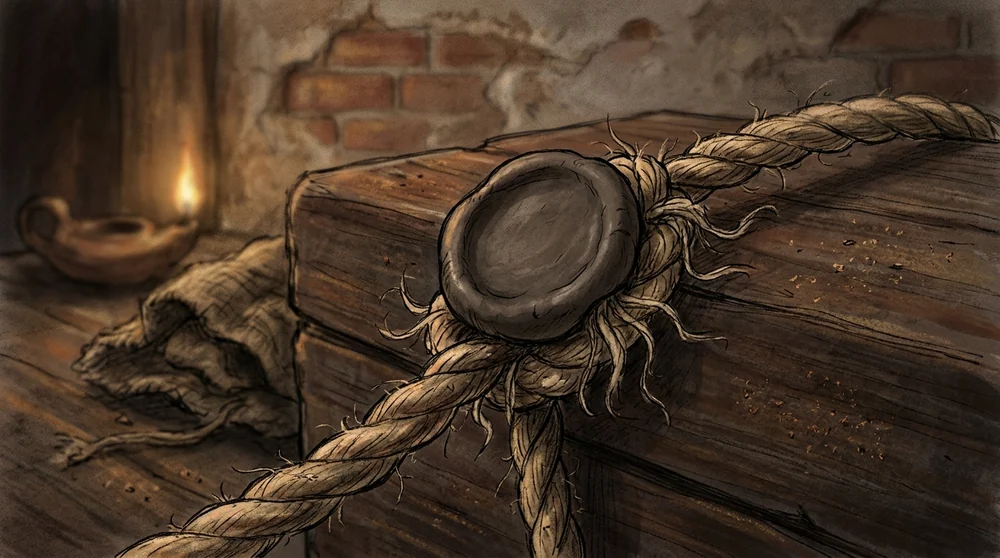
On the sixth day, before dawn, the mill turns again: Felix is back at it, and the baker at the oven. The caps go back in the chest. A few stalls at the figurine market stay open a couple more days, but this house is already working. Martial describes the festival's end in a few lines. The boy sadly leaves his nuts behind, and a shouting teacher calls him back. And the gambler, dragged out of a hidden tavern, now pleads with the aedile. In the shop, the grandmother and the daughter sit down by the oven.
Words from this home
- SaturnaliaSay it: sat-er-NAY-lee-uh
- The Roman festival of Saturn in December.
- pileusSay it: PIL-ee-us
- Felt cap of freed slaves; worn by the whole city at the festival.
- freedmanSay it: FREED-man
- A slave who had been freed; the pilleus was his cap.
- SigillariaSay it: sij-ih-LAIR-ee-uh
- The festival's gift market, named for its clay figurines; also its last day.
- king of the SaturnaliaSay it: PRIN-keps sat-er-nuh-LISH-us
- Mock king chosen by lot, who gives silly orders.
Sources
- Macrobius, “Saturnalia,” around AD 430: the festival's name and date, candles and figurines, masters waiting on their slaves
- Martial, “Epigrams,” around 85–102: the five days, dice, the felt cap, gifts and their prices, the holiday table
- Seneca, “Letters to Lucilius” 18 and 47, around AD 63: the city in December, the freedmen's cap, masters eating with their slaves
- Seneca, “Apocolocyntosis,” around AD 54: the king of the feast
- Pliny the Younger, “Letters,” II.17, around AD 100: the quiet room where he escaped the noise of the festival
- Varro, “On the Latin Language,” Book VI, 1st century BC: the festival's name, which comes from Saturn
- Suetonius, “Lives of the Caesars,” around AD 121: how long the festival lasted, and the figurine market
- Livy, “History of Rome,” Book XXII: the banquet of 217 BC and the cry “Saturnalia!” day and night
- Tacitus, “Annals,” Book XIII, around AD 117: the king of the feast, chosen by lot
- Juvenal, “Satires,” 3, around AD 110: upper floors and fire in the apartment buildings
- Petronius, “Satyricon,” 29, around AD 60: the guard dog at the entrance of the house
- Aulus Gellius, “Attic Nights,” Book V, around AD 170: the figurine market
- Catullus, “Carmina,” 14
- Horace, “Satires,” II.7, around 30 BC: a slave who speaks his mind to his master in December
- Statius, “Silvae,” I.6
- Lucian, “Saturnalia” and “Cronosolon,” around AD 160, translated by H. W. and F. G. Fowler, 1905: the king of the feast, the master who serves, the gifts
- Pompeii, House of Orpheus: the cast of the dog chained at the entrance
- Fanny Dolansky, “Celebrating the Saturnalia,” 2010
- Walter Scheidel, “Human Mobility in Roman Italy, II,” 2005
- Mark Cartwright, “Slavery in the Roman World,” World History Encyclopedia: craftsmen who owned one or two slaves
- Wikipedia, “Temple of Saturn”
- World History Encyclopedia, “Temple of Saturn, Rome,” 2013: the temple today, in the Forum
- Calendar of Filocalus, AD 354, ed. Th. Mommsen: December 17, the day of the Saturnalia
- W. Warde Fowler, “The Roman Festivals of the Period of the Republic,” 1899: the festival's date in the calendars
- Lucian, “Cronosolon,” Greek text, ed. Dindorf, 1884: cooks and pastry makers, the rich man's gifts