
Calle de la Ruda, Madrid · 1799
Toothache Before Anesthesia: Madrid, 1799
November 3, 2026 · 15 min · Audio in Spanish, English
Pressing play loads YouTube (Google). Privacy
It's Saturday, February 9, 1799, in Madrid: the feast of Saint Apollonia, the patron saint of toothache. In some ground-floor rooms on Calle de la Ruda, between the Rastro and Lavapiés, an old man has a toothache and hasn't slept. How did people get through a toothache before anesthesia? Ether wasn't used for surgery in Madrid until January 1847. We follow an imagined family, with the grandfather at its center, from one remedy to the next: from cloves in the morning to the bloodletter's shop in the afternoon.
The story, to read
The whole episode, chapter by chapter. Tap the minute to watch from there.
Madrid, February 9, 1799 ▶ 0:00
Madrid, Saturday, February 9, 1799. How did people get through a toothache before anesthesia? It's dawn in some ground-floor rooms on Calle de la Ruda, between the Rastro and Lavapiés, and an old man holds his cheek. He hasn't slept. Let's imagine he's the grandfather of our family. Madrid won't see surgery under ether anesthesia for almost half a century. And the masthead of the Diario de Madrid, the city's daily paper, names the saint of the day: Saint Apollonia, virgin and martyr. The patron saint of toothache.
A worm, or a hole ▶ 0:44
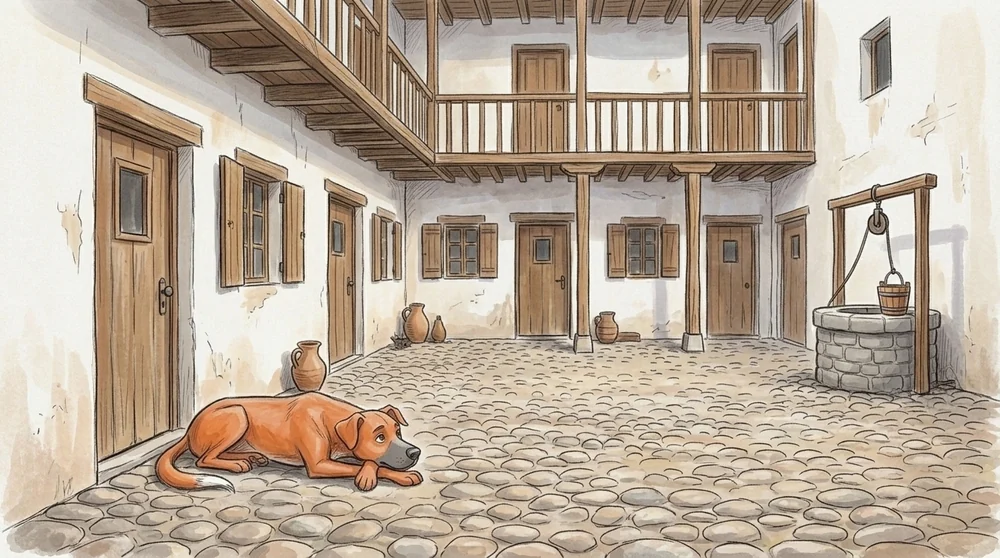
The home is a set of ground-floor rooms, the kind that faced the courtyard: a sitting room and a bedroom, like the ones people rented and sublet in Madrid back then. In the sitting room, the daughter asks her grandfather to open his mouth, and she peers in very carefully, the way you'd peer down a well. She's looking for something specific. Many people believed a tiny worm caused toothache, gnawing the tooth from inside, bit by bit. The daughter looks, and looks again. She finds no worm. She finds a dark hole. The tooth has a cavity, and worm or no worm, a cavity won't go away on its own. The grandfather closes his mouth, holds his face again and sighs. A long day begins in the house, one remedy after another.
Cloves, plasters and a poultice ▶ 1:33
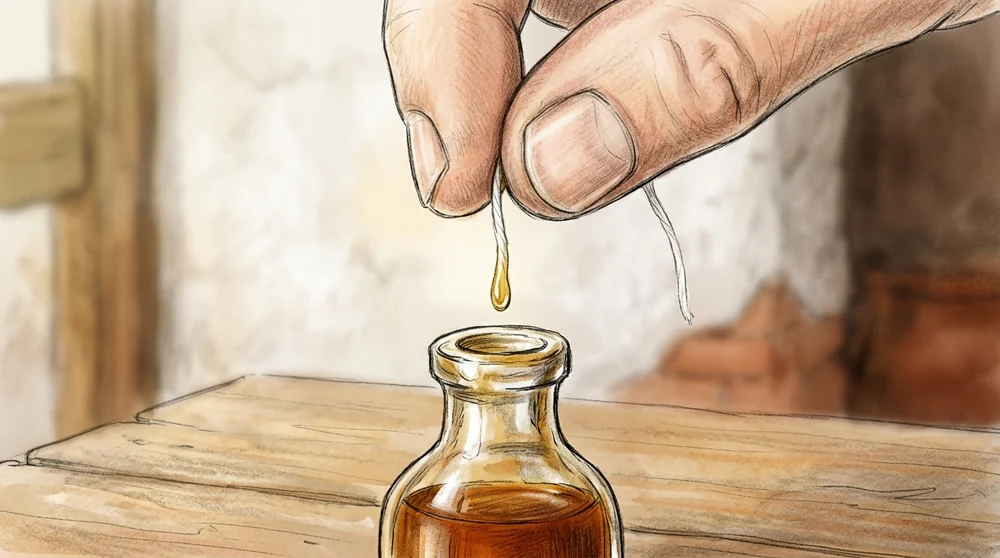
The father has already left for work. He's a journeyman in a tannery on the Ribera de Curtidores, the tanners' street: Madrid's trade guide for 1799 lists one of the city's tanning workshops there. At home, the mother tries the first remedy. She soaks a twist of lint, a few linen threads, in oil of cloves, and tucks it into the hole in the grandfather's tooth. Cloves were the remedy the books of the time mentioned most. A Madrid dentist was still recommending them in 1807, as something patients could do for themselves. And he had other ideas: a little ball of lint with warm oil, or a grain of salt in the hole. To seal the hole, a bit of hot wax or some mastic, a fragrant resin. These are remedies of their time, and we describe them here as history: none of them is recommended today. The grandfather clenches the teeth on his good side, carefully, and waits.
By mid-morning, the cloves haven't done much, so the mother moves on to the next thing: little plasters on his temples, and more behind his ears. Far from the tooth, yes, but they were a standard treatment for this pain. The manual that bloodletters studied prescribed them. Bloodletters bled their patients, and they also pulled teeth. The same manual suggested putting a few grains of mastic in the mouth, right where it hurt most, and rinsing with water and vinegar boiled with alum. Other books called for a poultice of bread and milk on the swollen cheek. Some people went further. In 1800, a reader wrote to the Diario from Cartagena, in southeastern Spain. He said that the farmers in the countryside around him smoked cigars of shaved bull's horn instead of tobacco to treat toothache. He added that people there called cavities «cuevas», caves. But Cartagena isn't Madrid. On Calle de la Ruda, at noon, the grandfather is quite a sight: plasters on his temples, plasters behind his ears, the poultice on his face and his mouth smelling of cloves and vinegar. The daughter tries not to laugh. She half manages.
Saint Apollonia, patron saint of toothache ▶ 3:42
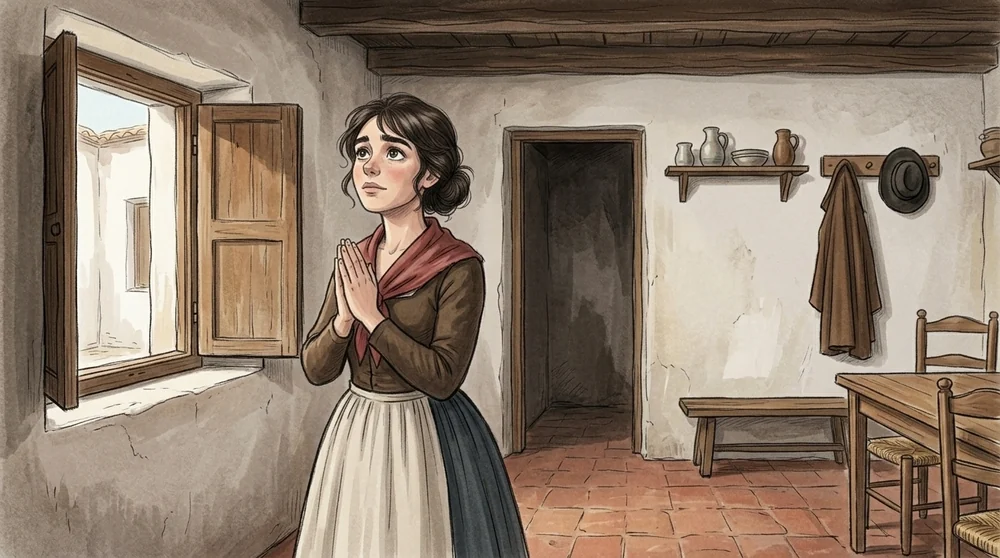
And then there's the saint of the day. Saint Apollonia was the saint people prayed to for toothache. Her feast day was printed in the Diario's calendar, and her fame crossed the ocean: a novena reprinted in Mexico in 1776 called her the advocate against ailments of the teeth. Much later, people who collected folk verses wrote down one that says everything in two lines. In the first line, someone tells Saint Apollonia that their teeth are aching. In the second, the aching has stopped. If only toothache worked that way. At home, saint or no saint, the tooth keeps throbbing, and the mother throws on her mantilla: she's going out to buy something stronger.
Toothache powders for a few reales ▶ 4:25
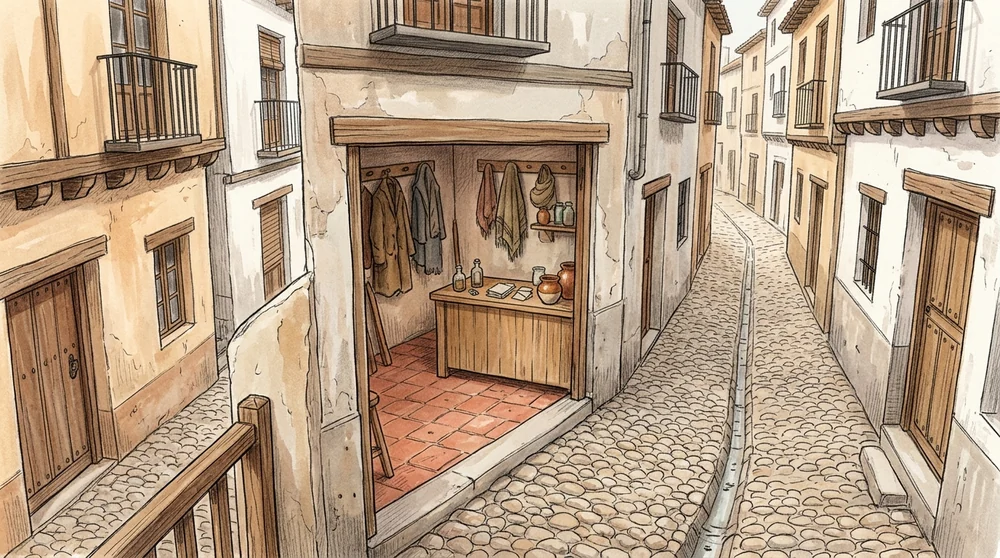
There was no shortage of remedies for sale in Madrid in those years. In the Diario's ads from 1800 and 1801, a little bottle or a packet of powder for toothache cost 4 to 10 reales, the coins of the day. In 1801, a secondhand clothes shop on this very street, Calle de la Ruda, sold powders to take away toothache, at 4 reales a packet. And as early as 1799, the same newspaper was advertising a kit for looking after your mouth: picks in graded sizes, toothpicks and a packet of powder, for 8 reales. The mother comes back with her folded packet. The grandfather opens it, hoping against hope.
What the Diario de Madrid advertised ▶ 5:22
A doorman for the Duke of Osuna advertised in the newspaper as a dentist. The place was Madrid, at the end of the eighteenth century, and the paper was the Diario de Madrid. The doorman of the duke's offices, at the upper end of Calle de Leganitos, claimed to be approved as a dentist by the royal medical board, which handed out licenses. And he offered an elixir he had invented himself: put a bit of linen lint soaked in the elixir on the tooth, and the pain would ease. Many people in Madrid, he claimed, had already tried it. And he treated the poor for free. We don't know if the elixir did any good. But his ads, from 1797 to 1800, do show that Madrid had licensed dentists who advertised in the paper. And a doorman could double as an approved dentist.
The same Diario that announced Saint Apollonia had advertised something else three days earlier. On February 6, it listed the Caprichos, 80 prints by Francisco de Goya, for 320 reales at a perfume and liquor shop on Calle del Desengaño. The ad said they mocked the common deceptions that custom, ignorance or self-interest had made respectable. One of the prints is titled «A caza de dientes», Out Hunting for Teeth. It shows a woman trying to pull teeth from a hanged man. According to a handwritten commentary from the time, people believed those teeth were good for spells. For spells, not for toothache. Our family has no time for prints today. Cloves, plasters, a saint and powder, and the tooth is still right where it was.
Who pulls the tooth? ▶ 7:02
By afternoon, the grandfather can't take any more: the tooth has to come out. But who pulls it? Madrid had several options, not all alike. A dentist treated teeth or tried to save them. A tooth-puller, as the name says, only pulled them. One on Calle de los Preciados was so well known that a May 1799 ad gave an address simply by saying: next to the tooth-puller. And a comic song sung in Madrid in 1786 mocked the quacks, telling any charlatan who wanted to be a fine dentist to say he was French and hang plenty of teeth from his balcony. Hanging teeth was no joke: it was the trade's signboard.
A tooth-puller on horseback pulled teeth for free in a public square. Ventura de Bustos, a Madrid dentist, wrote about him in an 1807 book. Bustos had seen him there several times, pulling every tooth anyone brought him, without checking what caused the pain. One day, Bustos went over to find out more about these exploits. He learned that, besides pulling teeth for free, the man gave away a paper explaining his secret remedies for various ailments. Afterward, the man strung the pulled teeth on a cord, like the beads of a rosary. Bustos thought they were meant to hang as a sign of the trade, like other teeth he had seen in various places. He doesn't say which square, or what year.
A surgeon complained about the charlatans who promised to pull teeth without pain. His complaint is from 1788. They went around the squares, handing out or selling their remedies. They bragged about their essences, toothpastes and balsams. The toothpastes weren't painkillers; they were for cleaning teeth. According to that surgeon, the least of their tall tales was pulling teeth without pain. Without anesthesia, a painless extraction was a lot to promise. Eleven years later, in 1799, a treatise on dental operations was printed in Madrid. Its author was Félix Pérez Arroyo, who had been a surgeon at the Royal Hospitals of Madrid. A present-day historian says the treatise mostly follows a French dentist. And the treatise complains, perhaps in that Frenchman's words, that so many people outside the trade were pulling teeth that you might think there were more dentists than people with toothache.
Another option was a licensed dentist. That same year, Antonio Palermo lived on the Red de San Luis, a small square, and advertised himself as a dentist of the Paris Academy, approved by Madrid's royal medical board. Dentists took swipes at each other, too. In January 1800, Palermo wrote in the Diario that he treated only the mouth, never posing, as he put it, as a hernia surgeon or eye doctor. And he attacked a certain compilation, without saying which one. Maybe he meant the 1799 treatise: it was billed as compiled from the best authors, and its author, Pérez Arroyo, had been a hernia surgeon. Palermo never named names.
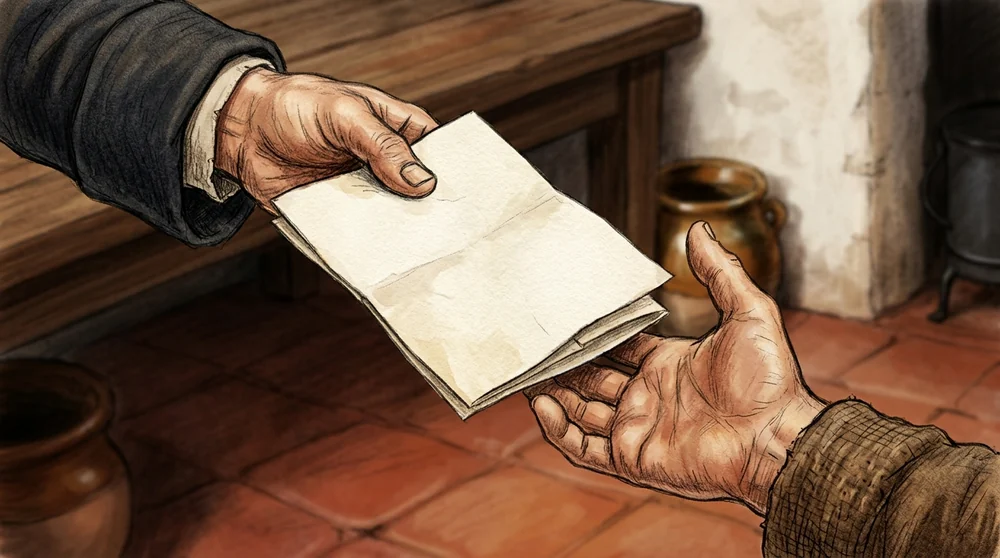
The bloodletter: down on the floor ▶ 10:14
Our family doesn't head for the square, or Calle de los Preciados, or the Red de San Luis. They go to the one closest to home: the bloodletter. Pulling teeth was part of his trade, and of his exam. Calle de la Ruda itself had a well-regarded bloodletter's shop. We know because in May 1799 it was up for sale, and the ad gave its takings: on Saturday and Sunday together, it brought in 60 to 70 reales, and on other days, 8 or 10. Those figures covered all its work, not the fee for one tooth. And today is Saturday. If nothing worked against the pain, the bloodletter also did what the name says: he let blood. But the grandfather isn't going for a bleeding. He's going to get the tooth out once and for all, and the daughter goes with him, holding his hand.
The bloodletter tapped the teeth one by one with the handle of the gatillo, his iron forceps, when the patient couldn't tell which one hurt. The manual bloodletters were examined on, printed in Madrid in 1788, gave these instructions: tap each tooth separately, then pull the one that hurt most and was most decayed. The manual listed seven tools. The forceps were the most common tool for pulling molars, and the 1799 trade guide even had a tariff for foreign forceps coming into Spain. Another tool was the pelican, named for its hook, which looks like the bird's beak. And the same manual said where each patient should sit. For a lower root, up on a high seat. For the small teeth, on a cushion. And to pull a molar, on the floor. Yes: right on the floor.
The grandfather sits down on the floor of the shop, his cape gathered up. The daughter stays by the door. The bloodletter taps, finds the right one and picks up the forceps. The daughter looks out at the street for a moment. When she turns back, the tooth is already out. The manual also covers what comes next, and the 1799 treatise agrees: press the gum with your fingers, and rinse your mouth with warm water and vinegar. The manual adds a tip for the way home: don't go out into the cold air without covering your mouth. The grandfather leaves with his cape pulled up to his nose. And there's a line in the manual the daughter hasn't heard: loose teeth should come out with a doubled thread, just as with children when they're losing their baby teeth. She touches a baby tooth that has been wiggling for days, and decides to keep quiet.
No anesthesia, and no known price ▶ 12:46
All of this, without anesthesia. Madrid had to wait 48 years: in January 1847, ether was first used there in surgery, and the press at the time reported that, with its vapor, even pulling a tooth caused very little discomfort. In 1799, Madrid had nothing of the kind. So what did the bloodletter charge the grandfather? We don't know. None of the sources we've read gives the price of pulling a tooth in Madrid that year. We do know that the dentists who advertised claimed to treat the poor for free: one, in 1737, said he cured them free of charge; another, in 1782, that he served them out of charity. And according to Bustos, the tooth-puller on horseback charged nothing. Many people paid the other price: losing teeth. And the 1799 treatise, perhaps following that French dentist again, says pulling teeth was so common that very few people had never had one pulled.
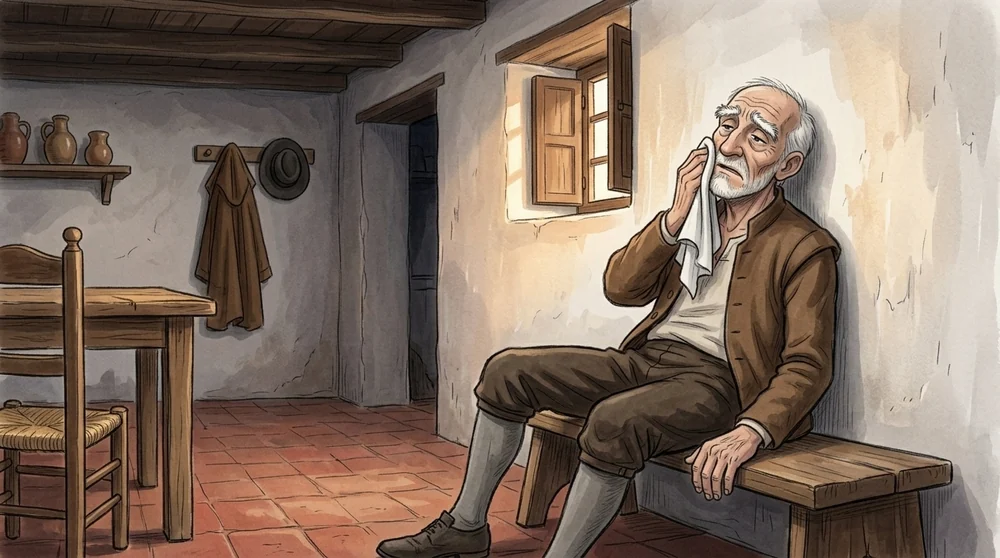
What survives of that Saturday ▶ 13:47
So how did they get through a toothache? With cloves and plasters, with bread and milk on the cheek, praying to a saint and buying powders for a few reales. And, when all else failed, on a bloodletter's floor, without anesthesia. A little of that Saturday survives. Saint Apollonia still has her day, February 9. And the Ribera de Curtidores, where the tanneries stood, is now the main street of the Rastro, which sets up in the open air on Sundays and holidays. The city bills it as its most traditional market. The 1799 treatise was right about one thing, even if it borrowed the idea: a tooth, as a wise man said, is worth more than a diamond. And you? What would you have tried first: the cloves, the saint or the corner bloodletter?
Words from this home
- sacamuelasSay it: sah-kah-MWEH-lahs
- A tooth-puller: someone who only pulled teeth, without a dentist's licence, often travelling from square to square.
- sangradorSay it: sahn-grah-DOR
- A licensed bloodletter, who also applied leeches and cupping and pulled teeth.
- gatilloSay it: gah-TEE-yoh
- Iron forceps for pulling molars; the most common tool.
- ProtomedicatoSay it: proh-toh-meh-dee-KAH-toh
- The royal board that examined and licensed medical practitioners.
- santa PoloniaSay it: Saint Apollonia: uh-puh-LOH-nee-uh
- Saint Apollonia of Alexandria, invoked against toothache; her feast day is 9 February.
- hilasSay it: —
- Lint: threads pulled from linen cloth, used for dressings.
- almácigaSay it: —
- Mastic, an aromatic resin chewed or packed into the tooth.
- opiataSay it: —
- A paste for cleaning and whitening the teeth; it contains no opium.
- cuarto bajoSay it: KWAR-toh BAH-hoh
- A ground-floor flat in a tenement house, often facing the courtyard.
- realSay it: reh-AHL, plural reh-AH-lehs
- The everyday unit of money.
Sources
- Félix Pérez Arroyo, Tratado de las operaciones que deben practicarse en la dentadura (Madrid, 1799)
- Ricardo Le Preux, Doctrina moderna para los sangradores (Madrid, 1788)
- Ventura de Bustos y Angulo, El conservador de la dentadura (Madrid, 1807)
- F. Javier Sanz Serrulla and M. Teresa Casero Gómez, "El dentista español del siglo XVIII" (Anales de la RANM, 2024)
- Javier Sanz Serrulla, Madrid, capital de la odontología (PhD thesis, Complutense University of Madrid, 2017)
- Diario de Madrid, 1797–1801 (Hemeroteca Digital, National Library of Spain)
- Gazeta de Madrid, October 8, 1782
- Almanak mercantil o Guía de comerciantes para el año de 1799 (Madrid, 1799)
- Fundación Goya en Aragón, catalog entry for "A caza de dientes" (Caprichos, no. 12)
- Joaquín Díaz González, "Santa Apolonia y los dientes a la luz de la tradición" (Biblioteca Virtual Miguel de Cervantes)
- El Español and La Opinión, January 31, 1847
- Novena a la gloriosísima Santa Apolonia (Puebla, Mexico, 1776), Europeana record
- Antonio Pérez Pérez and José R. Vallejo Villalobos, "Puerto Real en la historia de la anestesia decimonónica" (Matagorda, 2025)
- esmadrid.com (Madrid City Council), "El Rastro"
- madrid.es (Madrid City Council), "Mercadillo en la vía pública. El Rastro"
- spain.info (Turespaña), "El Rastro"
- Vatican News, "s. Apolonia, virgen y mártir" (saint of the day)
- Eduardo Ensaldo-Fuentes and others, "Día del Dentista, según la cosmovisión maya" (Revista ADM, 2020)