
Deir el-Medina, Egypt · 12th century BC
An Ordinary Day in Ancient Egypt, 3,000 Years Ago
October 28, 2026 · 14 min · Audio in Spanish, English
Egypt in the twelfth century BC, about 3,000 years ago. In a village across from Thebes, the men who cut and decorated the pharaohs' tombs lived with their families. We spend an ordinary day with an imagined family from that village, Deir el-Medina, using what their real neighbors wrote down: what they were paid in grain, why they missed work, and what they complained about.
The year the pay came late and the crew walked off the job: "We are hungry."
The story, to read
The whole episode, chapter by chapter. Tap the minute to watch from there.
An imagined family, a real village ▶ 0:00
Dawn breaks over a rocky pass in the hills, halfway between a village and the Valley of the Kings. This is Egypt, in the twelfth century BC, about three thousand years ago. What was an ordinary day like in ancient Egypt? Not the pharaoh's day: the day of the people who dug his tomb. Let's imagine one of them, stepping out of his stone hut. He's paid in grain: five and a half sacks a month. Down in the village, his wife and his daughter are waiting for him. We're going to spend a day with them, using what the village itself wrote down: its rations, its absences from work, and its complaints.
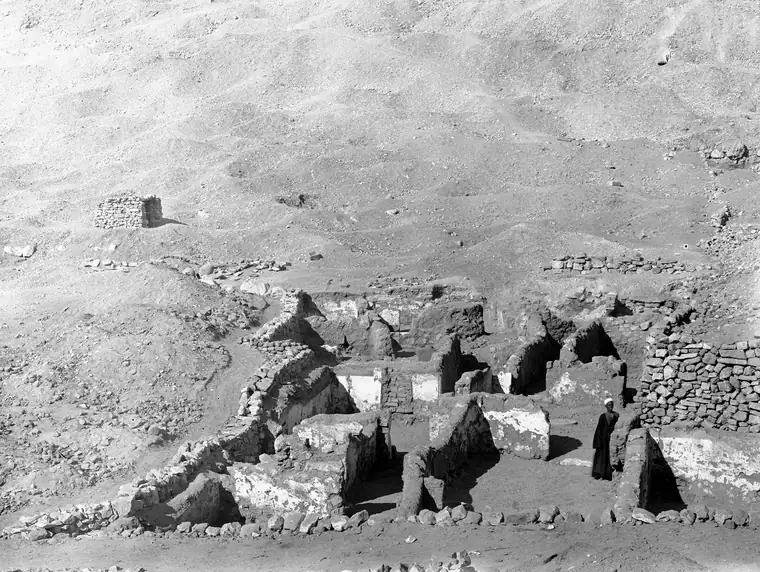
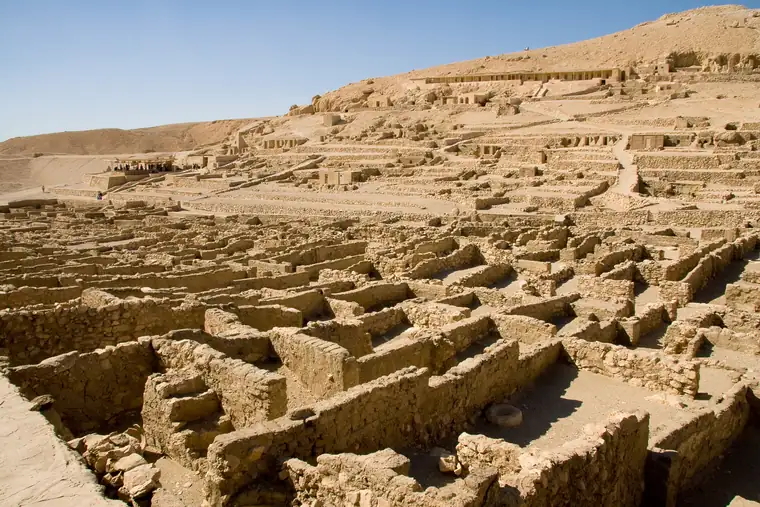
This family never existed. We've pieced them together from what the villagers wrote and from the excavation of their houses. The village did exist. Today it's called Deir el-Medina: the village of the men who cut and decorated the pharaohs' tombs, on the west bank, across from Thebes. They simply called it "the village." And their work, "the Tomb." It had about seventy houses, packed together inside a wall. Our year is the 29th of the reign of Ramesses III. At that time, about forty men work in the Tomb, and our man is one of them: a stonecutter. It's going to be an ordinary day, yes. But in a year when the pay came late.
Eight nights away from home ▶ 1:28
Their week had ten days, and for the first eight the father didn't sleep at home. He slept up on the pass, close to the work. According to the excavator, their stone huts are still there, each one belonging to one man. Inside, a built-in bed and a stone seat with his name on it. There's no trace of fire. Food and drink came up from the village ready to eat. Let's imagine the bread from home going up the path every day. Who carried it, we don't know. Along those paths, guards kept watch: the Medjay, the necropolis police. And from the pass, the crew went down into the valley, to the king's tomb.
Even the light was counted ▶ 2:11
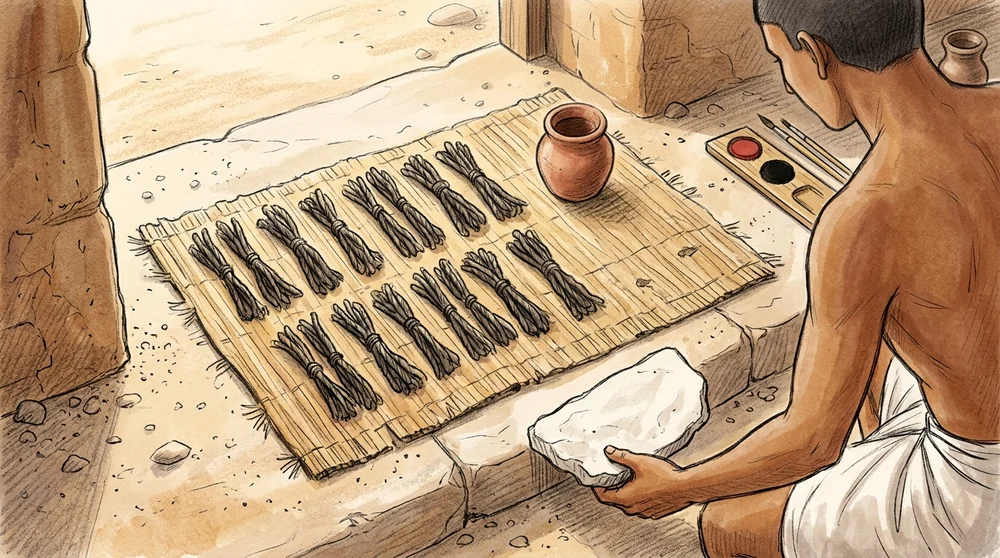
A scribe counted the wicks that lit the pharaoh's tomb. In Egypt's royal tombs, men worked by lamplight, and every greased wick left the storeroom counted. So many in the morning, so many in the afternoon, almost always the same number: two shifts, with a break at midday. For the whole crew, the wicks usually came in multiples of four per shift, and that's why it's been suggested that each shift lasted about four hours. But the accounts didn't always add up. An Egyptologist who went through the ones from the end of the Nineteenth Dynasty, a few decades before our year, found mistakes in the math. One wick account from the time of the pharaoh Seti II reads: sixteen plus sixteen, twenty-two.
Keeping those accounts was the job of scribes. In our year, the scribe of the Tomb is a real man: Amennakht, who also wrote poems, and signed them, something rare in Egypt. The scribes wrote everything down: the grain, the wicks, and also who missed work, and why. There's a list of absences that isn't from our year, but from almost a century earlier. On it, the most common reason is being ill. The next is being away with a superior, doing private work for him: a practice that was not forbidden if done in moderation. And you find all sorts of things.
Absent: he was brewing beer ▶ 3:32
An Egyptian workman missed work because he was brewing beer. A scribe wrote it down, in red ink, on a list of absences from more than three thousand years ago. It's from year 40 of Ramesses II, from the village of the pharaoh's tomb builders, and it's written on a flake of stone that's kept today in London. Next to each name, the reason he was absent. The scorpion bit him. Suffering with his eye. Embalming his brother. His daughter was bleeding: that's how the scribe put it. It means she had her period. Why that kept him at home, we don't know. And brewing beer comes up more than once. Missing work to brew beer? A study of the village's festivals suggests that beer was intended for a feast.
A four-room house ▶ 4:16
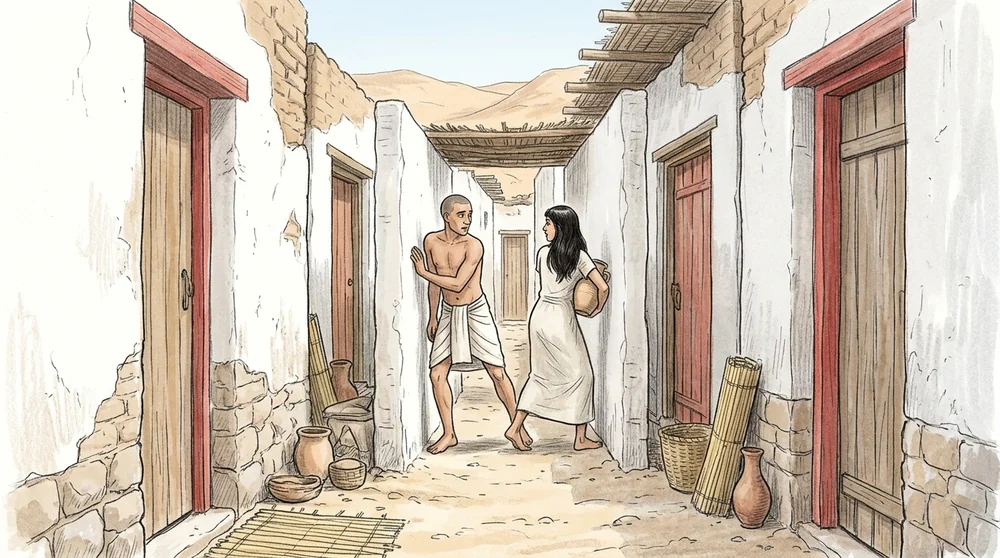
Let's imagine the mother in the village with their daughter, while the father is up on the pass. According to the excavator, their street was an alley where two people could barely squeeze past each other, with white housefronts and red doors. Their house is one of those seventy: long and narrow, four rooms in a row; from the door you see straight to the back. Stone below, mudbrick above. Inside, you go down two or three steps into a room whitewashed halfway up the walls. The same excavator explained why: against the white, you could spot scorpions. And there were scorpions. They turn up on more than one list of absences, and in a village grain account, a scorpion charmer gets paid too. What exactly he did, we don't know.
In one corner of that first room stands a mudbrick platform with steps, sometimes decorated with the god Bes. Archaeologists debate what it was for. Its excavator called it an "enclosed bed"; others have seen it as a place for giving birth. Today many believe it was the household altar. In the walls, niches for the busts of ancestors; on the floor, standing lamps, each a cup of grease with a wick. Next comes a taller room, with a column and a built-in bench. According to the excavator, that's where the master of the house sat by day to work, to eat and to receive guests; and a staircase led up to the flat roof, made of logs, palm fronds and mud, where people sometimes slept. And at the back, the kitchen, half open to the sky, with its clay oven shaped like a bell.
Grinding grain, hauling water ▶ 5:58
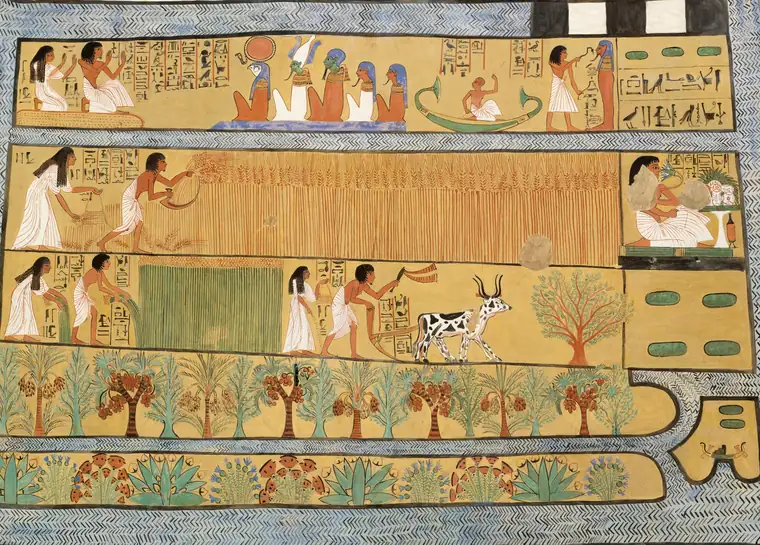
Everyday food starts in that kitchen. From the grain came bread and beer, both made at home. First it was pounded in stone mortars, then ground. An archaeologist who studied grinding stones believes grinding was women's work, and a low-prestige activity. In one experiment, grinding a little over a kilo of grain, about two and a half pounds, took two hours. But the village had help. There were servant women supplied by the state, and their working days were shared out among the crew's households. It's thought they ground the grain. The Egyptian word is translated "servants," and sometimes "slaves." The men of the crew, though, were not slaves: they were the pharaoh's craftsmen, with wages, a house and a tomb of their own. Both things are true at once.
Now let's imagine the daughter at the door, waiting for water. Because the village had no water of its own. It came up by donkey, and was kept in big jars. According to the excavator, just outside the north gate there was room for a jar two meters wide, six and a half feet, and the hut of a water guard. Whatever the grain didn't cover also came up from outside. The Tomb's service staff brought up water, firewood, fish, vegetables and pots, each man with his own quota for every ten-day week. A whole village depended on it all arriving.
The pay and the days off ▶ 7:22
And what most needed to arrive was the pay. Every month, the father received four sacks of emmer, a kind of wheat, and one and a half of barley. The sack was the khar, a big sack of grain. The foreman got seven and a half. How much was that? Going by the prices one Egyptologist gives, a tunic cost almost half a month's pay. They wore linen: tunics and loincloths. And the state also handed out clothing and sandals, which the accounts call "of Pharaoh," and oil. With that grain, our family eats and drinks.
On the ninth and tenth days, nobody went down to the tomb. The father comes home. But a day off wasn't for doing nothing: you worked for yourself. Each man on his own tomb, or on commissions in village workshops. And there were festivals. At the big ones, the village paraded the statue of Amenhotep I, a pharaoh dead for centuries whom the village worshipped as its patron. And that beer on the list of absences? The study of the village's festivals suggests it was for a feast. Many days had no tomb work. On that list from year 40 of Ramesses II, says the museum that holds it, only about seventy of two hundred eighty days seem to have been full working days. One Egyptologist writes that at the end of a reign, with the tomb nearly finished, they might spend no more than one day out of four in the Valley.
Notes, a letter and a will ▶ 8:51
And this village wrote a lot. It left thousands of notes on flakes of white stone and pieces of pottery, in black and red ink: accounts, receipts, letters, lawsuits, poems. They were its scrap paper. More people here could write than in any other town in Egypt, though we don't know how many. And if there was a dispute, it went before the kenbet, the village court, made up of the neighbors themselves. Above all, the court acted as a witness, and there people swore by the god and by the pharaoh. Among so many notes, some aren't about grain or lawsuits. They're about parents and children.
An Egyptian draftsman was losing his sight, and wrote to his son. His name was Pay, from the village of the craftsmen who decorated the royal tombs. His son was a draftsman too. An Egyptologist translated the letter. It begins: "Do not turn your back on me; I am not well." He asks for honey for his eyes, ocher and black eye paint, all to treat his eyes. "Am I not your father?" he reminds him. And finally, the line that stays with you: "I am searching for my sight and it is not there." A draftsman, asking for honey so he could see. Whether his son brought it, we don't know.
An Egyptian woman cut three of her children out of her will, because in her old age they didn't look after her. Her name was Naunakhte, from the village of the royal tomb workers, and she put it in writing in year 3 of Ramesses V. The Ashmolean Museum, in Oxford, tells her story. Her will says she had eight children. She names three, and leaves them out. She explains why: "I am grown old, and see, they are not looking after me in my turn." What she left was hers, and she could decide who got it. But the three could still inherit from their father, Khaemnun. She only took away what was hers.
The year the pay came late ▶ 10:54
In our house, years before that will, year 29 was no ordinary year. The bread, the beer, the tunic: everything came from the grain that arrived every month. That month, it didn't arrive on time. Let's imagine the sack of emmer, a little emptier every day, and the father coming down from the pass without his pay. The days go by, one after another, and still nothing comes. And then the crew stopped waiting.
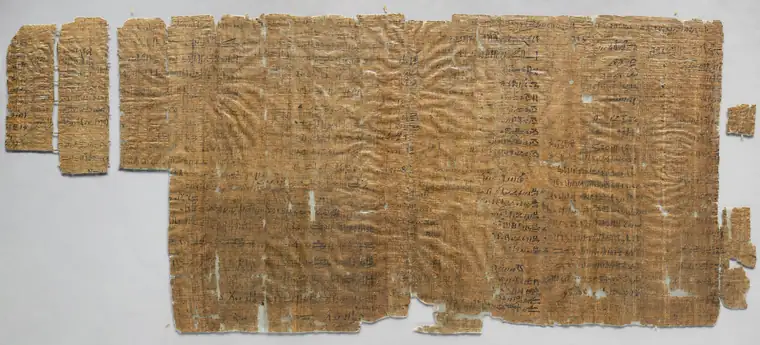
The men cutting the pharaoh's tomb walked off the job and sat down behind a temple. This was Egypt, in year 29 of Ramesses III. They passed the guard posts and said, according to the papyrus: "We are hungry, for 18 days have already elapsed in this month." Two days later, inside the temple of Ramesses II, they told the officials hunger and thirst had driven them to this: "There is no clothing, there is no ointment, there is no fish, there are no vegetables." They asked for a letter to Pharaoh and the vizier. That day they got last month's ration. But it wasn't one day: it was weeks of sitting in temples, including the temple of Seti I. In the end, the vizier sent word that there was nothing in the granaries, and gave them a half ration.
We know all this from the scribe Amennakht, the one who wrote poems. He himself was caught in the middle, between the crew and the authorities. In those weeks, a police chief went as far as telling them to fetch their wives and their children and go to a temple. Let's imagine our mother hearing those words, with her daughter beside her. And how did it end? The papyrus doesn't say. An Egyptologist who studied it says that year ended with the problems of the crew unresolved.
What remains ▶ 12:48
Nothing is left of our family, because it never existed. What's left of their real neighbors are their notes: thousands of them, found mostly in the village's garbage dumps. Grain accounts. Wicks, counted. A letter asking for honey for the eyes. A will. And a list of absences where a man missed work to brew beer. This isn't the story of a pharaoh. It's the story of the people who made his tomb, told by themselves. And now, the question is for you. If, three thousand years from now, someone found your notes from this week, what ordinary day would they reveal?
Let's imagine the night of a tenth day, in a quiet year. Tomorrow the father climbs back up to the pass, to his stone hut. Tonight he sleeps at home. All three go up to the roof to sleep. Down in the kitchen, the bell-shaped oven is cooling. And all around, inside their wall, the seventy houses sit packed together, in the dark. Bread, roof and fire — that's how they managed in Deir el-Medina.
Words from this home
- kharSay it: khar (kh as in Scottish «loch»)
- The sack: the grain measure in which the monthly ration was paid.
- debenSay it: DEH-ben
- A weight of copper used to set prices. It was not a coin.
- ostraconSay it: OS-truh-kon; plural OS-truh-kuh
- A flake of limestone or a potsherd used as scrap paper.
- kenbetSay it: KEN-bet
- The village’s own court, made up of its neighbors.
- Place of TruthSay it: set MAH-aht
- The name of the royal necropolis: the workmen were ‘servants in the Place of Truth’.
- MedjaySay it: MED-jay
- The police who guarded the necropolis and its paths.
Sources
- The British Museum, EA5634: list of absences from year 40 of Ramesses II (record and translation)
- Deir el-Medina Database, Leiden University
- Museo Egizio, Turin, The Turin Strike Papyrus (Cat. 1880)
- P. J. Frandsen, "Editing Reality: The Turin Strike Papyrus" (1990), translation of the papyrus
- C. J. Eyre, DPhil thesis on labor in the Theban necropolis (Oxford, 1981)
- J. J. Janssen, "Accountancy at Deir el-Medîna," SAK 33 (2005)
- H. Jauhiainen, PhD thesis on the feasts of Deir el-Medina (Helsinki, 2009)
- A. G. McDowell, "Daily Life in Ancient Egypt," Scientific American (1996)
- B. Bruyère, report on the excavation of the village, FIFAO 16 (IFAO, 1939)
- A. Koltsida, on the raised platforms in Deir el-Medina houses, SAK 35 (2006)
- L. Weiss, "House Altars at Deir el-Medina," JEA 95 (2009)
- E. Lang, "Maids at the grindstone," Journal of Lithic Studies (2016)
- A. Dorn and S. Polis, on the scribe Amennakht (Vicenza, 2022; in Italian)
- Ashmolean Museum, Museum Secrets podcast, "Ancient Egyptian Family Feud" (2021)